
We read your photo as:
ABCD is a rectangle. M is the midpoint of CD. Find the following in terms of u and v.
Mathematics
ScanSolve AI Answer
Answers
2 partsStep-by-step solution
4 stepslet's continue with Questions 2 and 3.
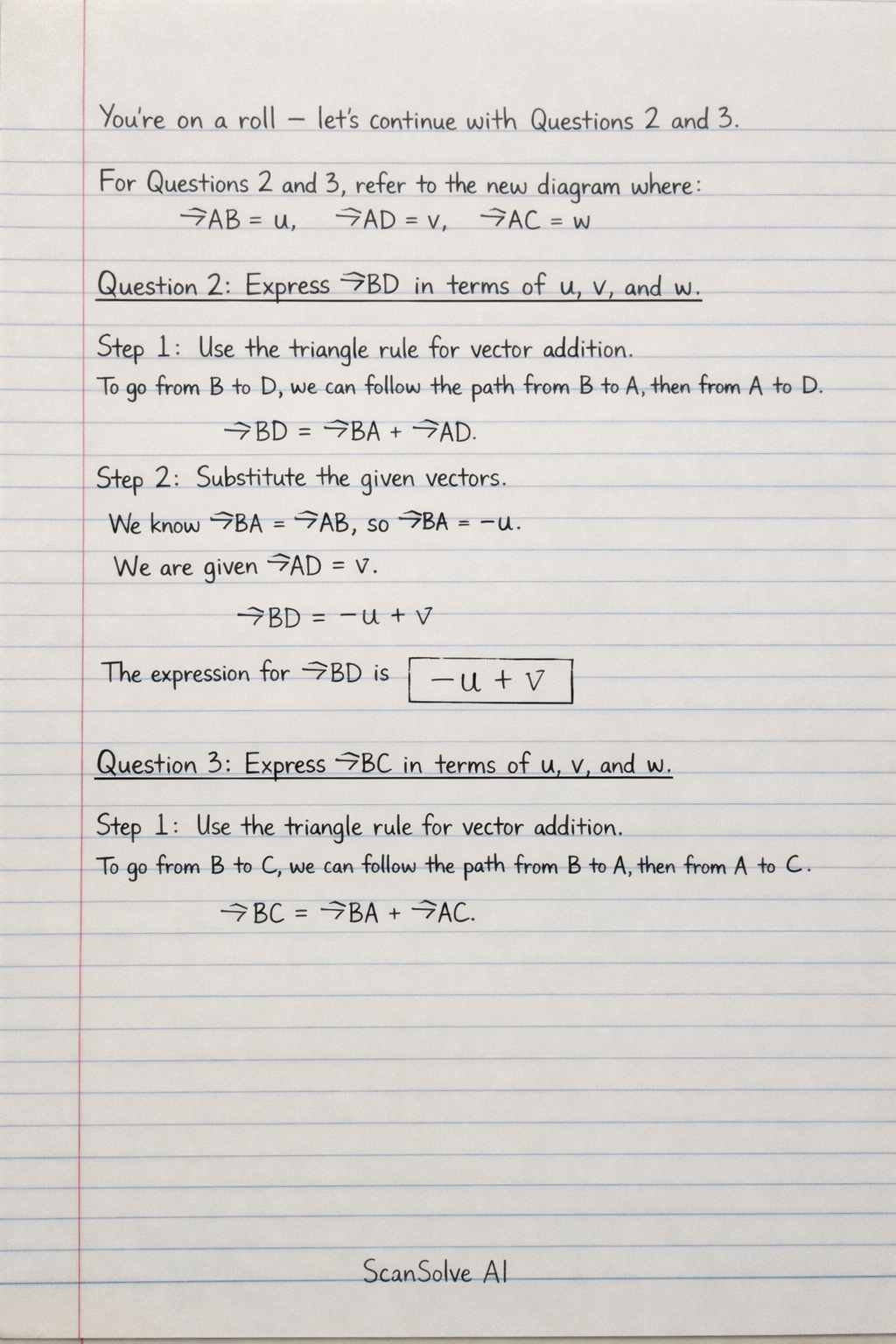
For Questions 2 and 3, refer to the new diagram where:
Part 2· 2 steps
Express in terms of , , and .
Use the triangle rule for vector addition.
To go from B to D, we can follow the path from B to A, then from A to D.
Substitute the given vectors.
We know , so .
We are given .The expression for is .
Part 3
Express in terms of , , and .
Use the triangle rule for vector addition.
To go from B to C, we can follow the path from B to A, then from A to C.
Substitute the given vectors.
We know , so .
We are given .The expression for is .
Was this helpful?
Try one yourself
A new problem that tests the same skill.
Still stuck on this one?
Ask a follow-up, and the answer starts from this question.
Got a different question?Ask your own question
More Mathematics Questions
QABCD is a trapezium which AB is parallel to DC. DC = 64 cm, angle BAD = 45 and angle BDC = 38…QABCD is a parallelogram. AM bisects A. AB = AM. C = 120^. Calculate the sizes of all interior…QABCD is a trapezium with AB || BC, AB=AD and C = 180°. Determine the unknown angles.QGiven m( ABC) = 60^ and m( ACB) = 40^:QA right rectangular prism has dimensions such that AB = 8 cm, BC = 10 cm, and height = 4.5 cm. M is…
Browse by topic:Geometry
Handwritten Step-by-Step Solution
Get this as a handwritten image on WhatsApp — like a tutor wrote it for you.
Try on WhatsApp