
We read your photo as:
Abdul and Chebet had 32 and 56 goats respectively. They both sold some goats. Chebet sold twice as many goats as Abdul. If the ratio of goats remaining for Abdul to Chebet is 3:5, how many goats did t
ScanSolve AI Answer
Answers
2 partsStep-by-step solution
12 stepsDefine initial quantities and variables for goats sold.
Let be the initial number of goats Abdul has, and be the initial number of goats Chebet has.
goats
goatsLet be the number of goats Abdul sold.
Chebet sold twice as many goats as Abdul, so Chebet sold goats.Express the number of goats remaining after the sale.
Abdul's remaining goats:
Chebet's remaining goats:Set up the ratio of remaining goats and solve for .
The ratio of goats remaining for Abdul to Chebet is .
Cross-multiply:
Rearrange the terms to solve for :
Calculate the total number of goats sold.
Number of goats Abdul sold goats.
Number of goats Chebet sold goats.
Total number of goats sold goats.The total number of goats sold by Abdul and Chebet is .
Define the four consecutive odd numbers.
Let the first odd number be .
Since the numbers are consecutive odd numbers, they differ by 2.
The four consecutive odd numbers are , , , and .Set up the equation for their sum.
The sum of these four numbers is 64.
Combine like terms:
Solve for .
Subtract 12 from both sides:
Divide by 4:
Determine the four integers.
The first number is .
The second number is .
The third number is .
The fourth number is .The first four such integers are .
Define the number of sides for each polygon and the formula for the sum of interior angles.
Let be the number of sides of the first polygon, so .
Let be the number of sides of the second polygon, so .
The sum of interior angles of a polygon with sides is .Write the sum of interior angles for each polygon.
Sum of interior angles for the first polygon ():
Sum of interior angles for the second polygon ():
Use the given ratio to find .
The ratio of the sums of interior angles is .
Cross-multiply:
Solve for :
Calculate the number of sides for the first polygon.
The polygon with sides has sides.
i) The size of the interior angle of the polygon with sides .
For a regular polygon with sides, the size of one interior angle is .
For sides:The size of the interior angle of the polygon with sides is .
ii) The size of the exterior angle of the polygon with sides .
For a regular polygon with sides, the size of one exterior angle is .
For sides:Alternatively, the interior angle and exterior angle sum to .
The size of the exterior angle of the polygon with sides is .
Try one yourself
A new problem that tests the same skill.
Still stuck on this one?
Ask a follow-up, and the answer starts from this question.
More Mathematics Questions
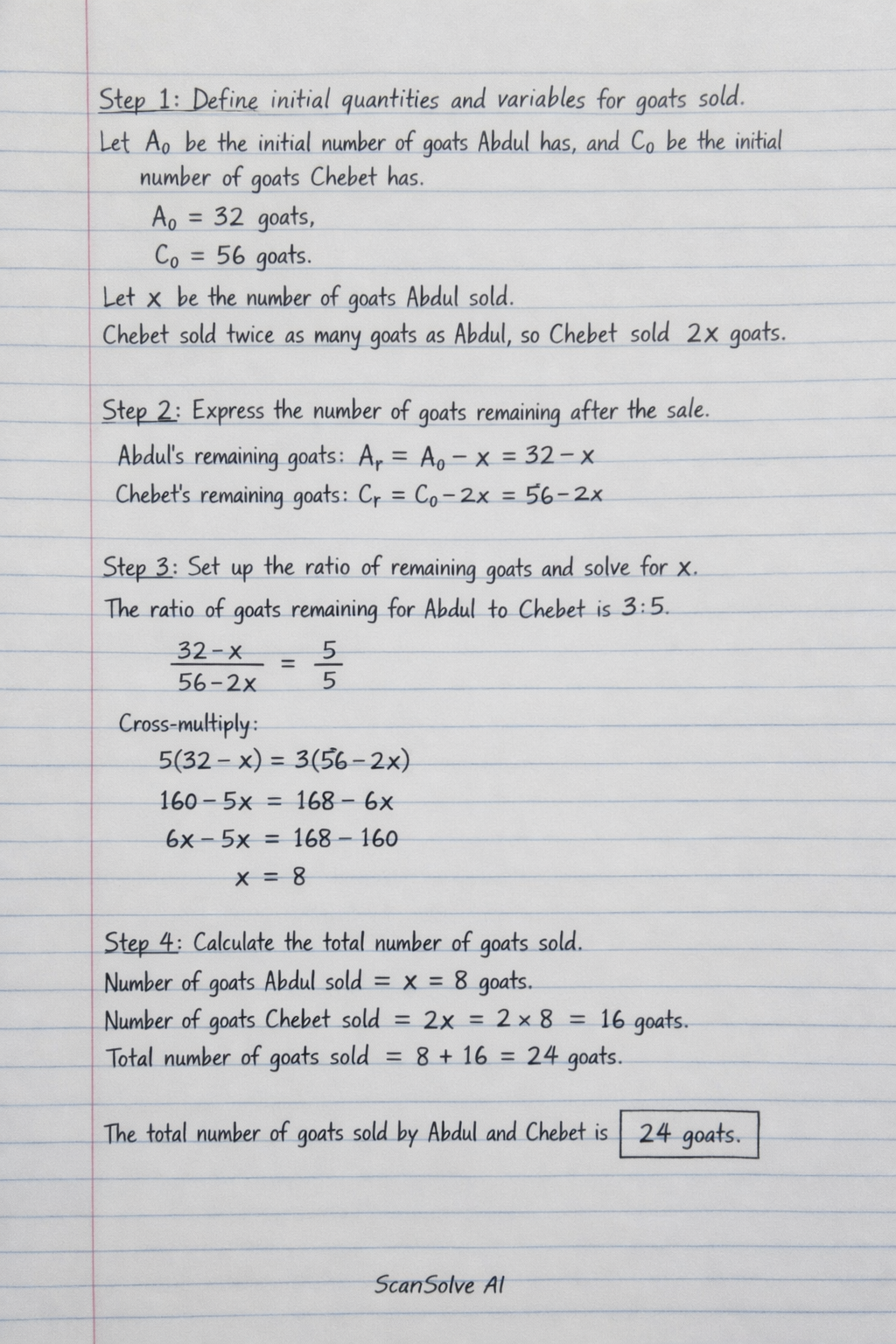
Handwritten Step-by-Step Solution
Get this as a handwritten image on WhatsApp — like a tutor wrote it for you.
Try on WhatsApp