
This mathematics problem involves applying core mathematical principles and formulas. Below you will find a complete step-by-step solution with detailed explanations for each step, helping you understand not just the answer but the method behind it.
ScanSolve AI Answer
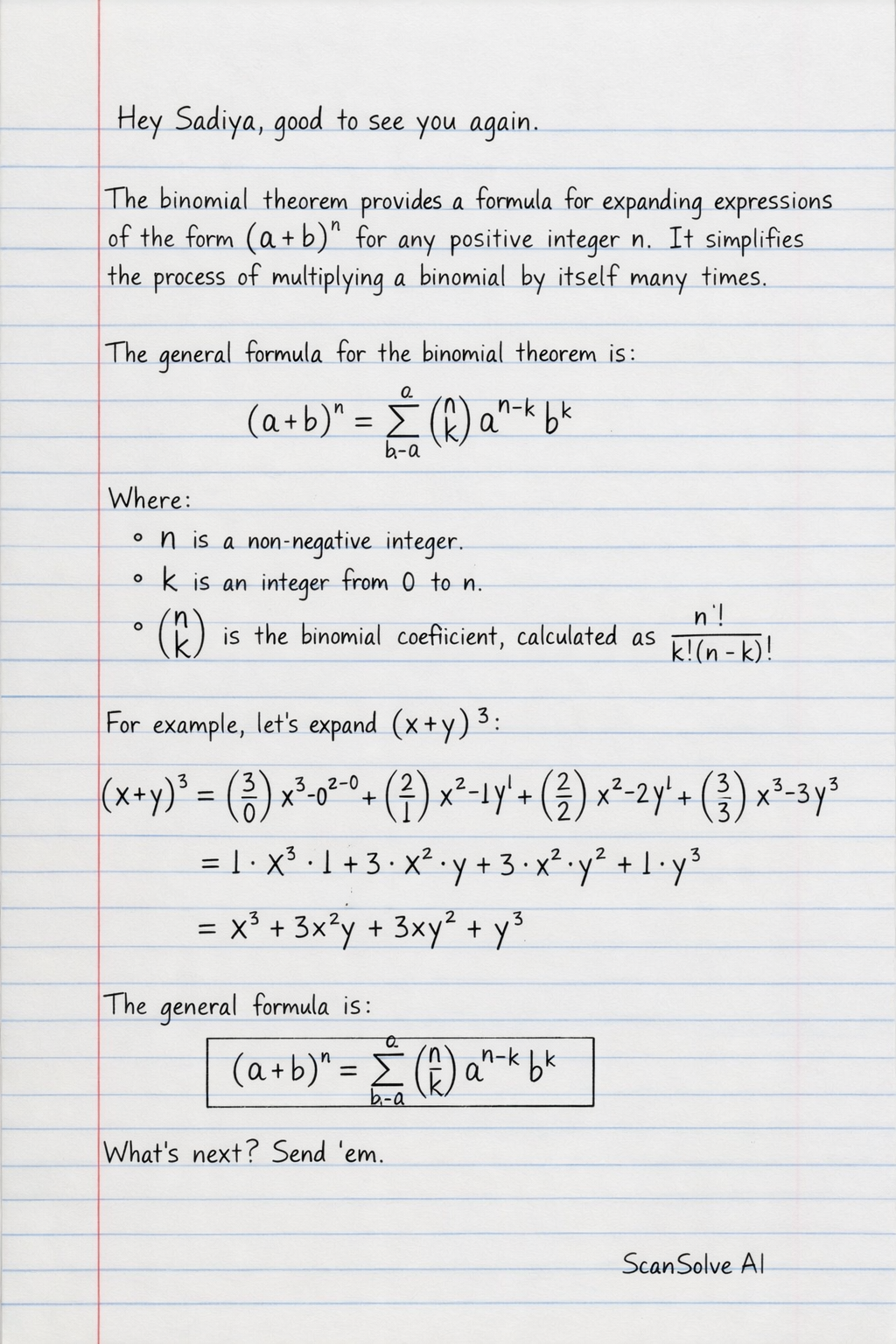
Hey Sadiya, good to see you again. The binomial theorem provides a formula for expanding expressions of the form (a+b)^n for any positive integer n. It simplifies the process of multiplying a binomial by itself many times. The general formula for the binomial theorem is: (a+b)^n = _k=0^n nk a^n-k b^k Where: • n is a non-negative integer. • k is an integer from 0 to n. • nk is the binomial coefficient, calculated as (n!)/(k!(n-k)!). For example, let's expand (x+y)^3: (x+y)^3 &= 30 x^3-0 y^0 + 31 x^3-1 y^1 + 32 x^3-2 y^2 + 33 x^3-3 y^3 \\ &= 1 · x^3 · 1 + 3 · x^2 · y + 3 · x^1 · y^2 + 1 · 1 · y^3 \\ &= x^3 + 3x^2y + 3xy^2 + y^3 The general formula is: (a+b)^n = _k=0^n nk a^n-k b^k What's next? Send 'em.