
We read your photo as:
An isosceles trapezoid MNQP has parallel sides MN = 120 m and PQ = 200 m, and non-parallel sides MP = NQ = 50 m. Calculate the lengths of the segments on the base and the height of the trapezoid.
ScanSolve AI Answer
Step-by-step solution
4 stepsDetermine the lengths of the segments on the base.
The given figure is an isosceles trapezoid with parallel sides and .
Given lengths:
Draw perpendiculars from and to the base , meeting at points and respectively. This forms a rectangle and two right-angled triangles and .
Since is a rectangle, .
In an isosceles trapezoid, the segments and are equal.
The total length of the base is the sum of these segments:Let .
Subtract from both sides:
Divide by 2:
So, and .
Calculate the height () of the trapezoid.
Consider the right-angled triangle .
The hypotenuse is .
One leg is .
The other leg is , which is the height .
Using the Pythagorean theorem ():Subtract from both sides:
Take the square root of both sides:
The height of the trapezoid is .
Calculate the area of the trapezoid.
The formula for the area of a trapezoid is , where and are the lengths of the parallel sides and is the height.
Here, , , and .The area of the trapezoid is .
Calculate the perimeter of the trapezoid.
The perimeter is the sum of the lengths of all its sides.
The perimeter of the trapezoid is .
Still stuck on this one?
Ask a follow-up, and the answer starts from this question.
More Mathematics Questions
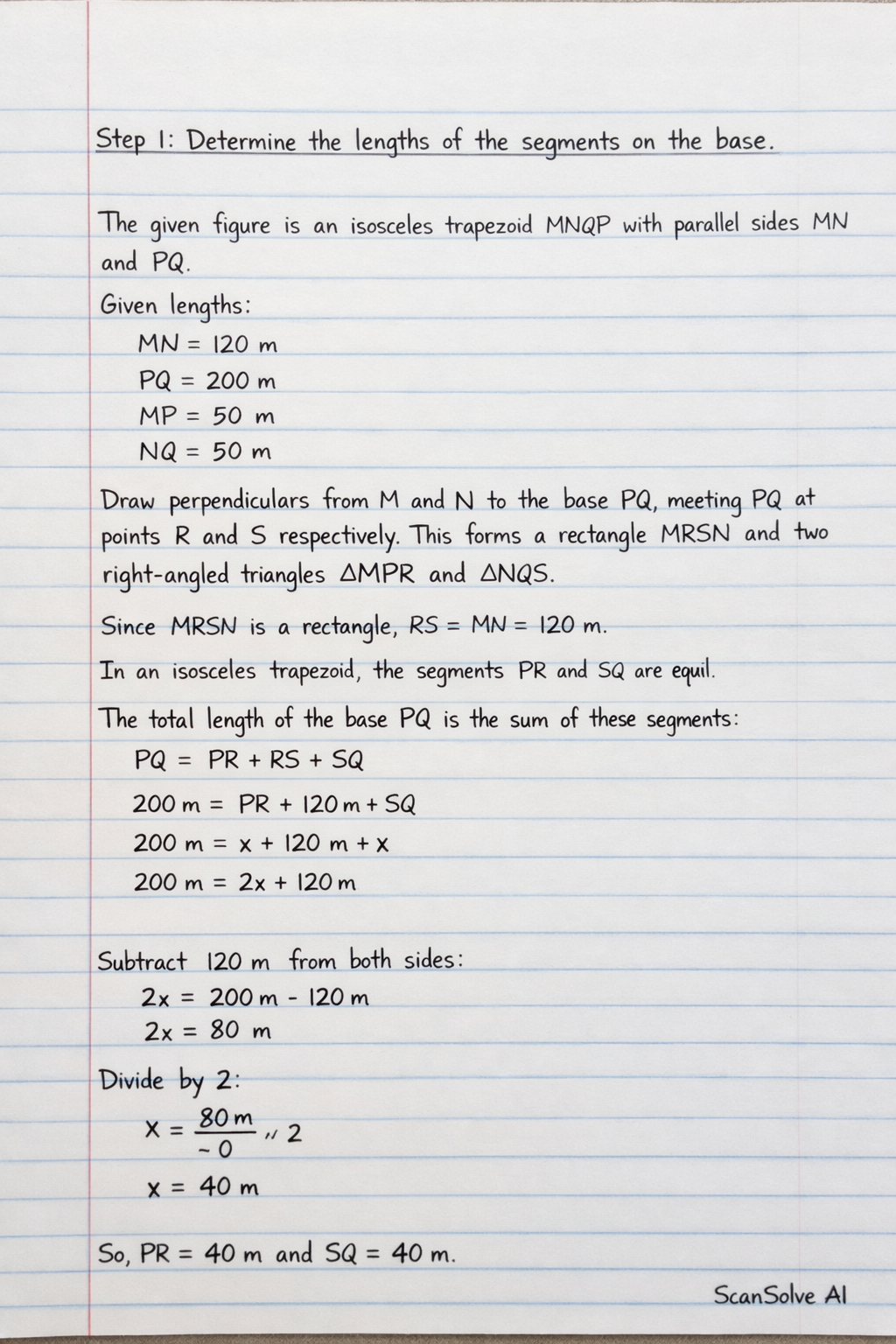
Handwritten Step-by-Step Solution
Get this as a handwritten image on WhatsApp — like a tutor wrote it for you.
Try on WhatsApp