
This mathematics problem involves applying core mathematical principles and formulas. Below you will find a complete step-by-step solution with detailed explanations for each step, helping you understand not just the answer but the method behind it.
ScanSolve AI Answer
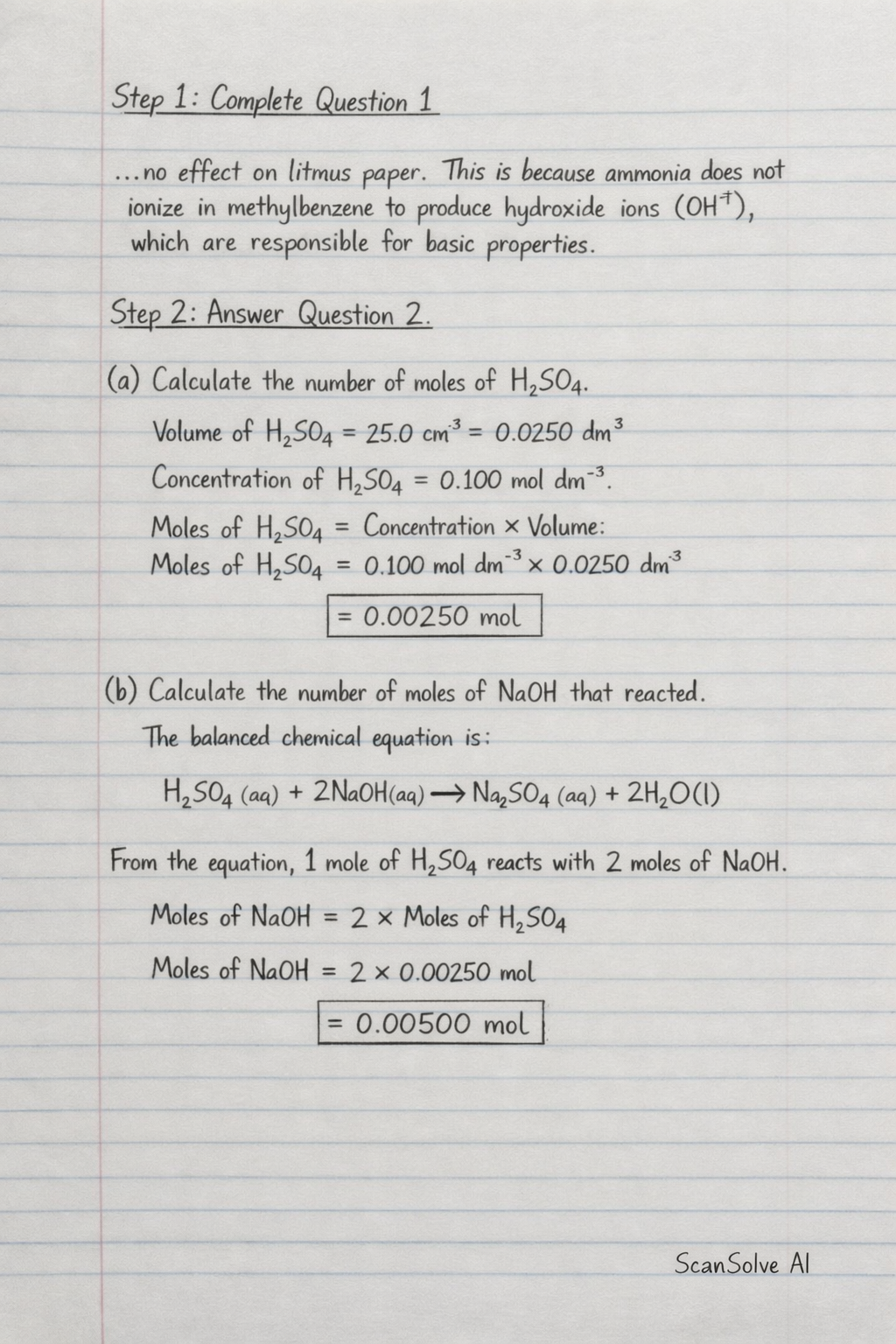
Step 1: Complete Question 1 ...no effect on litmus paper. This is because ammonia does not ionize in methylbenzene to produce hydroxide ions (OH^-), which are responsible for basic properties. Step 2: Answer Question 2 a) Calculate the number of moles of H_2SO_4. Volume of H_2SO_4 = 25.0 cm^3 = 0.0250 dm^3. Concentration of H_2SO_4 = 0.100 mol dm^-3. Moles of H_2SO_4 = Concentration × Volume Moles of H_2SO_4 = 0.100 mol dm^-3 × 0.0250 dm^3 Moles of H_2SO_4 = 0.00250 mol b) Calculate the number of moles of NaOH that reacted. The balanced chemical equation is: H_2SO_4(aq) + 2NaOH(aq) Na_2SO_4(aq) + 2H_2O(l) From the equation, 1 mole of H_2SO_4 reacts with 2 moles of NaOH. Moles of NaOH = 2 × Moles of H_2SO_4 Moles of NaOH = 2 × 0.00250 mol Moles of NaOH = 0.00500 mol c) Calculate the concentration of the NaOH solution. Volume of NaOH = 20.0 cm^3 = 0.0200 dm^3. Concentration of NaOH = Moles of NaOHVolume of NaOH Concentration of NaOH = 0.00500 mol0.0200 dm^3 Concentration of NaOH = 0.250 mol dm^-3 Step 3: Answer Question 3 a) The type of reaction that occurs when H_2SO_4 reacts with NaOH is a neutralization reaction. b) A common indicator used in this titration (strong acid-strong base) is phenolphthalein. Step 4: Answer Question 4 a) If phenolphthalein is used, the colour of the indicator in the conical flask (containing H_2SO_4) at the start of the titration is colorless. b) If phenolphthalein is used, the colour of the indicator in the conical flask at the end-point of the titration is pink. Step 5: Answer Question 5 a) Apparatus A is a burette. b) Apparatus B is a pipette. c) Apparatus C is a conical flask (or Erlenmeyer flask). d) Apparatus D is a retort stand (with a clamp). That's 2 down. 3 left today — send the next one.