We read your photo as:

Find the Area in the square but outside the circle. 2. Calculate the area and circumference of the circle shown below. Use pi = 3.14. 3. Calculate the area and circumference of the circle shown below. Use pi = 3.14. 4. Calculate the perimeter. Give your answer to 1 decimal place.

Mathematics

ScanSolve AI Answer

Step-by-step solution

10 steps

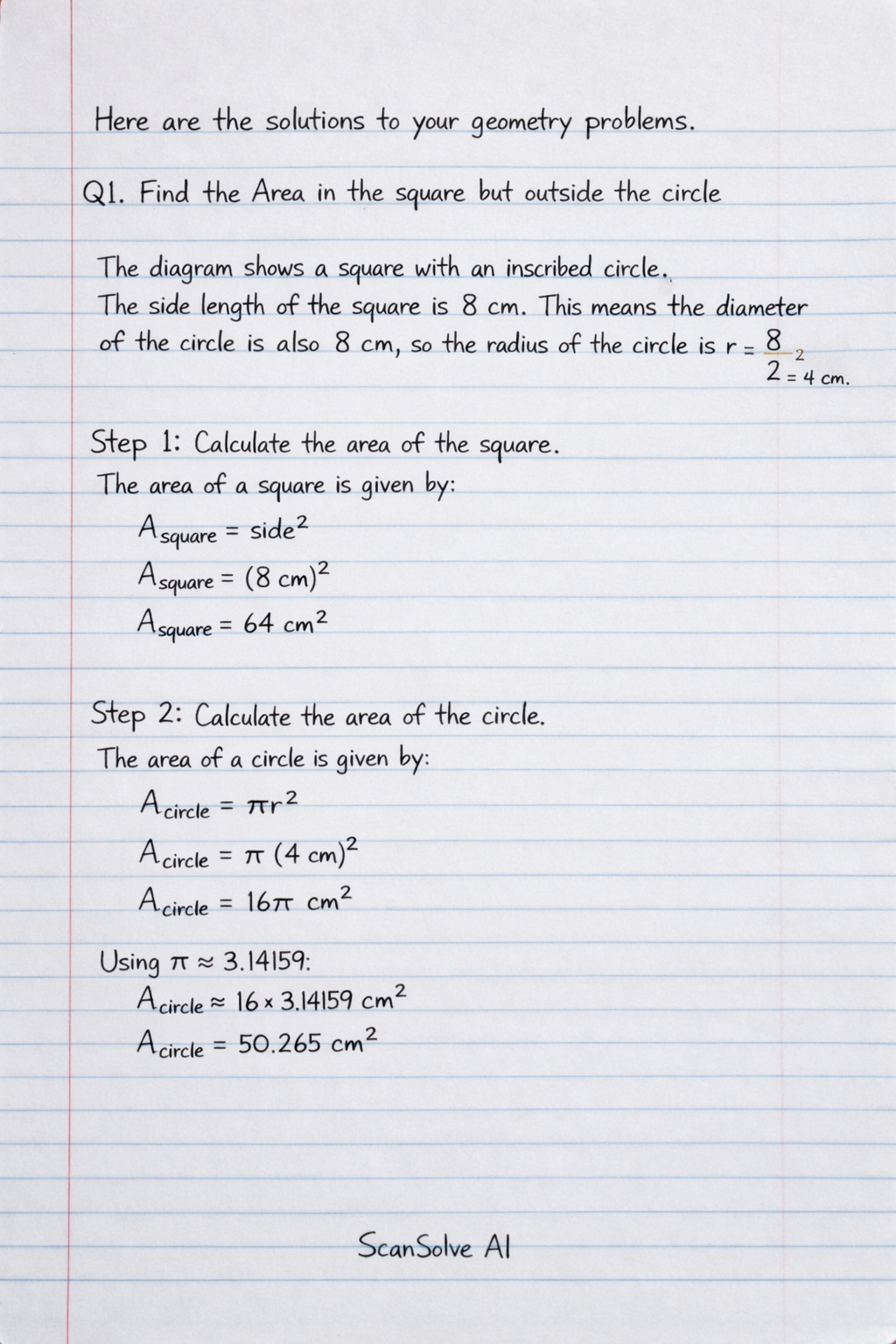
Here are the solutions to your geometry problems.

Q1. Find the Area in the square but outside the circle
The diagram shows a square with an inscribed circle. The side length of the square is 8 cm8 \text{ cm}. This means the diameter of the circle is also 8 cm8 \text{ cm}, so the radius of the circle is r=82=4 cmr = \frac{8}{2} = 4 \text{ cm}.

  1. Calculate the area of the square.

    The area of a square is given by Asquare=side2A_{square} = side^2.

    Asquare=(8 cm)2A_{square} = (8 \text{ cm})^2 Asquare=64 cm2A_{square} = 64 \text{ cm}^2
  2. Calculate the area of the circle.

    The area of a circle is given by Acircle=πr2A_{circle} = \pi r^2.

    Acircle=π(4 cm)2A_{circle} = \pi (4 \text{ cm})^2 Acircle=16π cm2A_{circle} = 16\pi \text{ cm}^2

    Using π≈3.14159\pi \approx 3.14159:

    Acircle≈16×3.14159 cm2A_{circle} \approx 16 \times 3.14159 \text{ cm}^2 Acircle≈50.265 cm2A_{circle} \approx 50.265 \text{ cm}^2
  3. Calculate the area in the square but outside the circle.

    This area is the difference between the area of the square and the area of the circle.

    Adifference=Asquare−AcircleA_{difference} = A_{square} - A_{circle} Adifference=64 cm2−16π cm2A_{difference} = 64 \text{ cm}^2 - 16\pi \text{ cm}^2 Adifference≈64 cm2−50.265 cm2A_{difference} \approx 64 \text{ cm}^2 - 50.265 \text{ cm}^2 Adifference≈13.735 cm2A_{difference} \approx 13.735 \text{ cm}^2

    Answer: 13.735 cm^2 (approx.) or (64 - 16\pi) cm^2

    Q2. Calculate the area and circumference of the circle shown below. use π=3.14\pi = 3.14
    The diagram shows a circle with a radius (rr) of 4.5 ft4.5 \text{ ft}.

  4. Calculate the area of the circle.

    The area of a circle is A=πr2A = \pi r^2.

    A=3.14×(4.5 ft)2A = 3.14 \times (4.5 \text{ ft})^2 A=3.14×20.25 ft2A = 3.14 \times 20.25 \text{ ft}^2 A=63.585 ft2A = 63.585 \text{ ft}^2
  5. Calculate the circumference of the circle.

    The circumference of a circle is C=2πrC = 2\pi r.

    C=2×3.14×4.5 ftC = 2 \times 3.14 \times 4.5 \text{ ft} C=6.28×4.5 ftC = 6.28 \times 4.5 \text{ ft} C=28.26 ftC = 28.26 \text{ ft}

    Answer: Area = 63.585 ft^2, Circumference = 28.26 ft

    Q3. Calculate the area and circumference of the circle shown below. use π=3.14\pi = 3.14
    The diagram shows a circle with a diameter (dd) of 14 in14 \text{ in}. The radius (rr) is half of the diameter, so r=142=7 inr = \frac{14}{2} = 7 \text{ in}.

  6. Calculate the area of the circle.

    The area of a circle is A=πr2A = \pi r^2.

    A=3.14×(7 in)2A = 3.14 \times (7 \text{ in})^2 A=3.14×49 in2A = 3.14 \times 49 \text{ in}^2 A=153.86 in2A = 153.86 \text{ in}^2
  7. Calculate the circumference of the circle.

    The circumference of a circle is C=πdC = \pi d or C=2πrC = 2\pi r.

    C=3.14×14 inC = 3.14 \times 14 \text{ in} C=43.96 inC = 43.96 \text{ in}

    Answer: Area = 153.86 in^2, Circumference = 43.96 in

    Q4. Calculate the perimeter. Give your answer to 1 decimal place.
    The diagram shows a semicircle with a diameter (dd) of 4 cm4 \text{ cm}. The radius (rr) is half of the diameter, so r=42=2 cmr = \frac{4}{2} = 2 \text{ cm}.
    The perimeter of a semicircle includes the curved arc length and the straight diameter.

  8. Calculate the length of the curved arc.

    The arc length of a semicircle is half the circumference of a full circle: 12(2πr)=πr\frac{1}{2} (2\pi r) = \pi r.

    Arc Length=π×2 cmArc\ Length = \pi \times 2 \text{ cm} Arc Length=2π cmArc\ Length = 2\pi \text{ cm}

    Using π≈3.14159\pi \approx 3.14159:

    Arc Length≈2×3.14159 cmArc\ Length \approx 2 \times 3.14159 \text{ cm} Arc Length≈6.28318 cmArc\ Length \approx 6.28318 \text{ cm}
  9. Calculate the total perimeter.

    The perimeter is the arc length plus the diameter.

    Perimeter=Arc Length+dPerimeter = Arc\ Length + d Perimeter=2π cm+4 cmPerimeter = 2\pi \text{ cm} + 4 \text{ cm} Perimeter≈6.28318 cm+4 cmPerimeter \approx 6.28318 \text{ cm} + 4 \text{ cm} Perimeter≈10.28318 cmPerimeter \approx 10.28318 \text{ cm}
  10. Round the answer to 1 decimal place.

    Perimeter≈10.3 cmPerimeter \approx 10.3 \text{ cm}

    Answer: 10.3 cm

Was this helpful?

Still stuck on this one?

Ask a follow-up, and the answer starts from this question.

Got a different question?Ask your own question
Handwritten step-by-step solution preview

Handwritten Step-by-Step Solution

Get this as a handwritten image on WhatsApp — like a tutor wrote it for you.

Try on WhatsApp