Calculate the area of a rectangular floor with length 18m and width 12m. Then, calculate the volume of a triangular prism roof with a triangular cross-section of sides 7m, 7m, and 12m, and a length of
|Mathematics
Calculate the area of a rectangular floor with length 18m and width 12m. Then, calculate the volume of a triangular prism roof with a triangular cross-section of sides 7m, 7m, and 12m, and a length of
ScanSolve AI Answer
Answer
216 m2
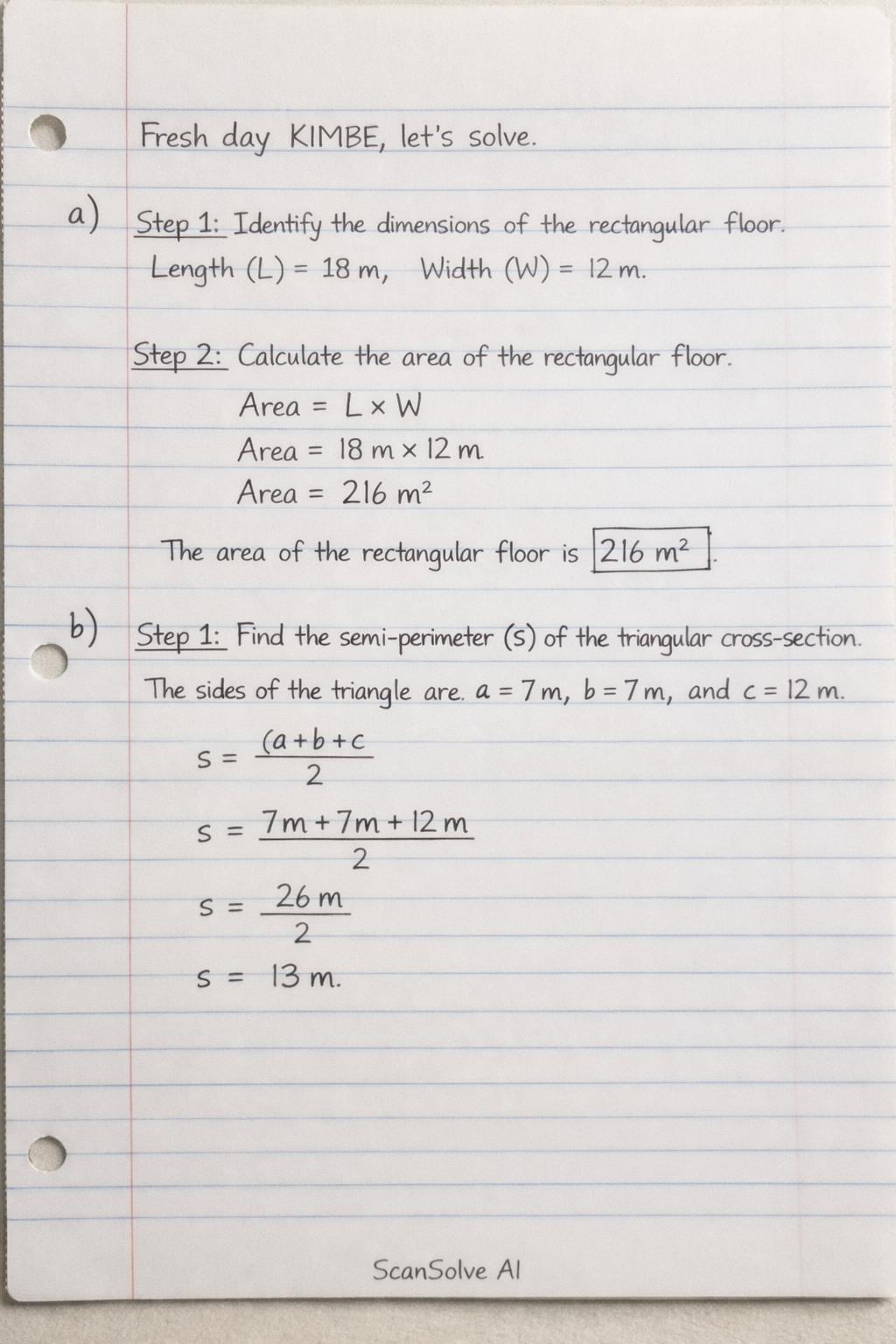
Fresh day KIMBE, let's solve.
a)
Step 1: Identify the dimensions of the rectangular floor.
Length (L) = 18 m, Width (W) = 12 m.
Step 2: Calculate the area of the rectangular floor.
Area=L×WArea=18m×12mArea=216m2
The area of the rectangular floor is 216m2.
b)
Step 1: Find the semi-perimeter (s) of the triangular cross-section.
The sides of the triangle are a=7 m, b=7 m, and c=12 m.
s=2a+b+cs=27m+7m+12ms=226ms=13m
Step 2: Use Heron's Formula to find the cross-sectional area of the triangle.
Areatriangle=s(s−a)(s−b)(s−c)Areatriangle=13(13−7)(13−7)(13−12)Areatriangle=13×6×6×1Areatriangle=13×36Areatriangle=468Areatriangle≈21.6333m2
Step 3: Calculate the volume of the triangular prism roof.
The length of the prism is 18 m.
Volumeprism=cross−sectionalarea×lengthVolumeprism=468m2×18mVolumeprism≈21.6333m2×18mVolumeprism≈389.40m3
The volume of the triangular prism roof is 389.40m3.
c)
Step 1: Calculate the total area of the two slant faces.
Each slant face has an area of 7m×18m=126m2.
Totalslantarea=2×126m2Totalslantarea=252m2
Step 2: Calculate the total cost of the roofing iron.
The cost is K28 per square metre.
Totalcost=Totalslantarea×costpersquaremetreTotalcost=252m2×K28/m2Totalcost=K7056
The total cost of roofing iron is K7056.
d)(i)
Step 1: Identify the dimensions of the cylindrical water tank.
Radius (r) = 1.2 m, Height (h) = 2.5 m.
Step 2: Calculate the total surface area (TSA) of the closed cylinder.
TSA=2πr2+2πrhTSA=2π(1.2m)2+2π(1.2m)(2.5m)TSA=2π(1.44m2)+2π(3m2)TSA=2.88πm2+6πm2TSA=8.88πm2TSA≈8.88×3.14159265...m2TSA≈27.897m2
Step 3: Round the total surface area to 2 decimal places.
TSA=27.90m2
The total surface area of the water tank is 27.90m2.
(ii)
Step 1: Identify the dimensions of the cylindrical water tank.
Radius (r) = 1.2 m, Height (h) = 2.5 m.
Step 2: Calculate the volume (V) of the water tank.
V=πr2hV=π(1.2m)2(2.5m)V=π(1.44m2)(2.5m)V=3.6πm3V≈3.6×3.14159265...m3V≈11.3097m3
Step 3: Round the volume to 2 decimal places.
V=11.31m3
The volume of the water tank is 11.31m3.
(iii)
Step 1: Convert the volume from cubic metres to litres.
Given that 1 m3 = 1000 litres.
Volumeinlitres=3.6πm3×1000litres/m3Volumeinlitres=3600πlitresVolumeinlitres≈11309.73litres
Step 2: Calculate the mass of water in the tank.
Given that the density of water is 1 kg per litre.
Mass=Volumeinlitres×densityMass=3600πlitres×1kg/litreMass=3600πkgMass≈11309.73kg
Step 3: Round the mass to 2 decimal places.
Mass=11309.73kg
The mass of water in the full tank is 11309.73kg.
Send me the next one 📸
Was this helpful?
Need help with your own homework?
Get instant step-by-step solutions to any question. Free to start.
Fresh day KIMBE, let's solve. a) Step 1: Identify the dimensions of the rectangular floor.
Calculate the area of a rectangular floor with length 18m and width 12m. Then, calculate the volume of a triangular prism roof with a triangular cross-section of sides 7m, 7m, and 12m, and a length of
This mathematics problem involves applying core mathematical principles and formulas. Below you will find a complete step-by-step solution with detailed explanations for each step, helping you understand not just the answer but the method behind it.
ScanSolve AI Answer
Fresh day KIMBE, let's solve. a) Step 1: Identify the dimensions of the rectangular floor. Length (L) = 18 m, Width (W) = 12 m. Step 2: Calculate the area of the rectangular floor. Area = L × W Area = 18 m × 12 m Area = 216 m^2 The area of the rectangular floor is 216 m^2. b) Step 1: Find the semi-perimeter (s) of the triangular cross-section. The sides of the triangle are a = 7 m, b = 7 m, and c = 12 m. s = (a+b+c)/(2) s = 7 m + 7 m + 12 m2 s = 26 m2 s = 13 m Step 2: Use Heron's Formula to find the cross-sectional area of the triangle. Area_triangle = sqrt(s(s-a)(s-b)(s-c)) Area_triangle = sqrt(13(13-7)(13-7)(13-12)) Area_triangle = sqrt(13 × 6 × 6 × 1) Area_triangle = sqrt(13 × 36) Area_triangle = sqrt(468) Area_triangle ≈ 21.6333 m^2 Step 3: Calculate the volume of the triangular prism roof. The length of the prism is 18 m. Volume_prism = cross-sectional area × length Volume_prism = sqrt(468) m^2 × 18 m Volume_prism ≈ 21.6333 m^2 × 18 m Volume_prism ≈ 389.40 m^3 The volume of the triangular prism roof is 389.40 m^3. c) Step 1: Calculate the total area of the two slant faces. Each slant face has an area of 7 m × 18 m = 126 m^2. Total slant area = 2 × 126 m^2 Total slant area = 252 m^2 Step 2: Calculate the total cost of the roofing iron. The cost is K28 per square metre. Total cost = Total slant area × cost per square metre Total cost = 252 m^2 × K28/m^2 Total cost = K7056 The total cost of roofing iron is K7056. d) (i) Step 1: Identify the dimensions of the cylindrical water tank. Radius (r) = 1.2 m, Height (h) = 2.5 m. Step 2: Calculate the total surface area (TSA) of the closed cylinder. TSA = 2 r^2 + 2 rh TSA = 2 (1.2 m)^2 + 2 (1.2 m)(2.5 m) TSA = 2 (1.44 m^2) + 2 (3 m^2) TSA = 2.88 m^2 + 6 m^2 TSA = 8.88 m^2 TSA ≈ 8.88 × 3.14159265... m^2 TSA ≈ 27.897 m^2 Step 3: Round the total surface area to 2 decimal places. TSA = 27.90 m^2 The total surface area of the water tank is 27.90 m^2. (ii) Step 1: Identify the dimensions of the cylindrical water tank. Radius (r) = 1.2 m, Height (h) = 2.5 m. Step 2: Calculate the volume (V) of the water tank. V = r^2 h V = (1.2 m)^2 (2.5 m) V = (1.44 m^2) (2.5 m) V = 3.6 m^3 V ≈ 3.6 × 3.14159265... m^3 V ≈ 11.3097 m^3 Step 3: Round the volume to 2 decimal places. V = 11.31 m^3 The volume of the water tank is 11.31 m^3. (iii) Step 1: Convert the volume from cubic metres to litres. Given that 1 m^3 = 1000 litres. Volume in litres = 3.6 m^3 × 1000 litres/m^3 Volume in litres = 3600 litres Volume in litres ≈ 11309.73 litres Step 2: Calculate the mass of water in the tank. Given that the density of water is 1 kg per litre. Mass = Volume in litres × density Mass = 3600 litres × 1 kg/litre Mass = 3600 kg Mass ≈ 11309.73 kg Step 3: Round the mass to 2 decimal places. Mass = 11309.73 kg The mass of water in the full tank is 11309.73 kg. Send me the next one 📸