
We read your photo as:
Calculate the area of Fig 1.1.
ScanSolve AI Answer
Answer
Step-by-step solution
4 stepsDivide the L-shaped figure into two rectangles.
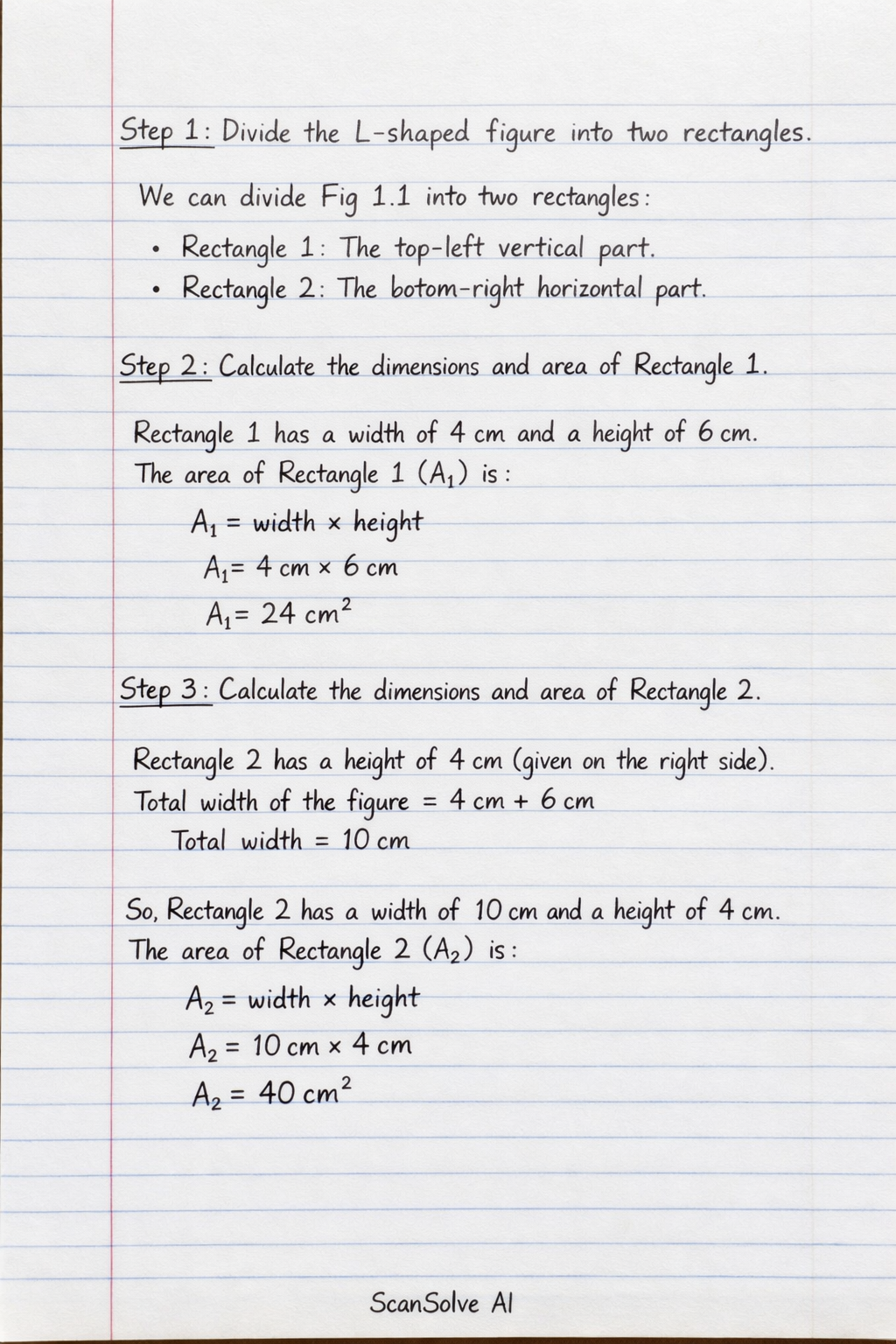
We can divide Fig 1.1 into two rectangles:
- Rectangle 1: The top-left vertical part.
- Rectangle 2: The bottom-right horizontal part.
Calculate the dimensions and area of Rectangle 1.
Rectangle 1 has a width of 4 cm and a height of 6 cm.
The area of Rectangle 1 () is:Calculate the dimensions and area of Rectangle 2.
Rectangle 2 has a height of 4 cm (given on the right side).
The total width of the figure is the sum of the top horizontal segment (4 cm) and the inner horizontal segment (6 cm).
Total width = .
So, Rectangle 2 has a width of 10 cm and a height of 4 cm.
The area of Rectangle 2 () is:Calculate the total area of Fig 1.1.
The total area () is the sum of the areas of Rectangle 1 and Rectangle 2.
The area of Fig 1.1 is .
Try one yourself
A new problem that tests the same skill.
Still stuck on this one?
Ask a follow-up, and the answer starts from this question.
More Mathematics Questions
Handwritten Step-by-Step Solution
Get this as a handwritten image on WhatsApp — like a tutor wrote it for you.
Try on WhatsApp