We read your photo as:

Calculate the shaded areas in the shapes in Fig. 14.33. All dimensions are in centimetres. (Use the value 22/7 for pi.)

Mathematics

ScanSolve AI Answer

This answer stops before the end.

It was cut off when it was first written. Ask ScanSolve this question again for the full working.

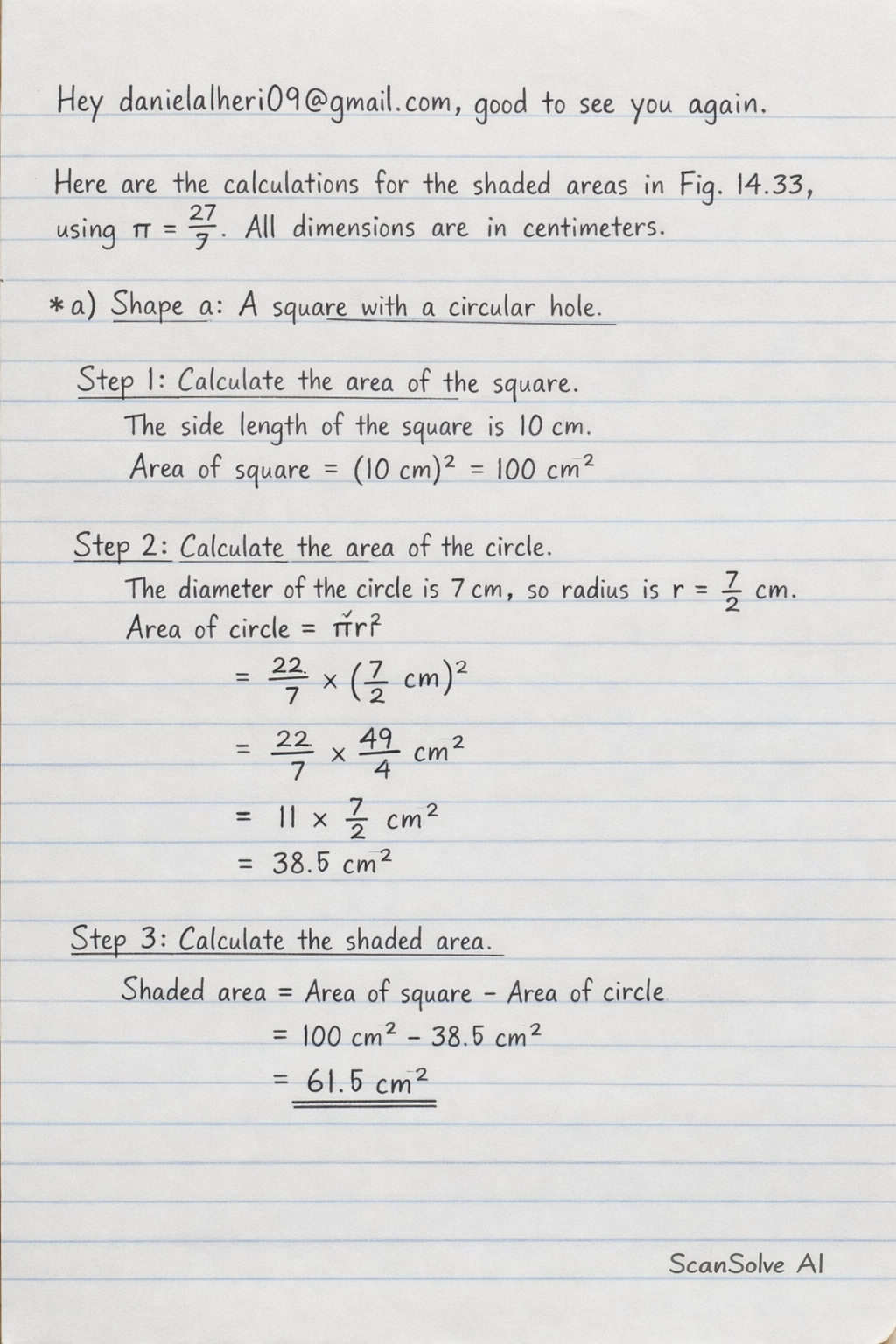
Here are the calculations for the shaded areas in Fig. 14.33, using π=227\pi = \frac{22}{7}. All dimensions are in centimeters.

a) Shape a: A square with a circular hole.

Step 1: Calculate the area of the square.
The side length of the square is 10 cm.

Area of square=(10 cm)2=100 cm2\text{Area of square} = (10 \text{ cm})^2 = 100 \text{ cm}^2

Step 2: Calculate the area of the circle.
The diameter of the circle is 7 cm, so the radius is r=72r = \frac{7}{2} cm.

Area of circle=πr2=227×(72 cm)2=227×494 cm2=11×72 cm2=38.5 cm2\text{Area of circle} = \pi r^2 = \frac{22}{7} \times \left(\frac{7}{2} \text{ cm}\right)^2 = \frac{22}{7} \times \frac{49}{4} \text{ cm}^2 = \frac{11 \times 7}{2} \text{ cm}^2 = 38.5 \text{ cm}^2

Step 3: Calculate the shaded area.

Shaded area=Area of square−Area of circle=100 cm2−38.5 cm2=61.5 cm2\text{Shaded area} = \text{Area of square} - \text{Area of circle} = 100 \text{ cm}^2 - 38.5 \text{ cm}^2 = \boxed{61.5 \text{ cm}^2}

b) Shape b: An annulus (ring).

Step 1: Calculate the area of the outer circle.
The outer diameter is 14 cm, so the outer radius is R=142=7R = \frac{14}{2} = 7 cm.

Area of outer circle=πR2=227×(7 cm)2=227×49 cm2=22×7 cm2=154 cm2\text{Area of outer circle} = \pi R^2 = \frac{22}{7} \times (7 \text{ cm})^2 = \frac{22}{7} \times 49 \text{ cm}^2 = 22 \times 7 \text{ cm}^2 = 154 \text{ cm}^2

Step 2: Calculate the area of the inner circle.
The inner diameter is 7 cm, so the inner radius is r=72r = \frac{7}{2} cm.

Area of inner circle=πr2=227×(72 cm)2=227×494 cm2=11×72 cm2=38.5 cm2\text{Area of inner circle} = \pi r^2 = \frac{22}{7} \times \left(\frac{7}{2} \text{ cm}\right)^2 = \frac{22}{7} \times \frac{49}{4} \text{ cm}^2 = \frac{11 \times 7}{2} \text{ cm}^2 = 38.5 \text{ cm}^2

Step 3: Calculate the shaded area.

Shaded area=Area of outer circle−Area of inner circle=154 cm2−38.5 cm2=115.5 cm2\text{Shaded area} = \text{Area of outer circle} - \text{Area of inner circle} = 154 \text{ cm}^2 - 38.5 \text{ cm}^2 = \boxed{115.5 \text{ cm}^2}

c) Shape c: A quarter circle.

Step 1: Calculate the area of the quarter circle.
The radius of the quarter circle is r=14r = 14 cm.

Shaded area=14πr2=14×227×(14 cm)2=14×227×196 cm2=14×22×28 cm2=22×7 cm2=154 cm2\text{Shaded area} = \frac{1}{4} \pi r^2 = \frac{1}{4} \times \frac{22}{7} \times (14 \text{ cm})^2 = \frac{1}{4} \times \frac{22}{7} \times 196 \text{ cm}^2 = \frac{1}{4} \times 22 \times 28 \text{ cm}^2 = 22 \times 7 \text{ cm}^2 = \boxed{154 \text{ cm}^2}

d) Shape d: Two semicircles joined.

Step 1: Calculate the area of the two semicircles.
Each semicircle has a diameter of 7 cm, so the radius is r=72r = \frac{7}{2} cm. Two semicircles form one full circle.

Shaded area=πr2=227×(72 cm)2=227×494 cm2=11×72 cm2=38.5 cm2\text{Shaded area} = \pi r^2 = \frac{22}{7} \times \left(\frac{7}{2} \text{ cm}\right)^2 = \frac{22}{7} \times \frac{49}{4} \text{ cm}^2 = \frac{11 \times 7}{2} \text{ cm}^2 = \boxed{38.5 \text{ cm}^2}

e) Shape e: A rectangle with two semicircles removed.

Step 1: Calculate the area of the rectangle.
The width of the rectangle is 14 cm and the height is 20 cm.

Area of rectangle=14 cm×20 cm=280 cm2\text{Area of rectangle} = 14 \text{ cm} \times 20 \text{ cm} = 280 \text{ cm}^2

Step 2: Calculate the area of the two semicircles.
Each semicircle has a diameter of 14 cm, so the radius is r=142=7r = \frac{14}{2} = 7 cm. Two semicircles form one full circle.

Area of two semicircles=πr2=227×(7 cm)2=227×49 cm2=22×7 cm2=154 cm2\text{Area of two semicircles} = \pi r^2 = \frac{22}{7} \times (7 \text{ cm})^2 = \frac{22}{7} \times 49 \text{ cm}^2 = 22 \times 7 \text{ cm}^2 = 154 \text{ cm}^2

Step 3: Calculate the shaded area.

Shaded area=Area of rectangle−Area of two semicircles=280 cm2−154 cm2=126 cm2\text{Shaded area} = \text{Area of rectangle} - \text{Area of two semicircles} = 280 \text{ cm}^2 - 154 \text{ cm}^2 = \boxed{126 \text{ cm}^2}

f) Shape f: A rectangle with a semicircle removed.

Step 1: Calculate the area of the rectangle.
The width of the rectangle is 5 cm and the height is 9 cm.

Was this helpful?

Still stuck on this one?

Ask a follow-up, and the answer starts from this question.

Got a different question?Ask your own question
Handwritten step-by-step solution preview

Handwritten Step-by-Step Solution

Get this as a handwritten image on WhatsApp — like a tutor wrote it for you.

Try on WhatsApp