We read your photo as:

Find the area of the shape below, the area of the shape shaded portion

Mathematics

ScanSolve AI Answer

Answers

4 parts
2

(81π4−40.5) cm2≈23.12 cm2\left(\frac{81\pi}{4} - 40.5\right) \text{ cm}^2 \approx 23.12 \text{ cm}^2

3

48 cm248 \text{ cm}^2

4

1527 cm≈21.71 cm\frac{152}{7} \text{ cm} \approx 21.71 \text{ cm}

5

16819 cm≈8.84 cm\frac{168}{19} \text{ cm} \approx 8.84 \text{ cm}

Step-by-step solution

12 steps

Here are the solutions to the problems:

Part 1

Area of the I-shape

The dimensions for the I-shaped figure are not provided in the image, so its area cannot be calculated.

Part 2

(81π4−40.5) cm2≈23.12 cm2\left(\frac{81\pi}{4} - 40.5\right) \text{ cm}^2 \approx 23.12 \text{ cm}^2

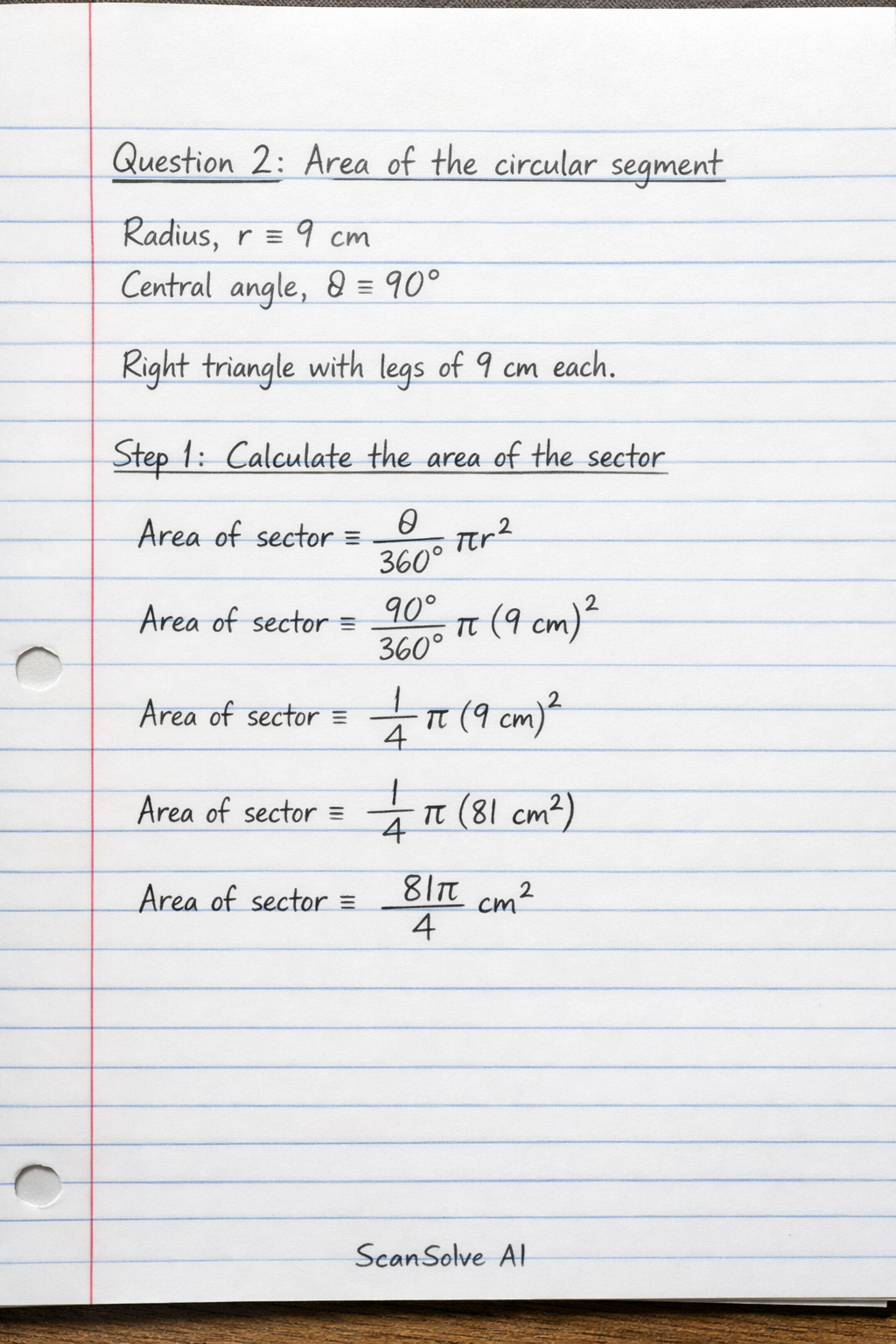
Area of the circular segment

This shape consists of a sector of a circle with a triangle removed.
The radius of the sector is r=9r = 9 cm.
The central angle is θ=90∘\theta = 90^\circ.
The triangle formed by the two radii and the chord is a right-angled triangle with legs of 9 cm each.

  1. Calculate the area of the sector.

    Area of sector=θ360∘πr2\text{Area of sector} = \frac{\theta}{360^\circ} \pi r^2 Area of sector=90∘360∘π(9 cm)2\text{Area of sector} = \frac{90^\circ}{360^\circ} \pi (9 \text{ cm})^2 Area of sector=14π(81 cm2)\text{Area of sector} = \frac{1}{4} \pi (81 \text{ cm}^2) Area of sector=81π4 cm2\text{Area of sector} = \frac{81\pi}{4} \text{ cm}^2
  2. Calculate the area of the triangle.

    Area of triangle=12×base×height\text{Area of triangle} = \frac{1}{2} \times \text{base} \times \text{height}

    Since it's a right-angled triangle with legs as radii:

    Area of triangle=12×9 cm×9 cm\text{Area of triangle} = \frac{1}{2} \times 9 \text{ cm} \times 9 \text{ cm} Area of triangle=812 cm2\text{Area of triangle} = \frac{81}{2} \text{ cm}^2 Area of triangle=40.5 cm2\text{Area of triangle} = 40.5 \text{ cm}^2
  3. Calculate the area of the shaded portion (segment).

    Area of segment=Area of sector−Area of triangle\text{Area of segment} = \text{Area of sector} - \text{Area of triangle} Area of segment=(81π4−40.5) cm2\text{Area of segment} = \left(\frac{81\pi}{4} - 40.5\right) \text{ cm}^2

    Using π≈3.14159\pi \approx 3.14159:

    Area of segment≈(81×3.141594−40.5) cm2\text{Area of segment} \approx \left(\frac{81 \times 3.14159}{4} - 40.5\right) \text{ cm}^2 Area of segment≈(63.617−40.5) cm2\text{Area of segment} \approx (63.617 - 40.5) \text{ cm}^2 Area of segment≈23.117 cm2\text{Area of segment} \approx 23.117 \text{ cm}^2

    The area of the circular segment is (81π4−40.5) cm2≈23.12 cm2\boxed{\left(\frac{81\pi}{4} - 40.5\right) \text{ cm}^2 \approx 23.12 \text{ cm}^2}.

Part 3

48 cm248 \text{ cm}^2

Area of the L-shaped shaded portion

The L-shaped figure can be divided into two rectangles.

  1. Identify the dimensions of the first rectangle (vertical part).

    Height = 8 cm
    Width = 4 cm

    Area1=8 cm×4 cm=32 cm2\text{Area}_1 = 8 \text{ cm} \times 4 \text{ cm} = 32 \text{ cm}^2
  2. Identify the dimensions of the second rectangle (horizontal part).

    Height = 4 cm
    Width = 4 cm

    Area2=4 cm×4 cm=16 cm2\text{Area}_2 = 4 \text{ cm} \times 4 \text{ cm} = 16 \text{ cm}^2
  3. Calculate the total area of the shaded portion.

    Total Area=Area1+Area2\text{Total Area} = \text{Area}_1 + \text{Area}_2 Total Area=32 cm2+16 cm2\text{Total Area} = 32 \text{ cm}^2 + 16 \text{ cm}^2 Total Area=48 cm2\text{Total Area} = 48 \text{ cm}^2

    The area of the shaded L-shaped portion is 48 cm2\boxed{48 \text{ cm}^2}.

Part 4

1527 cm≈21.71 cm\frac{152}{7} \text{ cm} \approx 21.71 \text{ cm}

Height of the trapezium

Given:
Area of trapezium (AA) = 152 cm²
Parallel sides (aa and bb) = 6 cm and 8 cm

  1. Write the formula for the area of a trapezium.

    A=12(a+b)hA = \frac{1}{2} (a+b) h
  2. Substitute the given values into the formula.

    152 cm2=12(6 cm+8 cm)h152 \text{ cm}^2 = \frac{1}{2} (6 \text{ cm} + 8 \text{ cm}) h 152 cm2=12(14 cm)h152 \text{ cm}^2 = \frac{1}{2} (14 \text{ cm}) h 152 cm2=7 cm⋅h152 \text{ cm}^2 = 7 \text{ cm} \cdot h
  3. Solve for the height (hh).

    h=152 cm27 cmh = \frac{152 \text{ cm}^2}{7 \text{ cm}} h=1527 cmh = \frac{152}{7} \text{ cm} h≈21.71 cmh \approx 21.71 \text{ cm}

    The height of the trapezium is 1527 cm≈21.71 cm\boxed{\frac{152}{7} \text{ cm} \approx 21.71 \text{ cm}}.

Part 5

16819 cm≈8.84 cm\frac{168}{19} \text{ cm} \approx 8.84 \text{ cm}

Base of the triangle

Given:
Area of triangle (AA) = 84 cm²
Height (hh) = 19 cm

  1. Write the formula for the area of a triangle.

    A=12×base×heightA = \frac{1}{2} \times \text{base} \times \text{height}
  2. Substitute the given values into the formula.

    84 cm2=12×base×19 cm84 \text{ cm}^2 = \frac{1}{2} \times \text{base} \times 19 \text{ cm}
  3. Solve for the base.

    84 cm2×2=base×19 cm84 \text{ cm}^2 \times 2 = \text{base} \times 19 \text{ cm} 168 cm2=base×19 cm168 \text{ cm}^2 = \text{base} \times 19 \text{ cm} base=168 cm219 cm\text{base} = \frac{168 \text{ cm}^2}{19 \text{ cm}} base=16819 cm\text{base} = \frac{168}{19} \text{ cm} base≈8.84 cm\text{base} \approx 8.84 \text{ cm}

    The base of the triangle is 16819 cm≈8.84 cm\boxed{\frac{168}{19} \text{ cm} \approx 8.84 \text{ cm}}.

Was this helpful?

Try one yourself

A new problem that tests the same skill.

Still stuck on this one?

Ask a follow-up, and the answer starts from this question.

Got a different question?Ask your own question
Handwritten step-by-step solution preview

Handwritten Step-by-Step Solution

Get this as a handwritten image on WhatsApp — like a tutor wrote it for you.

Try on WhatsApp