

This mathematics problem involves applying core mathematical principles and formulas. Below you will find a complete step-by-step solution with detailed explanations for each step, helping you understand not just the answer but the method behind it.
ScanSolve AI Answer
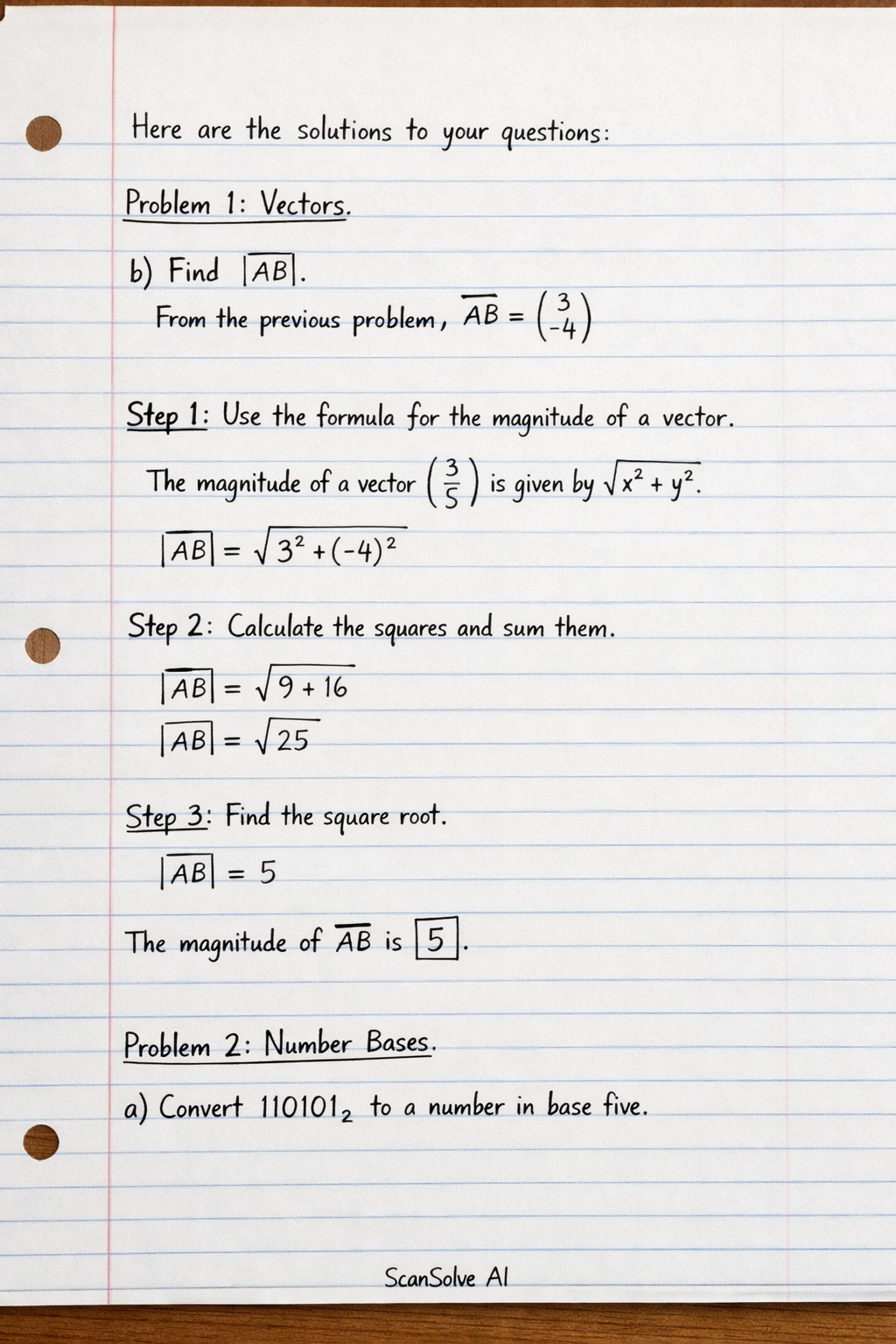
Here are the solutions to your questions: Problem 1: Vectors b) Find |AB|. From the previous problem, AB = 3 \\ -4 . Step 1: Use the formula for the magnitude of a vector. The magnitude of a vector x \\ y is given by sqrt(x^2 + y^2). |AB| = sqrt(3^2 + (-4)^2) Step 2: Calculate the squares and sum them. |AB| = sqrt(9 + 16) |AB| = sqrt(25) Step 3: Find the square root. |AB| = 5 The magnitude of AB is 5. Problem 2: Number Bases a) Convert 110101_2 to a number in base five. Step 1: Convert 110101_2 to base 10. 110101_2 = 1 × 2^5 + 1 × 2^4 + 0 × 2^3 + 1 × 2^2 + 0 × 2^1 + 1 × 2^0 = 1 × 32 + 1 × 16 + 0 × 8 + 1 × 4 + 0 × 2 + 1 × 1 = 32 + 16 + 0 + 4 + 0 + 1 = 53_10 Step 2: Convert 53_10 to base 5. Divide 53 by 5 repeatedly and record the remainders: 53 ÷ 5 = 10 remainder 3 10 ÷ 5 = 2 remainder 0 2 ÷ 5 = 0 remainder 2 Reading the remainders from bottom to top, we get 203_5. So, 110101_2 in base five is 203_5. b) Arrange the following in ascending order: 110101_2, 51_10, and 13_10. Step 1: Convert all numbers to base 10 for comparison. From part a), 110101_2 = 53_10. The other numbers are already in base 10: 51_10 and 13_10. Step 2: Arrange the base 10 numbers in ascending order. The numbers are 53_10, 51_10, 13_10. In ascending order: 13_10, 51_10, 53_10. Step 3: Write the numbers in their original bases. The ascending order is 13_10, 51_10, 110101_2. c) Evaluate 312_5 - 143_5 and give the answer in base 5. Step 1: Perform subtraction in base 5. 312_5 143_5 Starting from the rightmost digit: 2 - 3: We need to borrow. Borrow 1 from the '1' in the middle column (which becomes '0'). The borrowed '1' is worth 5 in base 5. So, 2+5 = 7. 7 - 3 = 4. Next column (middle): 0 - 4: We need to borrow. Borrow 1 from the '3' in the leftmost column (which becomes '2'). The borrowed '1' is worth 5 in base 5. So, 0+5 = 5. 5 - 4 = 1. Leftmost column: 2 - 1 = 1. Combining the results, we get 114_5. 312_5 - 143_5 = 114_5 Problem 3: Map Scale The scale on a map is given as 1:150\,000. a) Find the distance on the ground represented by 1 cm on the map. Give the answer in km. Step 1: Interpret the scale. The scale 1:150\,000 means that 1 cm on the map represents 150\,000 cm on the ground. Step 2: Convert the ground distance from cm to km. We know that 1 km = 1000 m and 1 m = 100 cm. So, 1 km = 1000 × 100 cm = 100\,000 cm. Distance in km = 150\,000 cm100\,000 cm/km = 1.5 km. The distance on the ground is 1.5 km. b) Find the distance on the map representing a distance on the ground of 7.5 km. Give the answer in cm. Step 1: Convert the ground distance from km to cm. Ground distance = 7.5 km = 7.5 × 100\,000 cm = 750\,000 cm. Step 2: Use the map scale to find the map distance. The scale is 1 cm (map) : 150\,000 cm (ground). Let x be the distance on the map. x cm (map)750\,000 cm (ground) = (1)/(150\,000) x = (750\,000)/(150\,000) cm x = 5 cm The distance on the map is 5 cm. c) Find the actual area represented by an area of 4 cm^2 on the map. Give the answer in km^2. Step 1: Determine the area scale factor. The linear scale is 1:150\,000. The area scale is (1)^2 : (150\,000)^2 = 1 : 22\,500\,000\,000. This means 1 cm^2 on the map represents 22\,500\,000\,000 cm^2 on the ground. Step 2: Convert the ground area from cm^2 to km^2. We know that 1 km^2 = (100\,000 cm)^2 = 10^10 cm^2. So, 1 cm^2 (map) represents 22\,500\,000\,000 cm^210^10 cm^2/km^2 = 2.25 km^2 on the ground. Step 3: Calculate the actual area for 4 cm^2 on the map. Actual area = 4 × 2.25 km^2 = 9 km^2. The actual area is 9 km^2.