
We read your photo as:
Convert the following numbers between bases: i) 1101001.10112 to Base 10. ii) 236.72510 to Base 7.
Mathematics
ScanSolve AI Answer
Step-by-step solution
10 stepsHere are the solutions to your number base problems:
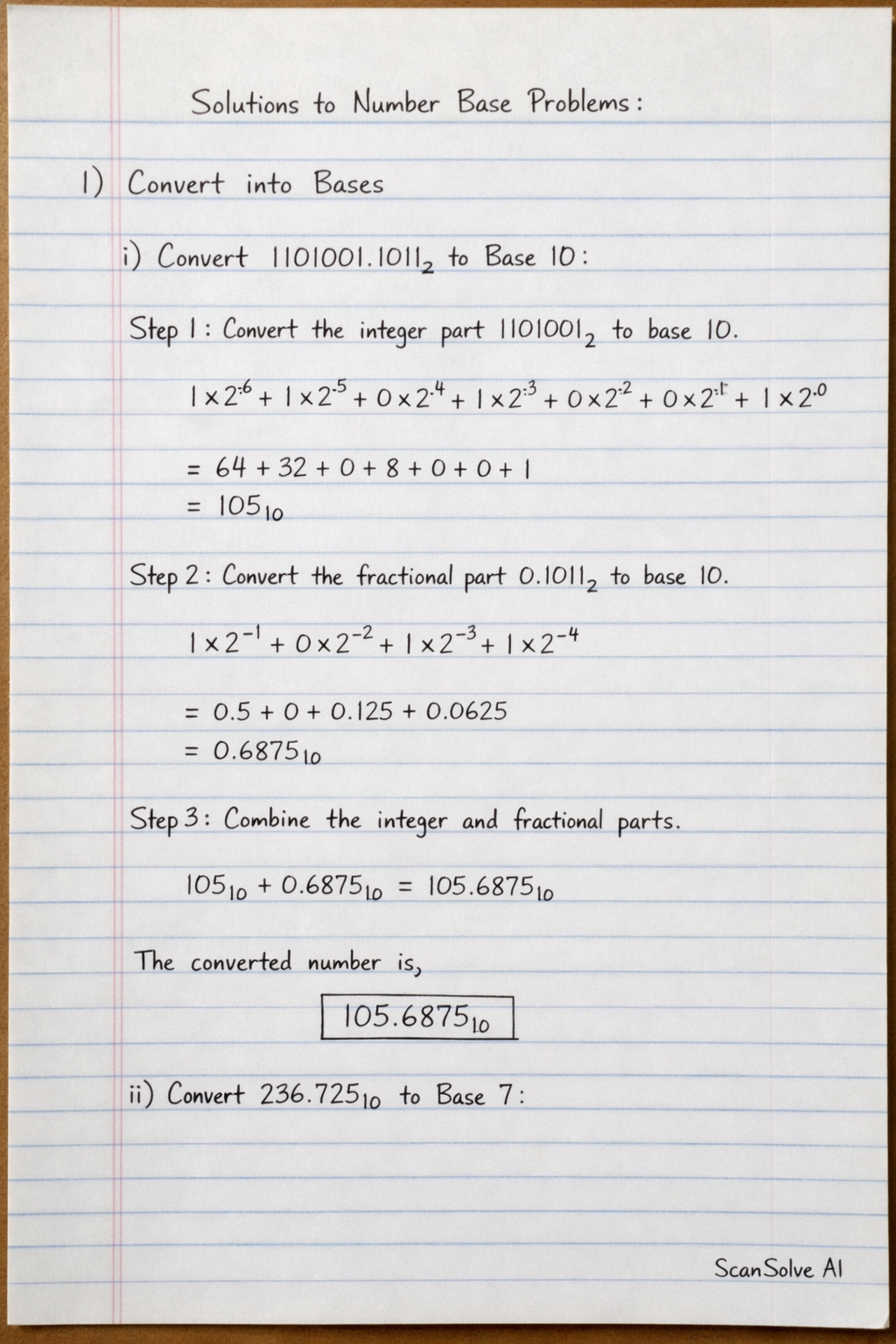
1) Convert into Bases
- i) Convert to Base 10.
Convert the integer part to base 10.
$$ 1101001_2 = (1 \times 2^6) + (1 \times 2^5) + (0 \times 2^4) + (1 \times 2^3) + (0 \times 2^2) + (0 \times 2^1) + (1 \times 2^0) $$ $$ = (1 \times 64) + (1 \times 32) + (0 \times 16) + (1 \times 8) + (0 \times 4) + (0 \times 2) + (1 \times 1) $$ $$ = 64 + 32 + 0 + 8 + 0 + 0 + 1 = 105_{10} $$Convert the fractional part to base 10.
$$ 0.1011_2 = (1 \times 2^{-1}) + (0 \times 2^{-2}) + (1 \times 2^{-3}) + (1 \times 2^{-4}) $$ $$ = (1 \times 0.5) + (0 \times 0.25) + (1 \times 0.125) + (1 \times 0.0625) $$ $$ = 0.5 + 0 + 0.125 + 0.0625 = 0.6875_{10} $$Combine the integer and fractional parts.
$$ 105_{10} + 0.6875_{10} = 105.6875_{10} $$ The converted number is $\boxed{105.6875_{10}}$.- ii) Convert to Base 7.
Convert the integer part to base 7 using successive division.
$$ 236 \div 7 = 33 \text{ remainder } 5 $$ $$ 33 \div 7 = 4 \text{ remainder } 5 $$ $$ 4 \div 7 = 0 \text{ remainder } 4 $$ Reading the remainders from bottom up gives $455_7$.Convert the fractional part to base 7 using successive multiplication.
$$ 0.725 \times 7 = 5.075 \implies \text{integer part is } 5 $$ $$ 0.075 \times 7 = 0.525 \implies \text{integer part is } 0 $$ $$ 0.525 \times 7 = 3.675 \implies \text{integer part is } 3 $$ $$ 0.675 \times 7 = 4.725 \implies \text{integer part is } 4 $$ (We can stop here or continue, as the pattern 0.725 repeats, leading to 5034...) Reading the integer parts from top down gives $0.5034..._7$.Combine the integer and fractional parts.
$$ 236.725_{10} \approx 455.5034_7 $$ The converted number is approximately $\boxed{455.5034_7}$.2) Calculate the following
-
i) Calculate
We perform hexadecimal addition column by column, remembering that A=10, B=11, C=12, D=13, E=14, F=15.
-
Add the rightmost column (1s place).
$$ 1_{16} + F_{16} = 1 + 15 = 16_{10} $$ $$ 16_{10} = 1 \times 16 + 0 \implies \text{write down } 0, \text{ carry over } 1 $$Add the second column from the right (16s place).
$$ C_{16} + B_{16} + 1 (\text{carry}) = 12 + 11 + 1 = 24_{10} $$ $$ 24_{10} = 1 \times 16 + 8 \implies \text{write down } 8, \text{ carry over } 1 $$Add the third column from the right (256s place).
$$ 6_{16} + 7_{16} + 1 (\text{carry}) = 6 + 7 + 1 = 14_{10} $$ $$ 14_{10} = E_{16} \implies \text{write down } E, \text{ carry over } 0 $$Add the leftmost column (4096s place).
$$
4_{16} + 7_{16} + 0 (\text{carry}) = 4 + 7 + 0 = 11_{10}
$$
$$
11_{10} = B_{16} \implies \text{write down } B
$$

Combining the results:
$$
46C1_{16} + 77BF_{16} = BE80_{16}
$$
The sum is $\boxed{BE80_{16}}$.
Was this helpful?
Still stuck on this one?
Ask a follow-up, and the answer starts from this question.
Got a different question?Ask your own question
More Mathematics Questions
QConvert each of the following to the number system indicated: i) Convert 1101.10112 to decimal…QConvert the binary number 1011 to base 10.QConvert the following number systems from base 10 to base 2: 1) 19 101 247 99QConvert the following numbers between number systems: 1) 630 to base 10, 2) DXIX to Hindu-Arabic…QConvert both numbers to base 10.
Browse by topic:Number Theory
Handwritten Step-by-Step Solution
Get this as a handwritten image on WhatsApp — like a tutor wrote it for you.
Try on WhatsApp