
We read your photo as:
Basic Rules of angles
ScanSolve AI Answer
Step-by-step solution
5 stepsIdentify parallel lines and vertically opposite angles.
The top and bottom lines are parallel, indicated by the double hash marks.
The angle is vertically opposite to the interior angle at the bottom-left vertex. Therefore, the interior angle at the bottom-left is .
The angle is vertically opposite to the angle formed by the left transversal and the top parallel line. This angle is composed of and , so the interior angle at the top-left vertex is . Thus, .
The angle at the bottom-right vertex is , indicated by the square symbol.
The angle is vertically opposite to the interior angle at the top-right vertex. Let's call the interior angle at the top-right . So, .Use properties of parallel lines to find .
Since the top and bottom lines are parallel, the consecutive interior angles on the right transversal are supplementary.
Since , we have:
Use properties of parallel lines to form an equation for and .
The consecutive interior angles on the left transversal are supplementary.
Use the isosceles triangle property and sum of angles in a triangle to find .
The single hash marks indicate that the left slanted side and the diagonal line are equal in length. Let the top-left vertex be A, the bottom-left vertex be B, and the bottom-right vertex be C. The equal sides are AB and AC, forming an isosceles triangle ABC.
In an isosceles triangle, the angles opposite the equal sides are equal. So, .
The angle is the interior angle at the bottom-left vertex, which is .
Therefore, . This is the angle formed by the diagonal AC and the bottom parallel line BC.
The angle is the angle labeled in the diagram.
The sum of angles in triangle ABC is :Calculate and .
Substitute the value of into Equation 1:
Now calculate using :
The values of the angles are:
Still stuck on this one?
Ask a follow-up, and the answer starts from this question.
More Mathematics Questions
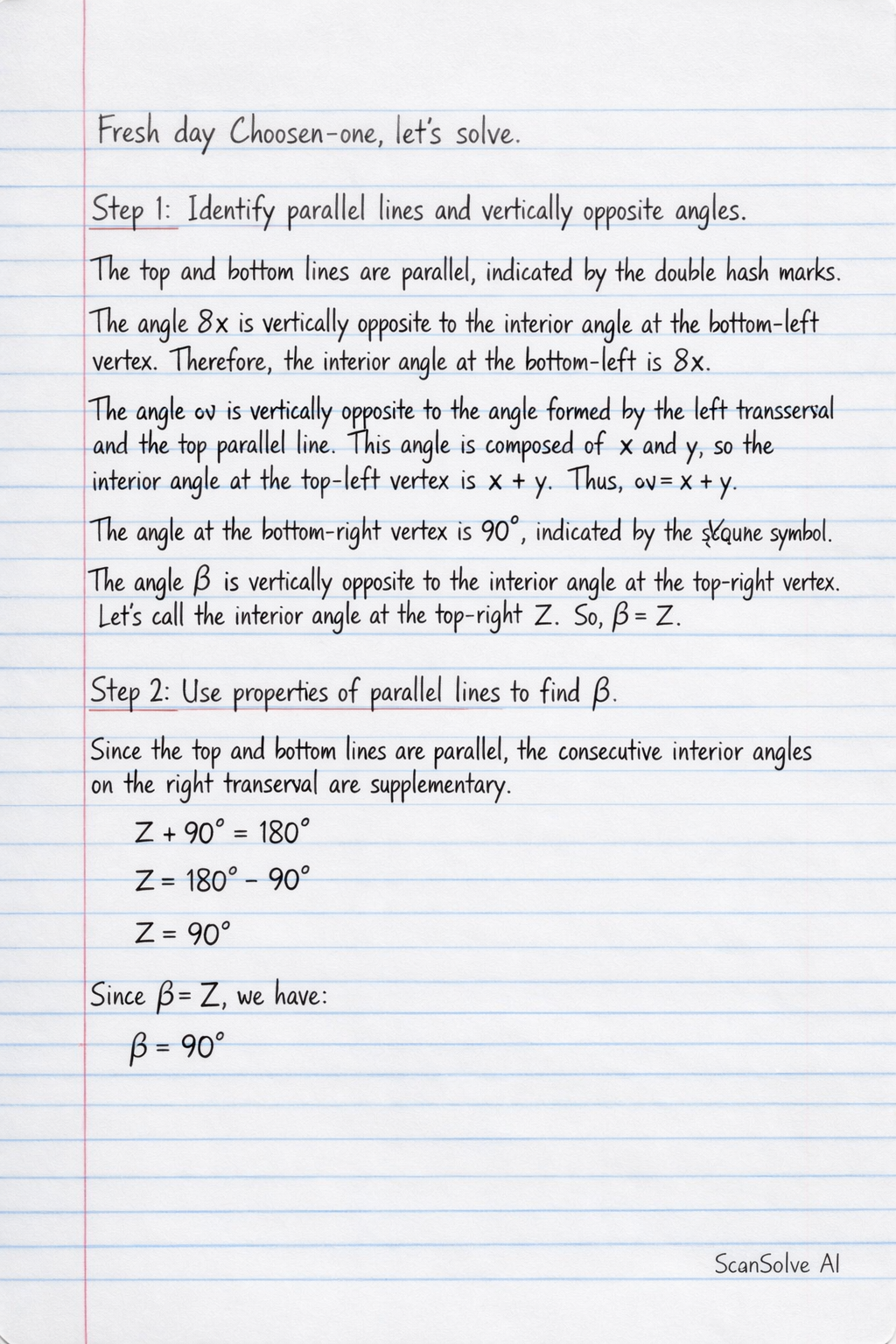
Handwritten Step-by-Step Solution
Get this as a handwritten image on WhatsApp — like a tutor wrote it for you.
Try on WhatsApp