
We read your photo as:
Find the cardinality of the set A=x | -3 < x < 33.
ScanSolve AI Answer
Answer
Step-by-step solution
17 stepsHere are the solutions to the questions:
Part 4· 2 steps
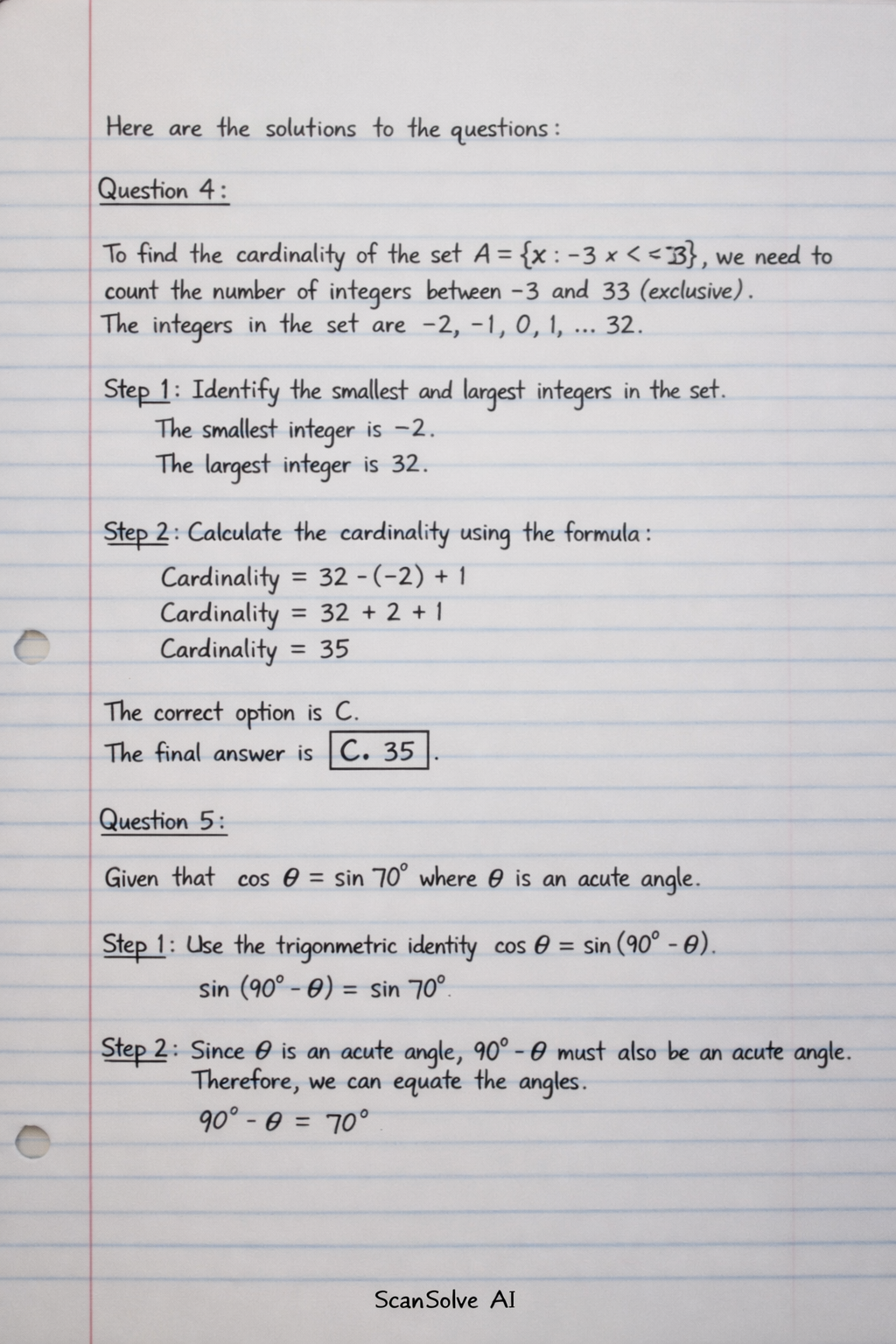
To find the cardinality of the set , we need to count the number of integers between -3 and 33 (exclusive).
The integers in the set are .
Identify the smallest and largest integers in the set.
The smallest integer is .
The largest integer is 32.Calculate the cardinality using the formula
(Largest integer - Smallest integer) + 1.
The correct option is C.
The final answer is .
Part 5· 3 steps
Given that where is an acute angle.
Use the trigonometric identity .
So, we can write the given equation as:
Since is an acute angle, must also be an acute angle.
Therefore, we can equate the angles.
Solve for .
The correct option is C.
The final answer is .
Part 6· 3 steps
A fair die is rolled once. We need to find the probability of obtaining a 3 or 4.
Identify the total possible outcomes when rolling a fair die.
The possible outcomes are .
Total number of outcomes = 6.Identify the favorable outcomes (obtaining a 3 or 4).
The favorable outcomes are .
Number of favorable outcomes = 2.Calculate the probability.
The correct option is A.
The final answer is .
Part 7· 3 steps
A bag contains two black, three green, and four red balls. A ball is picked at random. We need to find the probability that it is either black or red.
Determine the total number of balls in the bag.
Number of black balls = 2
Number of green balls = 3
Number of red balls = 4Determine the number of favorable outcomes (balls that are either black or red).
Calculate the probability.
The correct option is B.
The final answer is .
Part 8· 3 steps
Find the sum to infinity of a Geometric Progression whose first term is 10 and common ratio .
Recall the formula for the sum to infinity of a Geometric Progression.
The sum to infinity is given by , where is the first term and is the common ratio, provided .
Identify the given values.
First term .
Common ratio .
Since , the sum to infinity exists.Substitute the values into the formula and calculate.
The correct option is C.
The final answer is .
Part 9· 3 steps
The length and breadth of a rectangular piece of land are m and m respectively. The perimeter of the land is 30 m. We need to find the value of .
Write down the given dimensions and the perimeter formula for a rectangle.
Length m
Breadth m
Perimeter
Given m.Substitute the expressions for length and breadth into the perimeter formula.
Simplify and solve for .
Divide both sides by 2:
Add 1 to both sides:
Divide both sides by 2:
The correct option is A.
The final answer is .
Try one yourself
A new problem that tests the same skill.
Still stuck on this one?
Ask a follow-up, and the answer starts from this question.
More Mathematics Questions
Handwritten Step-by-Step Solution
Get this as a handwritten image on WhatsApp — like a tutor wrote it for you.
Try on WhatsApp