

This mathematics problem involves applying core mathematical principles and formulas. Below you will find a complete step-by-step solution with detailed explanations for each step, helping you understand not just the answer but the method behind it.
ScanSolve AI Answer
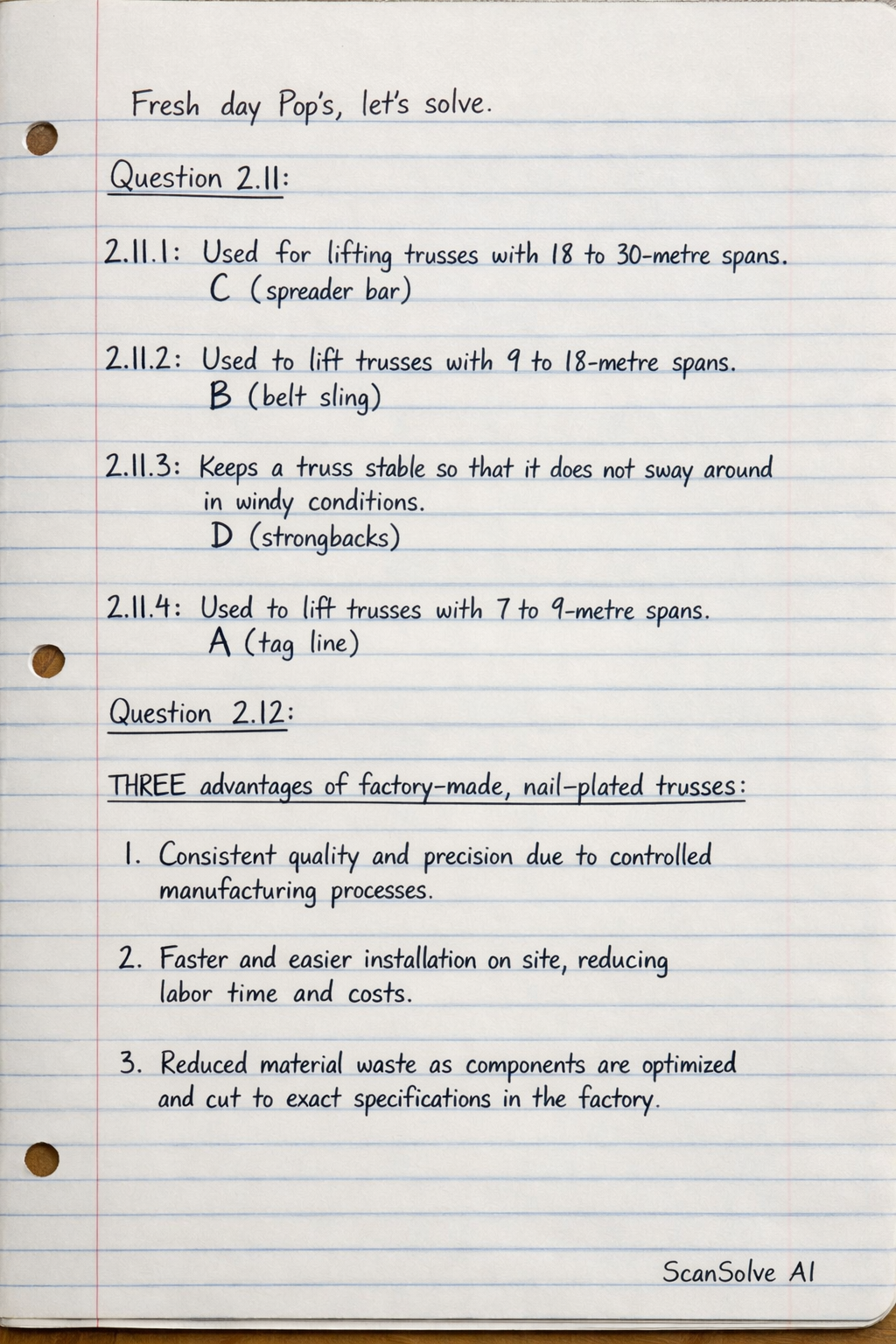
Question 2.11: 2.11.1: Used for lifting trusses with 18 to 30-metre spans. C (spreader bar) 2.11.2: Used to lift trusses with 9 to 18-metre spans. B (belt sling) 2.11.3: Keeps a truss stable so that it does not sway around in windy conditions. D (strongbacks) 2.11.4: Used to lift trusses with 7 to 9-metre spans. A (tag line) Question 2.12: THREE advantages of factory-made, nail-plated trusses: 1. Consistent quality and precision due to controlled manufacturing processes. 2. Faster and easier installation on site, reducing labor time and costs. 3. Reduced material waste as components are optimized and cut to exact specifications in the factory. Question 2.13: THREE ways in which permanent bracing stabilises a gable roof: 1. Diagonal bracing (web bracing) prevents the truss system from racking or moving laterally. 2. Ceiling diaphragms (if present) transfer lateral loads from the roof to the supporting walls. 3. Ridge bracing provides lateral support to the top chords at the ridge, preventing buckling. Question 2.14: Suitable batten spacing for fixing the following roofing materials: 2.14.1: Slate tiles: Typically 100 mm to 150 mm*. 2.14.2: Concrete tiles: Typically 250 mm to 350 mm*. Question 3: BUILDING A HOWE TRUSS Question 3.1: THREE stages of building a Howe roof truss: 1. Setting out and marking the individual timber members according to design specifications. 2. Cutting the timber members to their precise lengths and angles. 3. Assembling and joining the cut members, often using gusset plates, to form the complete truss. Question 3.2: FIVE different members that make up a Howe roof truss: 1. Top Chord (Rafter) 2. Bottom Chord (Tie Beam) 3. Vertical Web Member 4. Diagonal Web Member 5. Gusset Plate (connector) Question 3.3: Define the following terms used in truss construction: 3.3.1: joint: A joint* is a point where two or more structural members of a truss are connected to each other. 3.3.2: strike a line: To strike a line* means to mark a straight line on a surface, typically using a chalk line or a straightedge and pencil. Question 3.4: Steps taken when using the 3:4:5 method for marking a 90° angle: 1. Mark a starting point for the corner of the angle. 2. Measure 3 units along one desired direction from the starting point and mark this position. 3. Measure 4 units along the other desired direction from the starting point and mark this position. 4. Measure the diagonal distance between the 3-unit mark and the 4-unit mark. 5. If the diagonal measurement is exactly 5 units, the angle formed by the two lines is a perfect 90°. Adjust the lines as needed until the 5-unit diagonal is achieved. Question 3.5: The size of nail commonly used for joining the members of a roof truss is typically a 75 mm to 100 mm common wire nail. Question 3.6: The tool used for marking plumb cuts is a speed square or a framing square. Question 3.7: There are 4 plumb cuts made on the top chords of a Howe truss (two at the apex where the top chords meet, and two at the heel where the top chords rest on the wall plate). Drop the next question. 📸