A factory releases radioactive waste. Given the table of activity over time, determine if the waste is radioactive, its half-life, when it's safe to release, and the dangers of radioactive waste.

Physics
A factory releases radioactive waste. Given the table of activity over time, determine if the waste is radioactive, its half-life, when it's safe to release, and the dangers of radioactive waste.

ScanSolve AI Answer

Answer

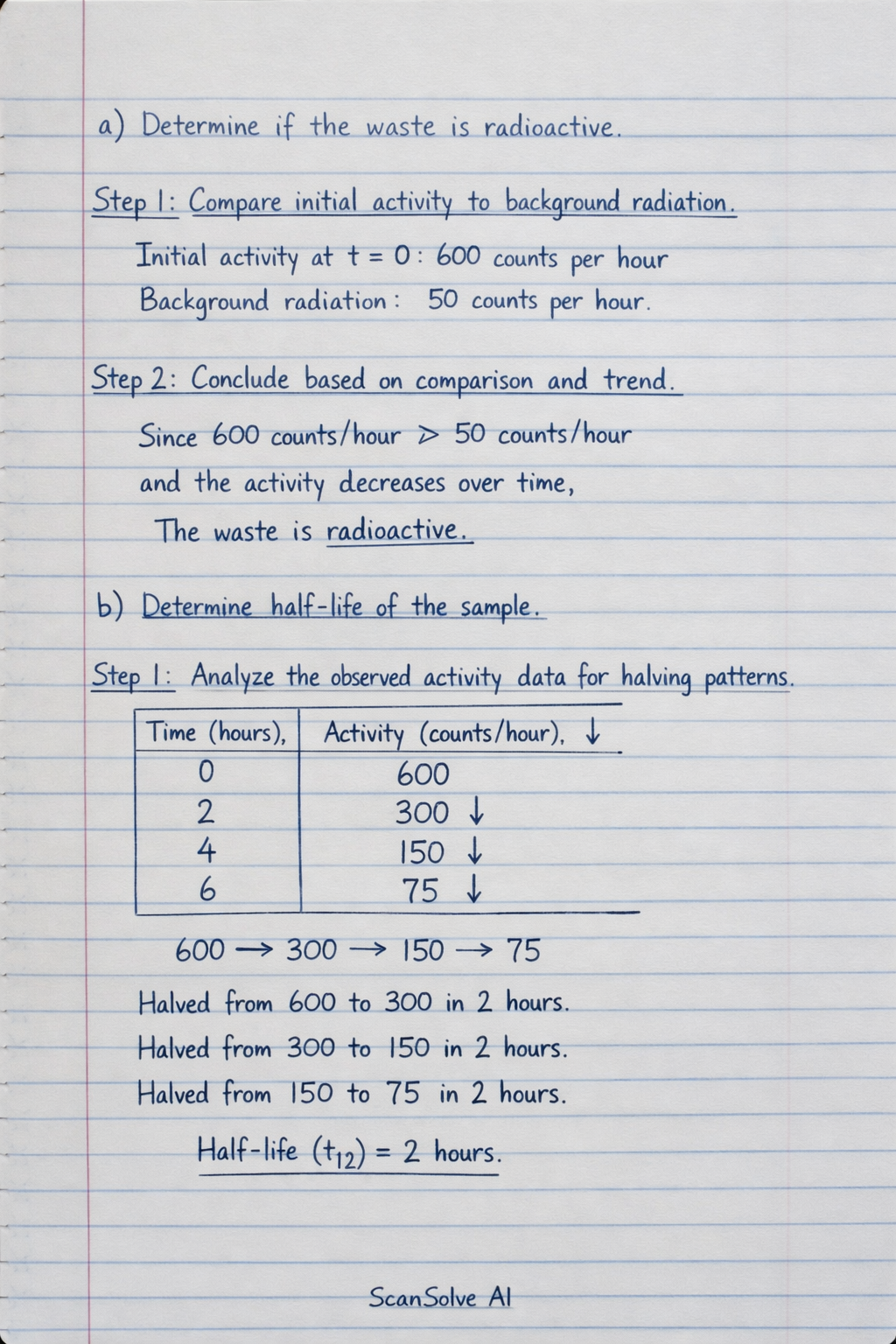
0$ is 600 counts per hour.

a) Determine if the waste is radioactive.

Step 1: Compare initial activity to background radiation. The initial activity of the waste at time t=0t=0 is 600 counts per hour. The background radiation in the area is 50 counts per hour.

Step 2: Conclude based on comparison and trend. Since the initial activity (600 counts/hour) is significantly higher than the background radiation (50 counts/hour) and the activity decreases over time as shown in the table, the waste is radioactive.

b) Determine half life of the sample.

Step 1: Analyze the observed activity data for halving patterns. The half-life is the time it takes for the activity of a

Was this helpful?

Need help with your own homework?

Get instant step-by-step solutions to any question. Free to start.

Ask Your Question
Handwritten step-by-step solution preview

Handwritten Step-by-Step Solution

Get this as a handwritten image on WhatsApp — like a tutor wrote it for you.

Try on WhatsApp

Still have questions?

Quick Answer

a) Determine if the waste is radioactive. Step 1: Compare initial activity to background radiation.

A factory releases radioactive waste. Given the table of activity over time, determine if the waste is radioactive, its half-life, when it's safe to release, and the dangers of radioactive waste.
Physics

This physics problem tests your understanding of fundamental physical laws and their applications. The step-by-step solution below breaks down the problem using relevant equations and physical reasoning.

ScanSolve AI Answer
a) Determine if the waste is radioactive. Step 1: Compare initial activity to background radiation. The initial activity of the waste at time t=0 is 600 counts per hour. The background radiation in the area is 50 counts per hour. Step 2: Conclude based on comparison and trend. Since the initial activity (600 counts/hour) is significantly higher than the background radiation (50 counts/hour) and the activity decreases over time as shown in the table, the waste is radioactive. b) Determine half life of the sample. Step 1: Analyze the observed activity data for halving patterns. The half-life is the time it takes for the activity of a