
We read your photo as:
Consider V₁ = 16 V acting alone.
Mathematics
ScanSolve AI Answer
1.2 Use the superposition method to calculate the current flowing through a resistor in FIGURE 1.
The superposition theorem requires us to consider each independent source acting alone while all other independent sources are turned off (voltage sources are short-circuited, current sources are open-circuited).
Step 1: Consider acting alone.
Deactivate by replacing it with a short circuit.
The circuit now consists of , , , , , and .
Was this helpful?
Still stuck on this one?
Ask a follow-up, and the answer starts from this question.
Got a different question?Ask your own question
More Mathematics Questions
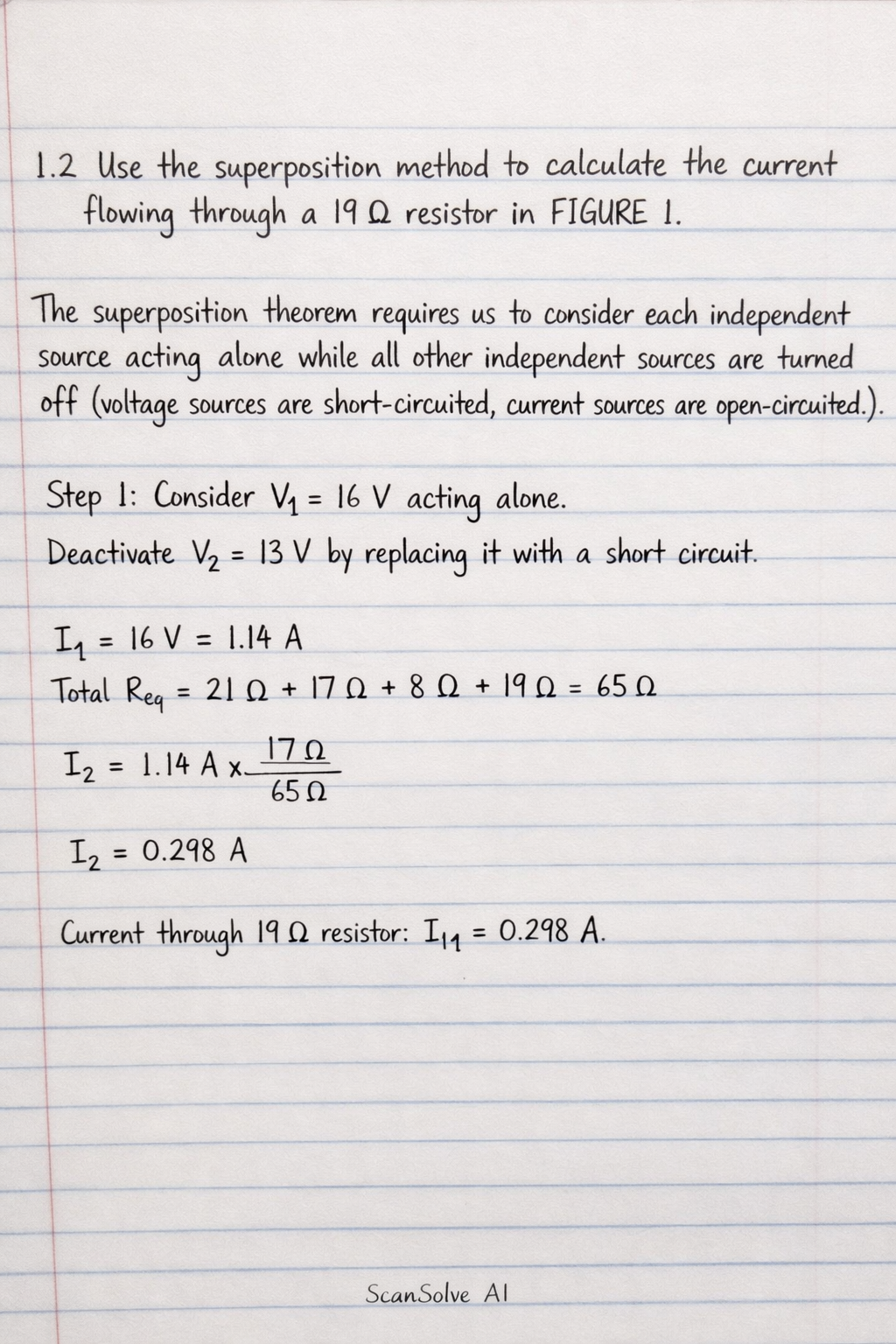
Handwritten Step-by-Step Solution
Get this as a handwritten image on WhatsApp — like a tutor wrote it for you.
Try on WhatsApp