
We read your photo as:
Construct a quadrilateral ABCD such that angle BAD = 60°, BC = 7cm and AB = 10cm. Measure and write down the length of CD. Bisect the quadrilateral ABCD, draw the locus of points which are equidistant from BC and CD.
ScanSolve AI Answer
Step-by-step solution
15 stepsThis question involves geometric construction and loci. Since I cannot perform constructions or shading, I will describe the steps you would take to solve each part.
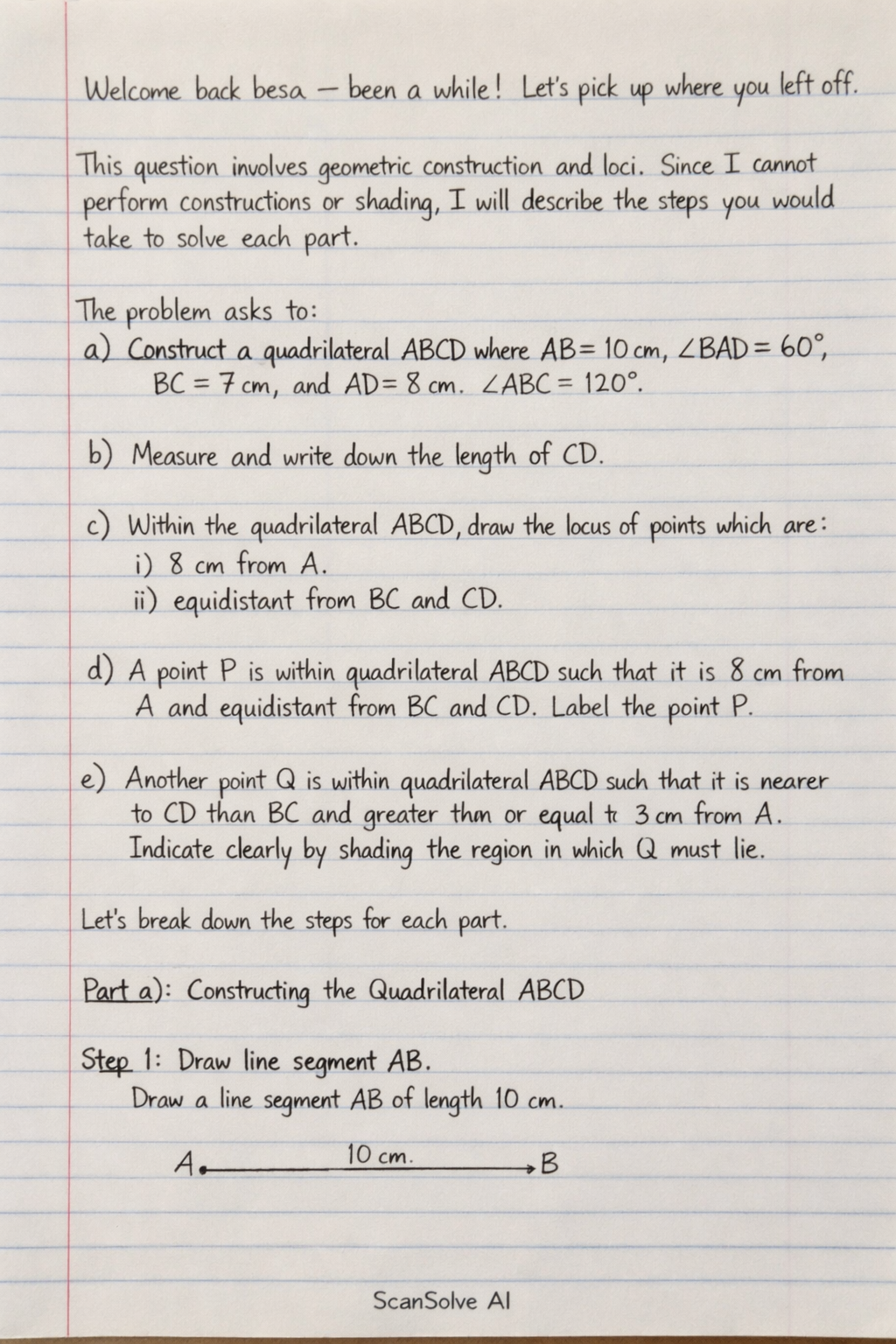
The problem asks to:
*a) Construct a quadrilateral ABCD where AB = 10 cm, angle BAD = 60°, BC = 7 cm, and AD = 8 cm. Angle ABC = 120°.
*b) Measure and write down the length of CD.
*c) Within the quadrilateral ABCD, draw the locus of points which are:
*i) 8 cm from A.
*ii) equidistant from BC and CD.
*d) A point P is within quadrilateral ABCD such that it is 8 cm from A and equidistant from BC and CD. Label the point P.
*e) Another point Q is within the quadrilateral ABCD such that it is nearer to CD than BC and greater than or equal to 3 cm from A. Indicate clearly by shading the region in which Q must lie.
Let's break down the steps for each part.
Part a): Constructing the Quadrilateral ABCD
Draw line segment AB.
Draw a line segment AB of length 10 cm.
Construct angle BAD.
At point A, use a protractor to draw a line segment AD such that .
Mark point D.
Measure 8 cm along the line segment AD from point A and mark point D.
Construct angle ABC.
At point B, use a protractor to draw a line segment BC such that .
Mark point C.
Measure 7 cm along the line segment BC from point B and mark point C.
Complete the quadrilateral.
Join points C and D to complete the quadrilateral ABCD.
Part b): Measure the length of CD
Measure CD.
Using a ruler, measure the length of the line segment CD that you constructed in Part a).
The length of CD will depend on the accuracy of your construction. For example, it might be around 7.5 cm to 8.5 cm.
Part c): Drawing Loci
c)i) Locus of points 8 cm from A.
Draw an arc.
With A as the center and a radius of 8 cm, draw an arc. This arc represents all points 8 cm from A. Only consider the portion of the arc that lies within the quadrilateral ABCD.
c)ii) Locus of points equidistant from BC and CD.
Bisect the angle.
The locus of points equidistant from two intersecting lines (or line segments) is the angle bisector of the angle formed by those lines. In this case, you need to bisect .
Draw the bisector.
Draw the angle bisector of . Only consider the portion of the bisector that lies within the quadrilateral ABCD.
Part d): Labeling point P
Locate point P.
Point P is the intersection of the locus from c)i) (arc 8 cm from A) and the locus from c)ii) (angle bisector of ) within the quadrilateral ABCD.
Label P.
Mark this intersection point as P.
Part e): Shading the region for Q
Point Q is within the quadrilateral ABCD such that:
- It is nearer to CD than BC.
- It is greater than or equal to 3 cm from A.
Identify the region "nearer to CD than BC".
This region is on the side of the angle bisector of (drawn in c)ii)) that is closer to CD.
Identify the region "greater than or equal to 3 cm from A".
Draw an arc with A as the center and a radius of 3 cm. The region "greater than or equal to 3 cm from A" is outside this arc (further away from A).
Shade the final region.
The region for Q is the area within the quadrilateral ABCD that satisfies both conditions: it is on the side of the angle bisector closer to CD, AND it is outside or on the arc of radius 3 cm from A. Shade this specific region.
Since I cannot perform the physical construction, I cannot provide numerical answers for parts b) and d) or an image for part e). However, these steps guide you through the process.
Still stuck on this one?
Ask a follow-up, and the answer starts from this question.
More Mathematics Questions
Handwritten Step-by-Step Solution
Get this as a handwritten image on WhatsApp — like a tutor wrote it for you.
Try on WhatsApp