
We read your photo as:
Continue applying the tangent addition formula.
Mathematics
ScanSolve AI Answer
Step-by-step solution
2 stepsContinue applying the tangent addition formula.
From the previous step, we have:
The left side of this equation is the expansion of using the tangent addition formula .
So, we can write:Find the general solution for .
The general solution for an equation of the form is , where is an integer.
In this case, , so .
Therefore, for :Divide by 3 to solve for :
where (the set of all integers).
The final answer is .
Was this helpful?
Still stuck on this one?
Ask a follow-up, and the answer starts from this question.
Got a different question?Ask your own question
More Mathematics Questions
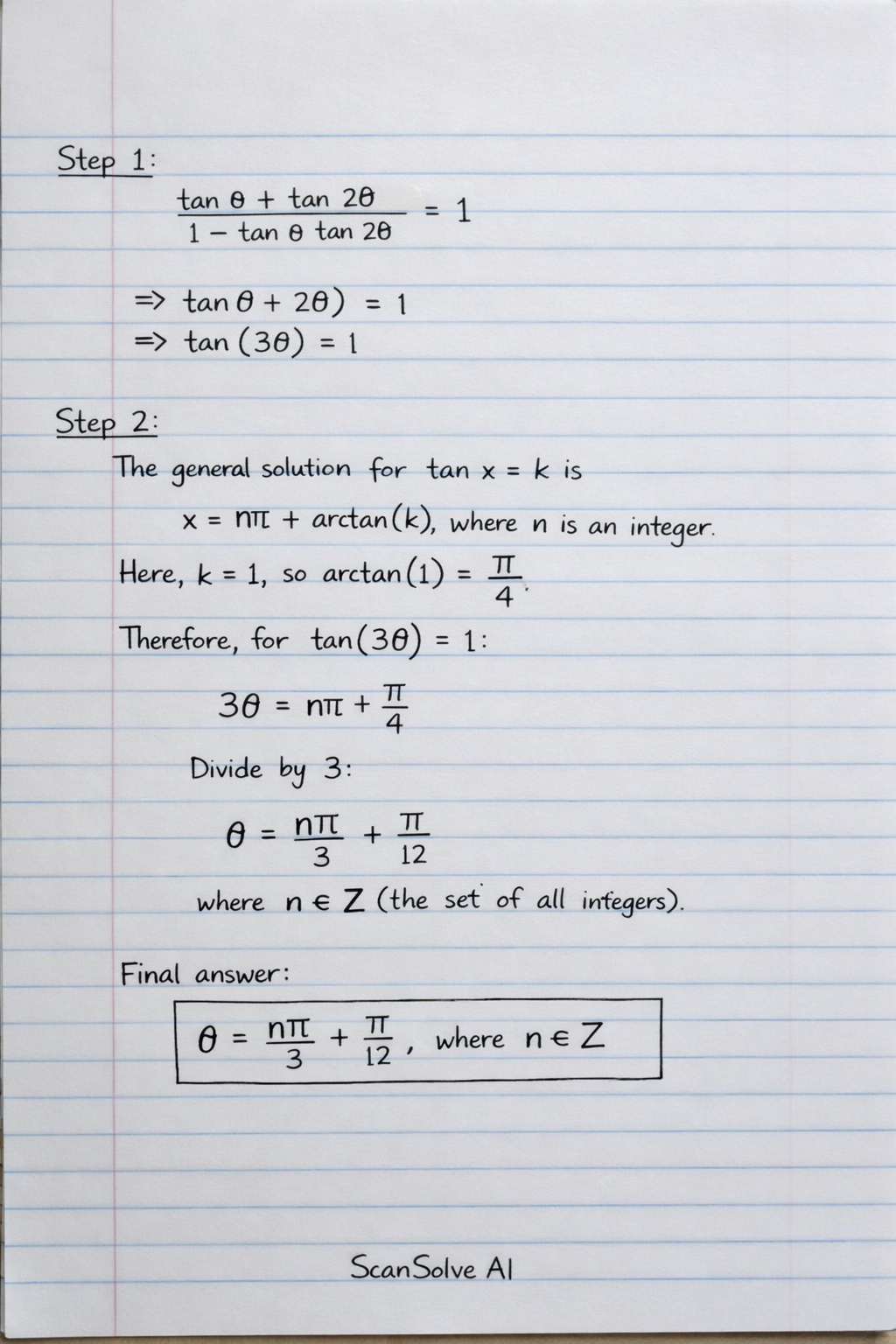
Handwritten Step-by-Step Solution
Get this as a handwritten image on WhatsApp — like a tutor wrote it for you.
Try on WhatsApp