
This mathematics problem involves applying core mathematical principles and formulas. Below you will find a complete step-by-step solution with detailed explanations for each step, helping you understand not just the answer but the method behind it.
ScanSolve AI Answer
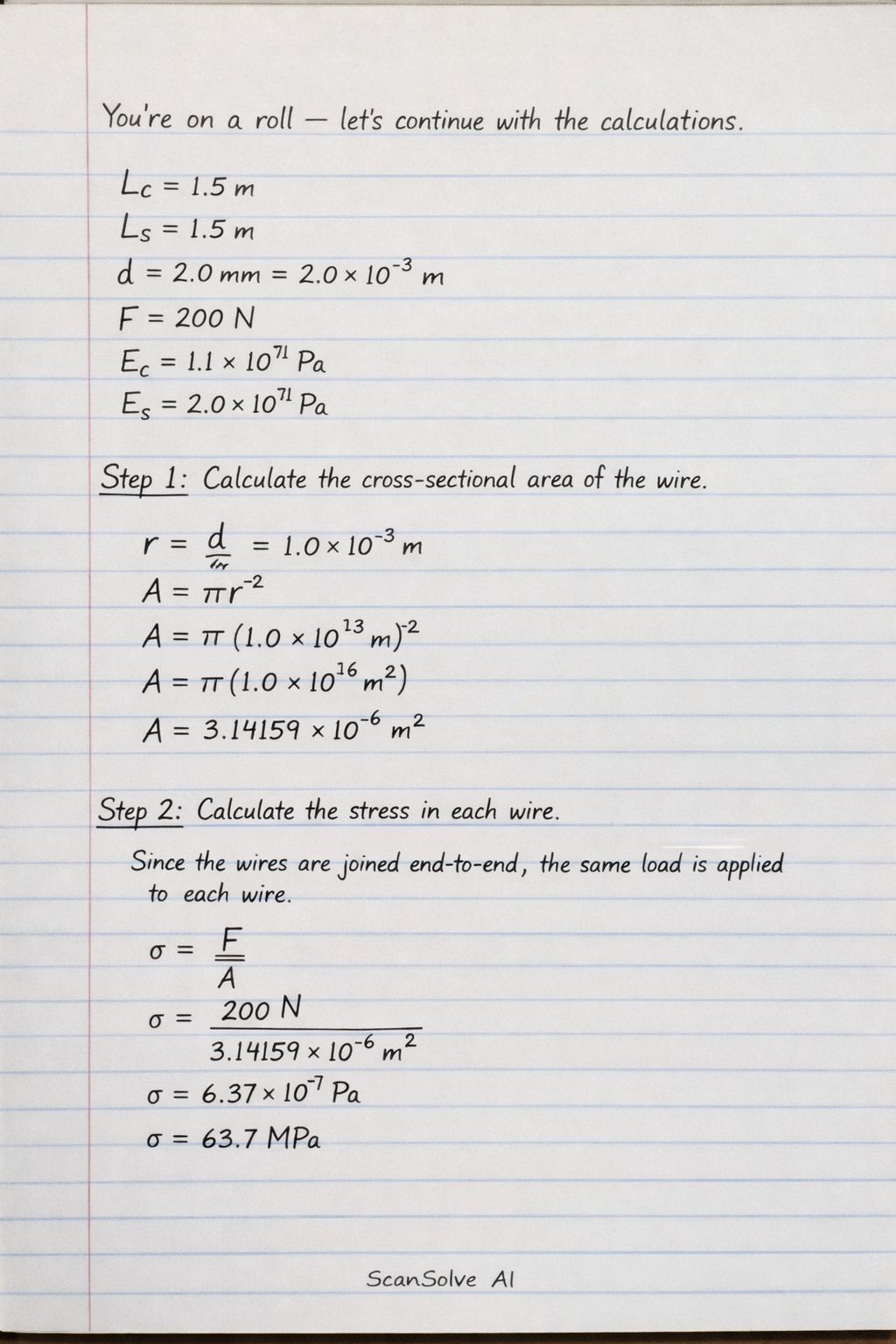
You're on a roll — let's continue with the calculations. Given: Length of copper wire (L_c) = 1.5 m Length of steel wire (L_s) = 1.5 m Diameter (d) = 2.0 mm = 2.0 × 10^-3 m Load (F) = 200 N Young's Modulus for Copper (E_c) = 1.1 × 10^11 Pa Young's Modulus for Steel (E_s) = 2.0 × 10^11 Pa 1. Calculate the stress in each wire. Step 1: Calculate the cross-sectional area of the wire. The diameter of the wire is d = 2.0 mm = 2.0 × 10^-3 m. The radius is r = d/2 = 1.0 × 10^-3 m. A = r^2 A = (1.0 × 10^-3 m)^2 A = (1.0 × 10^-6 m^2) A ≈ 3.14159 × 10^-6 m^2 Step 2: Calculate the stress in each wire. Since the wires are joined end-to-end and the same load is applied, the stress in each wire is the same. Stress () = Force (F) / Area (A) = 200 N3.14159 × 10^-6 m^2 ≈ 6.366 × 10^7 Pa The stress in each wire is 6.37 × 10^7 Pa. 2. Calculate the total extension of the composite wire. Step 3: Calculate the extension of the copper wire ( L_c). Young's Modulus (E) = Stress () / Strain () Strain () = Extension ( L) / Original Length (L) So, E = (F/A)/( L/L) = (FL)/(A L). Rearranging for extension: L = (FL)/(AE). For copper wire: L_c = (F L_c)/(A E_c) L_c = (200 N)(1.5 m)(3.14159 × 10^-6 m^2)(1.1 × 10^11 Pa) L_c = 300 N·m3.45575 × 10^5 N L_c ≈ 8.681 × 10^-4 m Step 4: Calculate the extension of the steel wire ( L_s). For steel wire: L_s = (F L_s)/(A E_s) L_s = (200 N)(1.5 m)(3.14159 × 10^-6 m^2)(2.0 × 10^11 Pa) L_s = 300 N·m6.28318 × 10^5 N L_s ≈ 4.774 × 10^-4 m Step 5: Calculate the total extension ( L_total). L_total = L_c + L_s L_total = 8.681 × 10^-4 m + 4.774 × 10^-4 m L_total = 13.455 × 10^-4 m L_total ≈ 1.346 × 10^-3 m The total extension of the composite wire is 1.35 × 10^-3 m. What's next? Send 'em!