
We read your photo as:
Convert the decimal to a fraction and simplify.
Mathematics
ScanSolve AI Answer
Answer
-0.2128
Step-by-step solution
5 stepsConvert the decimal to a fraction and simplify.
Divide both numerator and denominator by common factors.
So, we need to evaluate .
Express the fraction in terms of prime factors.
Therefore,
Apply logarithm properties.
Using the properties , , and :
Determine the value of .
We are given . Assuming base 10 logarithms (standard when no base is specified and values like 0.6990 are given), we know .
Since , we have:Substitute the known values and calculate.
Given and .
Substitute these values and into the expression from Step 3:The final answer is .
Was this helpful?
Try one yourself
A new problem that tests the same skill.
Still stuck on this one?
Ask a follow-up, and the answer starts from this question.
Got a different question?Ask your own question
More Mathematics Questions
QRewrite the decimal numbers as fractions to simplify the expression.QConvert the given fractions to decimals.QConvert the fraction to a decimal by dividing the numerator by the denominator.QConvert the fractional part to a decimal.QConvert each fraction to its decimal equivalent, add them, and then convert the sum back to a…
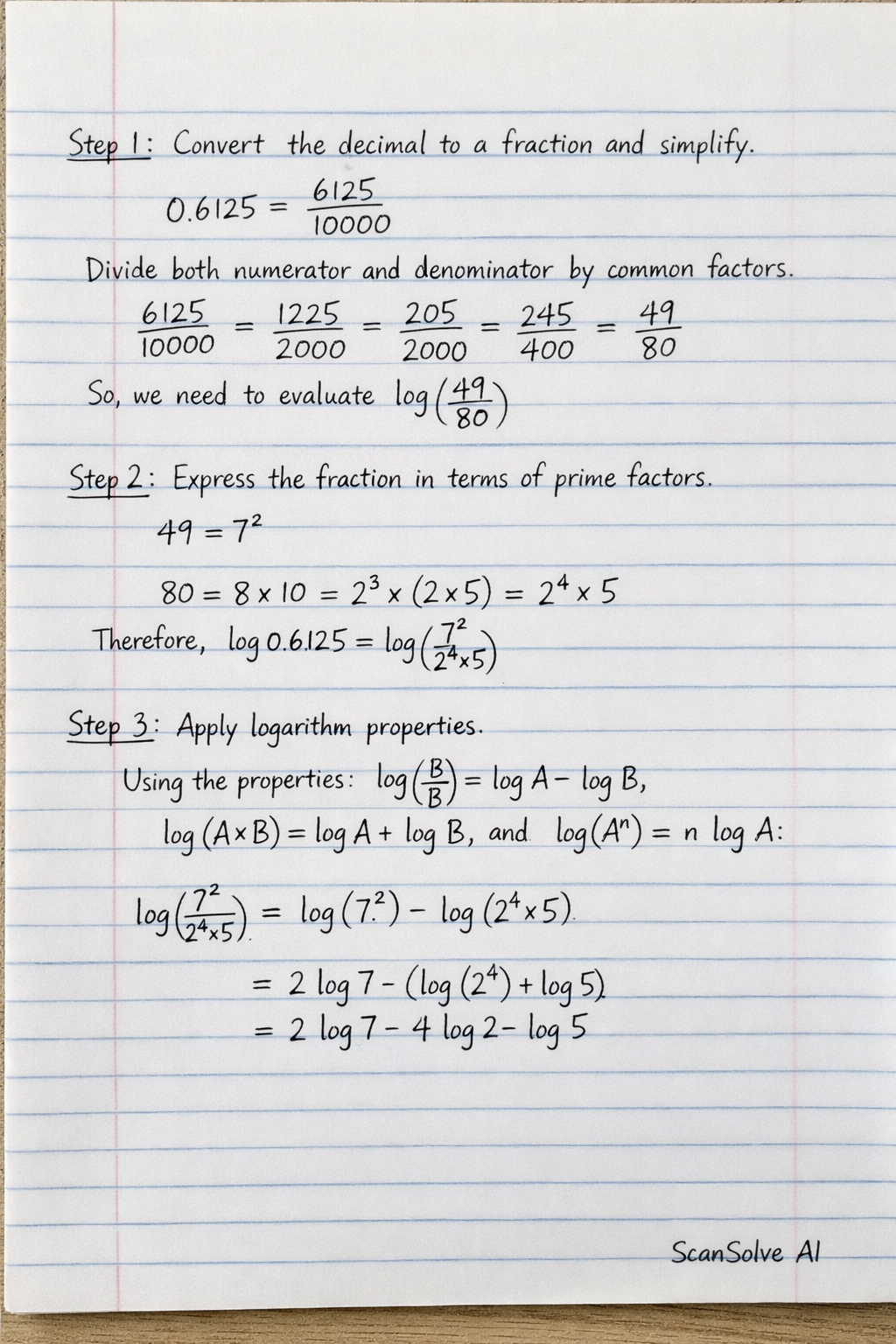
Handwritten Step-by-Step Solution
Get this as a handwritten image on WhatsApp — like a tutor wrote it for you.
Try on WhatsApp