
We read your photo as:
Determine the coordinates of points E and P, calculate the value of m and c, and calculate the length of NT.
ScanSolve AI Answer
Answer
Here's the solution to the problem:
4.1.1 Determine the coordinates of points E and P.
Points E and P are the x-intercepts of the graph . To find them, set :
Multiply by -1 to make the leading coefficient positive:
Factor the quadratic equation:
This gives two possible x-values:
From the graph, E is on the negative x-axis and P is on the positive x-axis.
Therefore, the coordinates are:
- E =
- P =
4.1.2 Calculate the value of and .
The line passes through points E and M.
From 4.1.1, E is .
Point M is the y-intercept of . To find M, set in :
So, M is .
Now we have two points on the line : E and M.
Calculate the slope :
The value of is the y-intercept of the line, which is the y-coordinate of point M.
Therefore, the values are:
4.1.3 Calculate the length of NT.
N is the turning point of .
The x-coordinate of the turning point is given by . For , and .
Substitute into to find the y-coordinate:
So, the coordinates of N are .
NTD is the axis of symmetry of , which is the vertical line .
Point T is on the graph of and on the axis of symmetry .
From 4.1.2, .
Substitute into to find the y-coordinate of T:
So, the coordinates of T are .
To calculate the length of NT, since both points have the same x-coordinate, we find the absolute difference of their y-coordinates:
The length of NT is .
4.1.4 Determine the coordinates of point S, the mirror image of point M with respect to the axis of symmetry.
Point M is .
The axis of symmetry is the line .
When a point is reflected across a vertical line, its y-coordinate remains the same. So, .
The x-coordinate of the axis of symmetry is the midpoint of the x-coordinates of M and S.
Let S be .
Therefore, the coordinates of point S are .
Try one yourself
A new problem that tests the same skill.
Still stuck on this one?
Ask a follow-up, and the answer starts from this question.
More Mathematics Questions
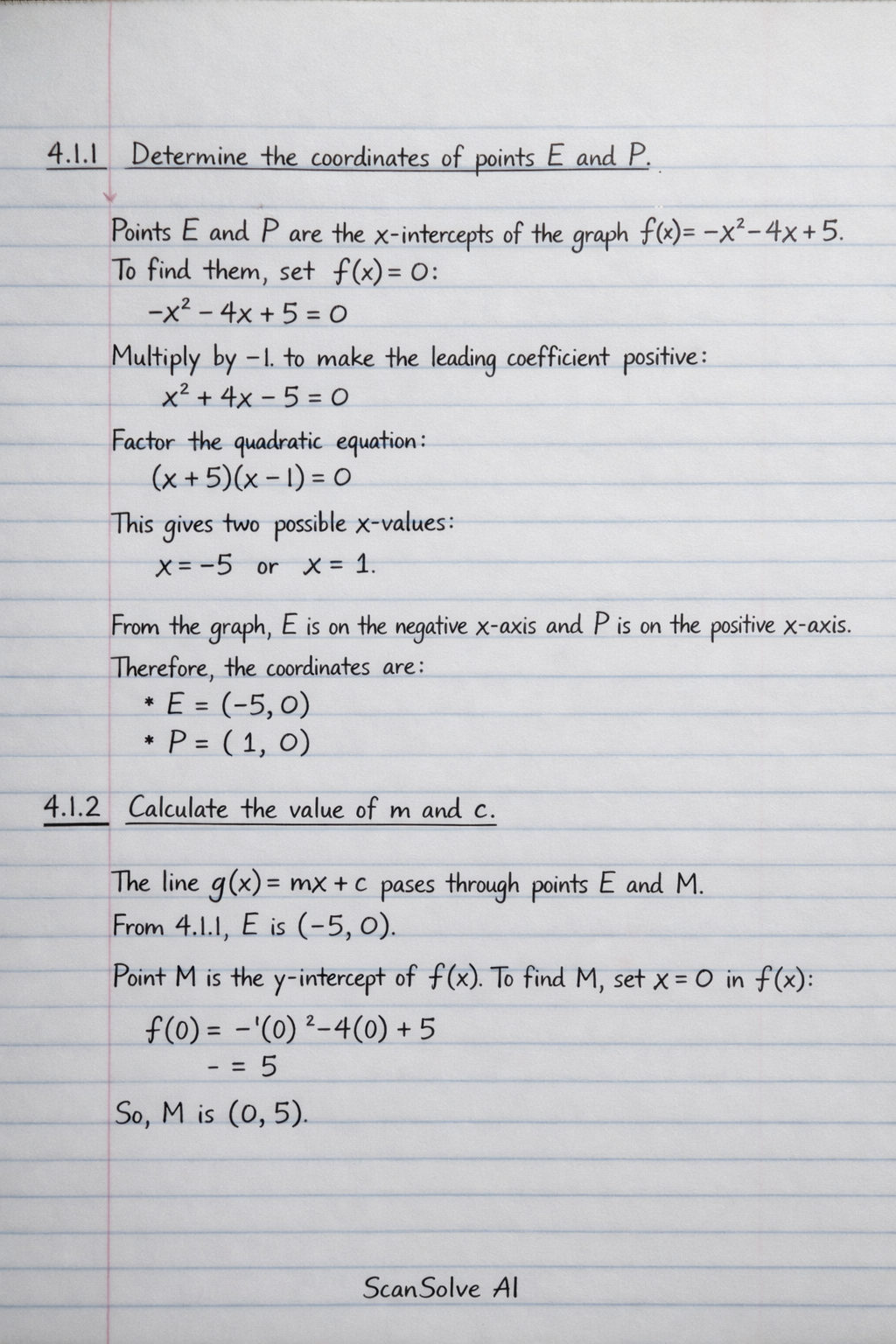
Handwritten Step-by-Step Solution
Get this as a handwritten image on WhatsApp — like a tutor wrote it for you.
Try on WhatsApp