
We read your photo as:
Copy and complete each of the following tables using the information provided: Minnie sells her AIDS ribbons for R8,50 each.
Mathematics
ScanSolve AI Answer
Answer
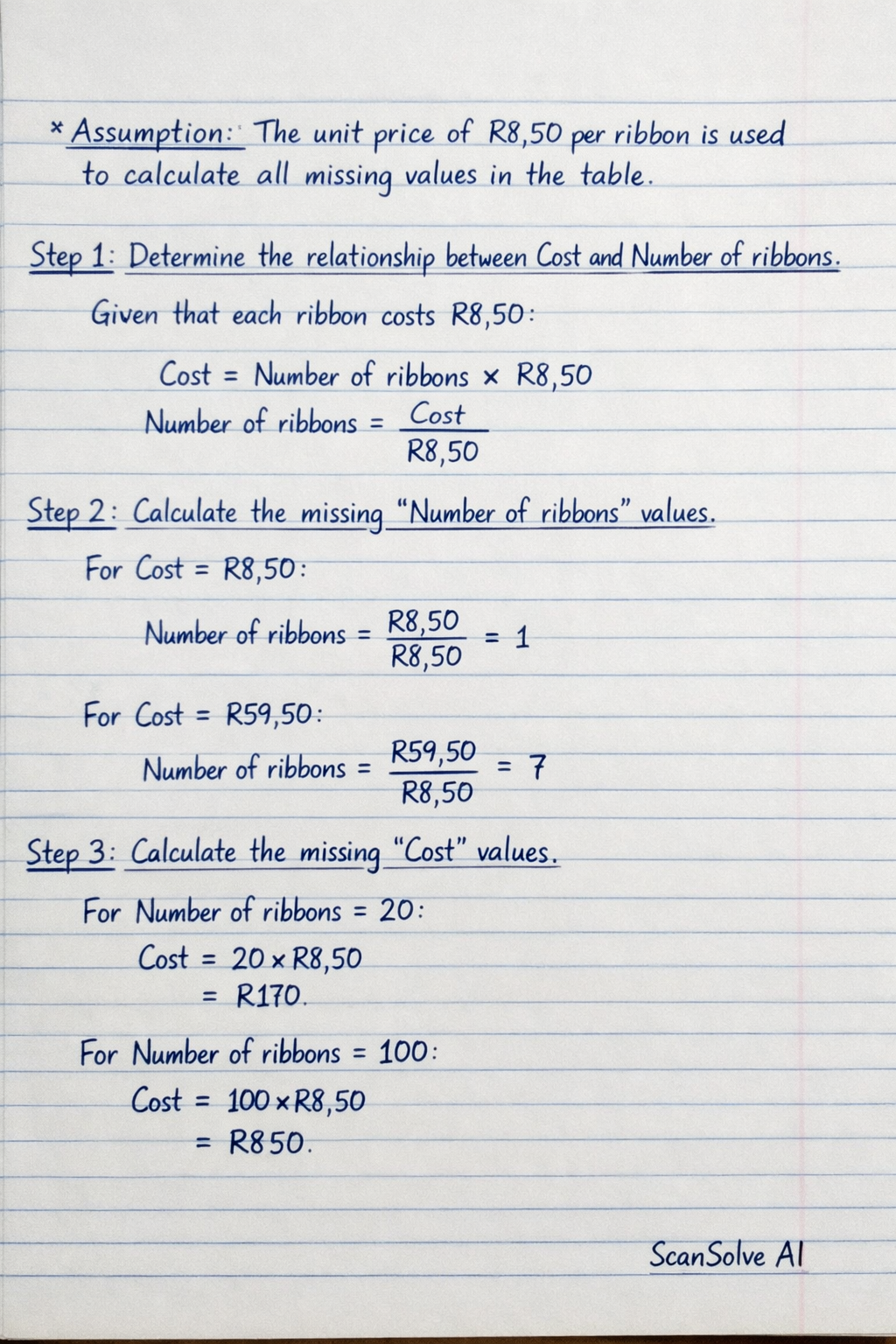
To complete the table, we use the information that Minnie sells her AIDS ribbons for R8,50 each. This means the cost of ribbons is calculated by multiplying the number of ribbons by R8,50.
Step-by-step solution
4 stepsAssumption: The unit price of R8,50 per ribbon is used to calculate all missing values in the table.
Determine the relationship between Cost and Number of ribbons.
Given that each ribbon costs R8,50:
Cost = Number of ribbons R8,50
Number of ribbons =Calculate the missing "Number of ribbons" values.
- For Cost = R8,50:
- For Cost = R59,50:
Calculate the missing "Cost" values.
- For Number of ribbons = 20:
- For Number of ribbons = 100:
Complete the table with the calculated values.
The completed table is:
Was this helpful?
Still stuck on this one?
Ask a follow-up, and the answer starts from this question.
Got a different question?Ask your own question
More Mathematics Questions
QCalculate the selling price of a human wig with a 50% markup, and the discount on cash sales of…QSolve the following word problems: 1. Lerato has R60. She buys a book for R45 and a ruler for R10…QComplete the following: a) 3 oranges for R6, b) 5 oranges for R10, c) 2 apples for R5, d) 4 apples…QTranslate the following word problems into algebraic equations: You buy three cans of coke and pay…QBelow is a retail receipt. Answer the following questions: 1 Write down Nontobeko's monthly gross…
Handwritten Step-by-Step Solution
Get this as a handwritten image on WhatsApp — like a tutor wrote it for you.
Try on WhatsApp