
We read your photo as:
Determine the correctness of statements regarding subtraction and solve the given problems.
ScanSolve AI Answer
Step-by-step solution
8 stepsHere are the solutions to the problems:
1. Statement A: Large-number subtraction uses column method. Statement B: Borrowing is never needed in 4-digit subtraction.
- Statement A is correct. Large-number subtraction is typically performed using the column method.
- Statement B is incorrect. Borrowing (or regrouping) is often needed in 4-digit subtraction, just like in subtraction of smaller numbers, if a digit in the minuend is smaller than the corresponding digit in the subtrahend.
Therefore, only Statement A is correct.
The correct option is 1) Statement A is correct.
2. Match Column-I with Column-II.
- A. Backward 10s: This refers to counting backward by tens.
- Matches with 2. 90, 80, 70
- B. Subtraction fact: This is a basic subtraction equation.
- Matches with 1.
- C. Regrouping: This is another term for borrowing in subtraction.
- Matches with 4. Borrowing
- D. Profit: The formula for profit is Selling Price (SP) minus Cost Price (CP).
- Matches with 3. SP - CP
So the correct matching order for A, B, C, D is 2, 1, 4, 3.
The correct option is 1) 2, 1, 4, 3.
3. using expanded form is-
To multiply using the expanded form of 14, we write 14 as .
Then, we distribute the multiplication:
The correct option is 1) .
4. Match Column-I with Column-II.
Calculate the products for each item in Column-I.
- A.
- B.
- C.
- D.
Match the results with Column-II.
- A. 130 matches with 2.
- B. 360 matches with 1.
- C. 2950 matches with 4.
- D. 1692 matches with 3.
So the correct matching order for A, B, C, D is 2, 1, 4, 3.
The correct option is 3) 2, 1, 4, 3.
5. A shelf holds 125 books. There are 14 shelves. How many books are there in total?
Multiply the number of books per shelf by the number of shelves.
Perform the multiplication.
There are a total of 1750 books.
The correct option is 4) 1750.
6. A man buys 45 packets of chocolates. Each packet contains 14 chocolates. He distributes 350 chocolates. How many does he have left?
Calculate the total number of chocolates the man bought.
Subtract the distributed chocolates from the total chocolates bought to find the remaining chocolates.
The man has 280 chocolates left.
The correct option is 4) 280.
7. If 750 candles are packed in packets of 12, how many full packets and leftover candles?
Divide the total number of candles by the number of candles per packet.
Perform the division to find the quotient and remainder.
This means there are 62 full packets and 6 leftover candles.
There are 62 packets, 6 left.
The correct option is 1) 62 packets, 6 left.
Still stuck on this one?
Ask a follow-up, and the answer starts from this question.
More Mathematics Questions
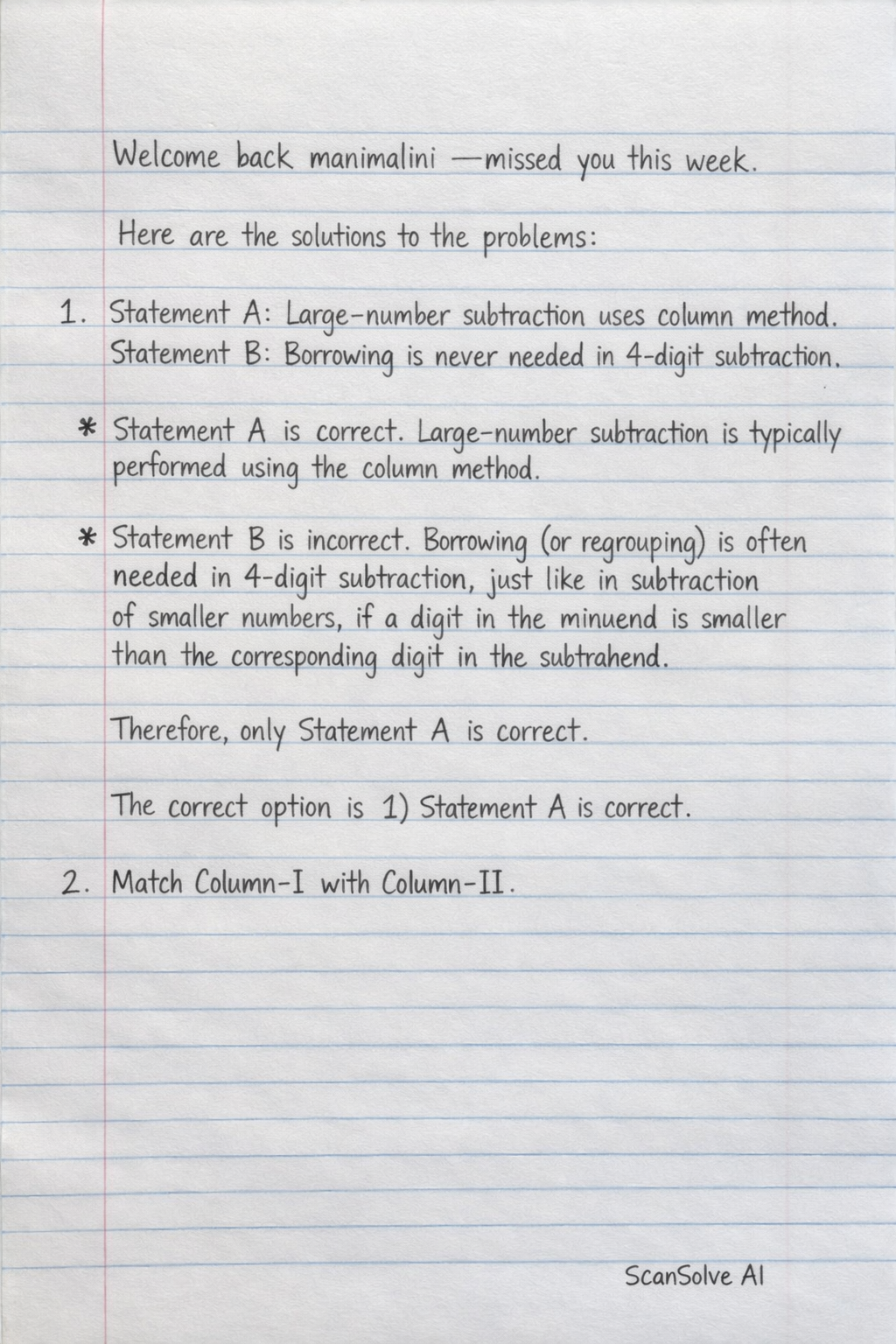
Handwritten Step-by-Step Solution
Get this as a handwritten image on WhatsApp — like a tutor wrote it for you.
Try on WhatsApp