
We read your photo as:
Solve the following problems involving integers: True/False statements, identify multiplication identity, and perform subtraction.
ScanSolve AI Answer
Step-by-step solution
9 stepsHere are the solutions to the problems:
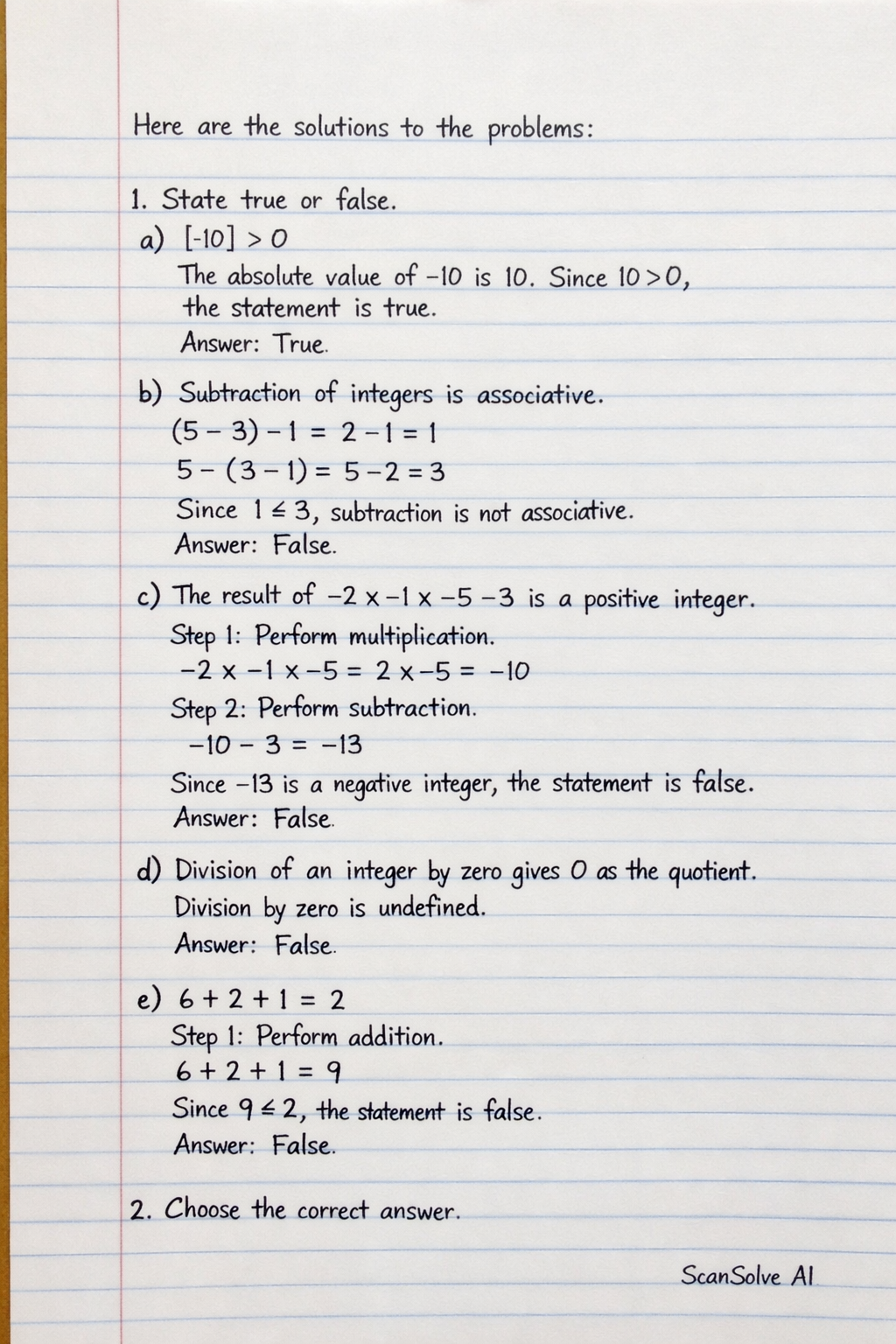
1. State true or false.
-
a) The absolute value of is 10. Since , the statement is true. Answer: True
-
b) Subtraction of integers is associative. For example, , but . Since , subtraction is not associative. Answer: False
-
c) The result of is a positive integer.
Perform multiplication.
$$ -2 \times -1 \times -5 = 2 \times -5 = -10 $$Perform subtraction.
$$ -10 - 3 = -13 $$ Since $-13$ is a negative integer, the statement is false. **Answer: False**-
d) Division of an integer by zero gives 0 as the quotient. Division by zero is undefined. Answer: False
-
e)
-
Perform addition.
$$ 6 + 2 + 1 = 9 $$ Since $9 \neq 2$, the statement is false. **Answer: False**2. Choose the correct answer.
-
a) ____ is the identity of multiplication of integers. The identity for multiplication is 1, because any integer multiplied by 1 remains unchanged. Answer: iii) 1
-
b)
-
Perform subtraction.
$$ -100 - 60 = -160 $$ **Answer: iv) -160**- c)
Simplify the double negative.
$$ 200 - (-50) = 200 + 50 $$Perform addition.
$$ 200 + 50 = 250 $$ **Answer: i) 250**- d)
Perform the operation inside the parentheses.
$$ 2 + 2 = 4 $$Perform division from left to right.
$$ 24 \div 3 = 8 $$Perform multiplication.
$$ 8 \times 4 = 32 $$ **Answer: i) 32**-
e) . This is the ____ property. This equation demonstrates the distributive property of multiplication over addition. Answer: iv) distributive
-
f) The division of integers does not have closure property because ____ The closure property means that the result of an operation on two integers is always an integer. For division, this is not always true (e.g., , which is not an integer). Answer: iii) quotient can be a fraction
3. Add.
-
a)
The sum is .
-
b)
The sum is .
-
c)
The sum is .
-
d)
The sum is .
4. Subtract.
-
a)
The difference is .
-
Still stuck on this one?
Ask a follow-up, and the answer starts from this question.
More Mathematics Questions
Handwritten Step-by-Step Solution
Get this as a handwritten image on WhatsApp — like a tutor wrote it for you.
Try on WhatsApp