
We read your photo as:
Evaluate the validity of each statement concerning divisibility rules for integers.
ScanSolve AI Answer
Answer
Step-by-step solution
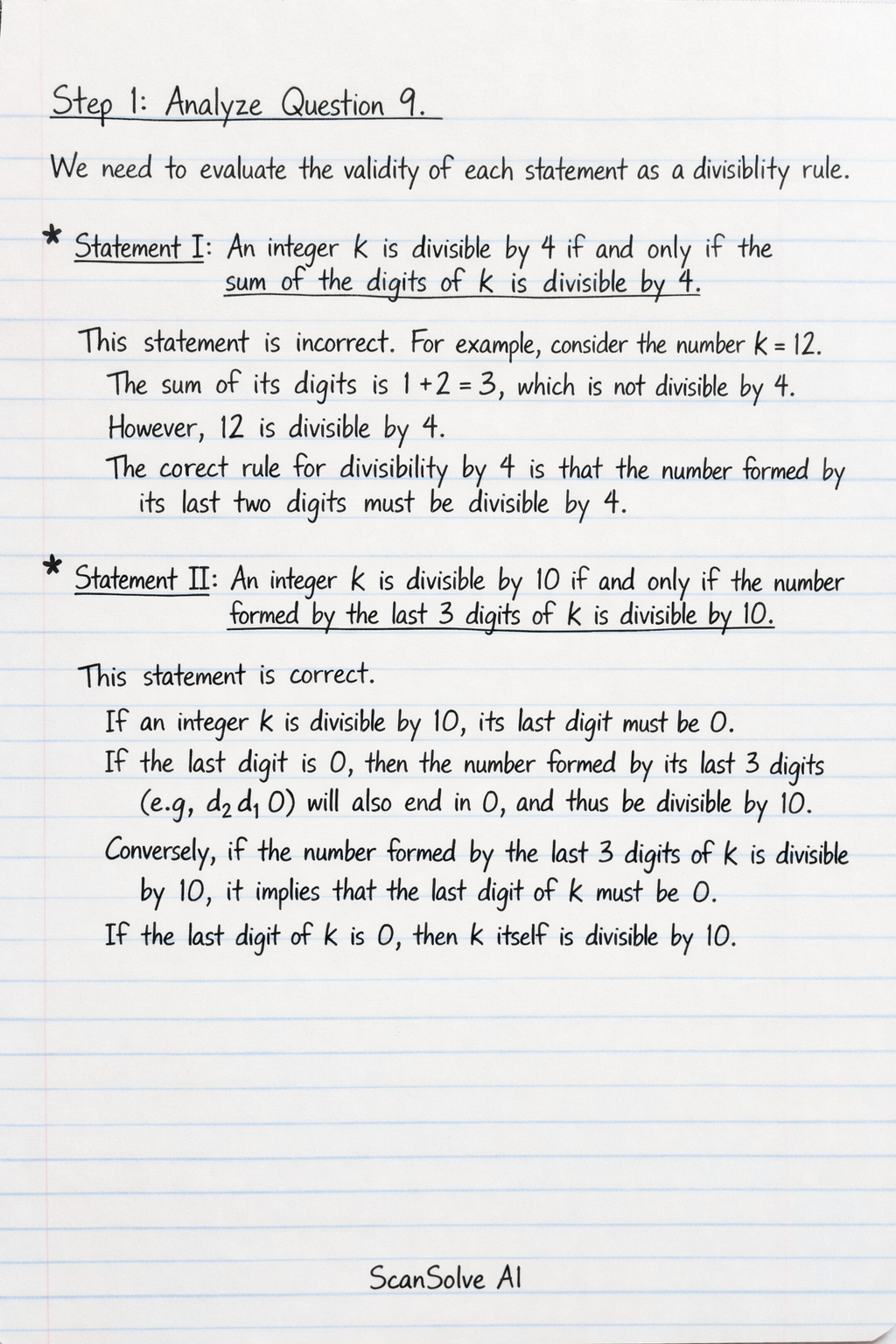
3 stepsAnalyze Question 9.
We need to evaluate the validity of each statement as a divisibility rule.
-
Statement I: An integer is divisible by 4 if and only if the sum of the digits of is divisible by 4. This statement is incorrect. For example, consider the number . The sum of its digits is , which is not divisible by 4. However, 12 is divisible by 4. The correct rule for divisibility by 4 is that the number formed by its last two digits must be divisible by 4.
-
Statement II: An integer is divisible by 10 if and only if the number formed by the last 3 digits of is divisible by 10. This statement is correct. If an integer is divisible by 10, its last digit must be 0. If the last digit is 0, then the number formed by its last 3 digits (e.g., ) will also end in 0, and thus be divisible by 10. Conversely, if the number formed by the last 3 digits of is divisible by 10, it implies that the last digit of must be 0. If the last digit of is 0, then itself is divisible by 10.
-
Statement III: An integer is divisible by 3 if and only if the number formed by the last 2 digits is divisible by 3. This statement is incorrect. For example, consider the number . The number formed by its last two digits is 23, which is not divisible by 3. However, 123 is divisible by 3 (since the sum of its digits is divisible by 3). The correct rule for divisibility by 3 is that the sum of its digits must be divisible by 3.
Only statement II is a valid way to verify divisibility by 10. Therefore, none of the options A, B, C, or D are correct, as they all include I or III.
The correct option is E.
-
Analyze Question 10.
We are given and . We need to find the greatest common divisor (GCD) of and .
First, find the prime factorization of each number:
To find the GCD, we take the lowest power of each common prime factor:
The greatest common divisor of 24 and 36 is 12.
The correct option is C.
Analyze Question 11.
The question asks about the base case typically used when proving a statement by mathematical induction.
Mathematical induction is a method used to prove that a statement is true for all natural numbers (or for all greater than or equal to some initial integer). It consists of two steps:
- Base Case: Prove that the statement is true for the initial value of (e.g., or ).
- Inductive Step: Assume that is true for an arbitrary natural number (the inductive hypothesis), and then prove that is also true.
Let's evaluate the given options:
- A. The statement is assumed to be true for all . This is incorrect; we aim to prove it for all , not assume it.
- B. The statement is true for the smallest value of . This describes the base case, but option C is more complete.
- C. The statement is proven true for the initial value, usually or . This accurately describes the base case, emphasizing that it must be proven for a specific initial value.
- D. The statement is assumed true for . This is part of the inductive step, where we assume is true to prove .
Option C provides the most accurate and complete description of the base case in mathematical induction.
The correct option is C.
Try one yourself
A new problem that tests the same skill.
Still stuck on this one?
Ask a follow-up, and the answer starts from this question.
More Mathematics Questions
Handwritten Step-by-Step Solution
Get this as a handwritten image on WhatsApp — like a tutor wrote it for you.
Try on WhatsApp