
We read your photo as:
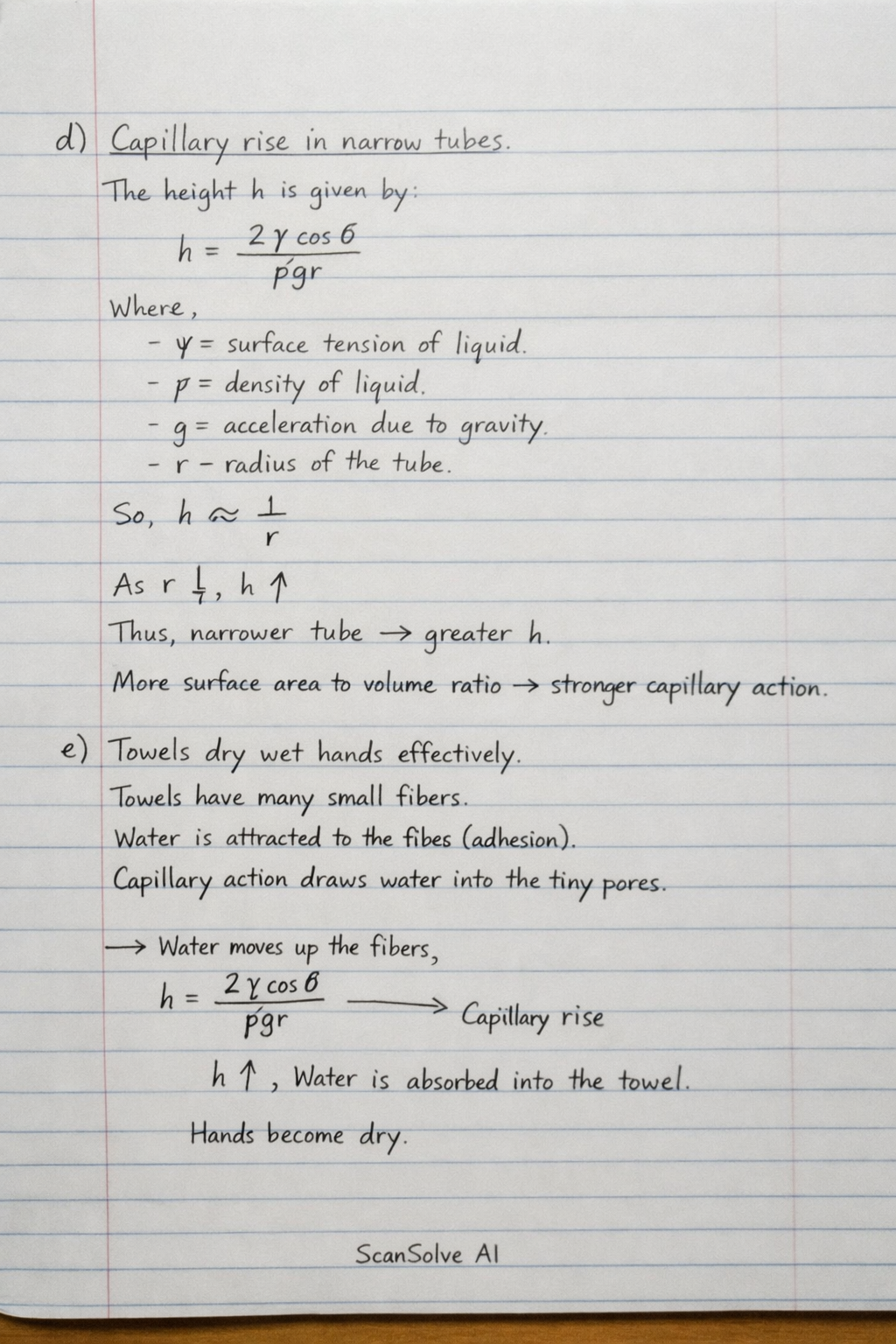
d) Capillarity is more pronounced in very narrow tubes because the height to which a liquid rises (or falls) in a capillary tube is inversely proportional to the radius of the tube. This means tha
ScanSolve AI Answer
Here are the scientific reasons for the given statements and the distinction requested:
d) Capillarity is more pronounced in very narrow tubes because the height to which a liquid rises (or falls) in a capillary tube is inversely proportional to the radius of the tube. This means that the narrower the tube, the greater the capillary effect due to the increased surface area to volume ratio and the stronger influence of surface tension and adhesive forces.
e) Towels are used to dry wet hands because they are made of materials with many small fibers, creating a network of tiny pores. Water molecules are attracted to these fibers (adhesion), and the water is drawn into these small spaces through capillary action, effectively absorbing the water from the hands.
Q2)
- Cohesion is the attractive force between molecules of the same substance. For example, water molecules are cohesive, which gives water its surface tension.
- Adhesion is the attractive force between molecules of different substances. For example, water molecules adhere to glass, causing water to wet the glass surface.
Still stuck on this one?
Ask a follow-up, and the answer starts from this question.
More Mathematics Questions
Handwritten Step-by-Step Solution
Get this as a handwritten image on WhatsApp — like a tutor wrote it for you.
Try on WhatsApp