We read your photo as:

Find the length of side PQ using the Pythagorean theorem in the right-angled triangle PQR.

Mathematics

ScanSolve AI Answer

Answer

31713\frac{3\sqrt{17}}{13}

−413-\frac{4}{13}

41751\frac{4\sqrt{17}}{51}

Step-by-step solution

5 steps
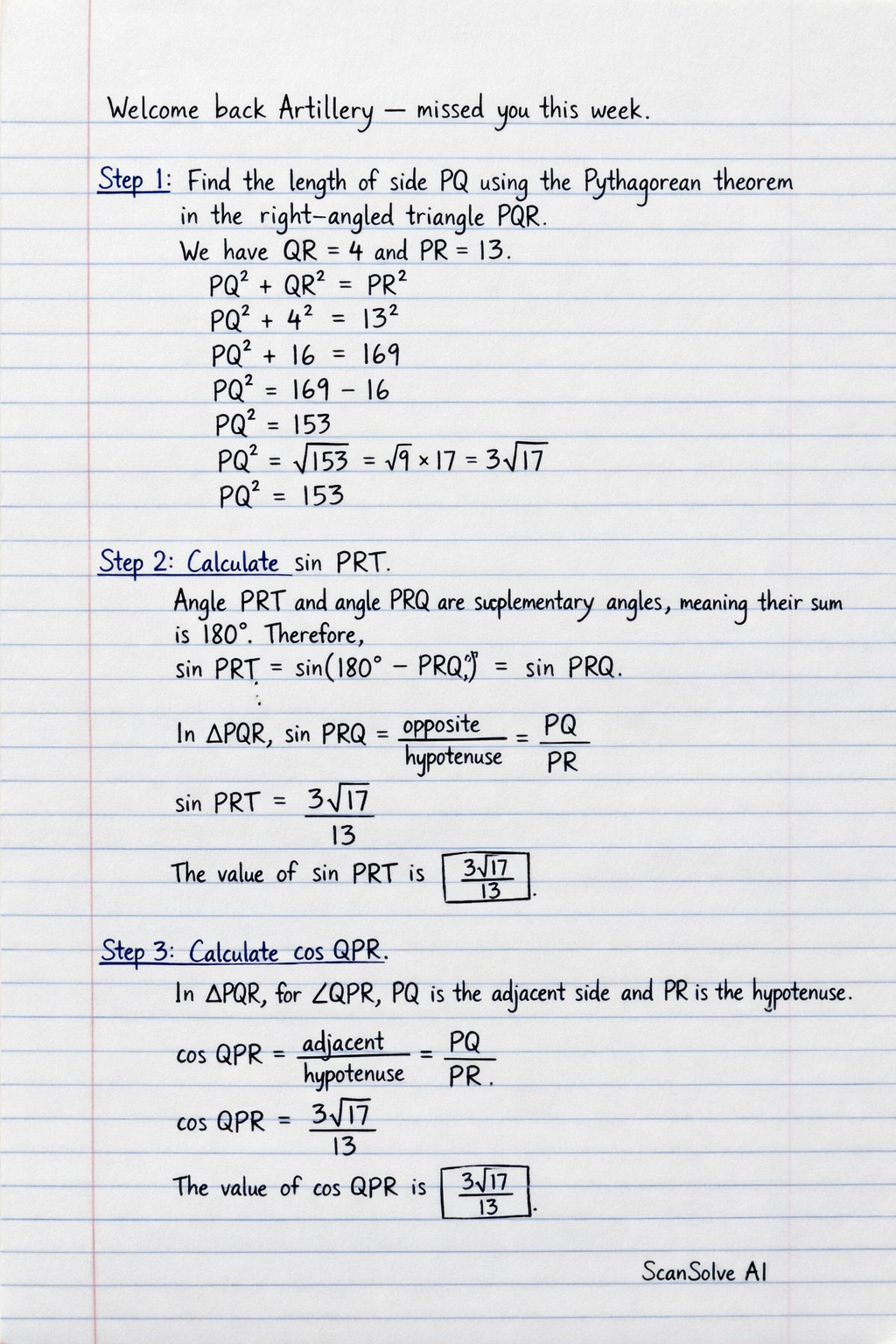
  1. Find the length of side PQ using the Pythagorean theorem in the right-angled triangle PQR.

    We have QR=4QR = 4 and PR=13PR = 13.

    PQ2+QR2=PR2PQ^2 + QR^2 = PR^2 PQ2+42=132PQ^2 + 4^2 = 13^2 PQ2+16=169PQ^2 + 16 = 169 PQ2=169−16PQ^2 = 169 - 16 PQ2=153PQ^2 = 153 PQ=153=9×17=317PQ = \sqrt{153} = \sqrt{9 \times 17} = 3\sqrt{17}
  2. Calculate sin⁡PRT\sin PRT.

    Angle PRT and angle PRQ are supplementary angles, meaning their sum is 180∘180^\circ. Therefore, sin⁡PRT=sin⁡(180∘−PRQ)=sin⁡PRQ\sin PRT = \sin(180^\circ - PRQ) = \sin PRQ.
    In △PQR\triangle PQR, sin⁡PRQ=oppositehypotenuse=PQPR\sin PRQ = \frac{\text{opposite}}{\text{hypotenuse}} = \frac{PQ}{PR}.

    sin⁡PRT=31713\sin PRT = \frac{3\sqrt{17}}{13}

    The value of sin⁡PRT\sin PRT is 31713\boxed{\frac{3\sqrt{17}}{13}}.

  3. Calculate cos⁡QPR\cos QPR.

    In △PQR\triangle PQR, for angle QPR, PQ is the adjacent side and PR is the hypotenuse.

    cos⁡QPR=adjacenthypotenuse=PQPR\cos QPR = \frac{\text{adjacent}}{\text{hypotenuse}} = \frac{PQ}{PR} cos⁡QPR=31713\cos QPR = \frac{3\sqrt{17}}{13}

    The value of cos⁡QPR\cos QPR is 31713\boxed{\frac{3\sqrt{17}}{13}}.

  4. Calculate cos⁡PRT\cos PRT.

    Angle PRT and angle PRQ are supplementary angles. Therefore, cos⁡PRT=cos⁡(180∘−PRQ)=−cos⁡PRQ\cos PRT = \cos(180^\circ - PRQ) = -\cos PRQ.
    In △PQR\triangle PQR, cos⁡PRQ=adjacenthypotenuse=QRPR\cos PRQ = \frac{\text{adjacent}}{\text{hypotenuse}} = \frac{QR}{PR}.

    cos⁡PRT=−QRPR=−413\cos PRT = -\frac{QR}{PR} = -\frac{4}{13}

    The value of cos⁡PRT\cos PRT is −413\boxed{-\frac{4}{13}}.

  5. Calculate tan⁡QPR\tan QPR.

    In △PQR\triangle PQR, for angle QPR, QR is the opposite side and PQ is the adjacent side.

    tan⁡QPR=oppositeadjacent=QRPQ\tan QPR = \frac{\text{opposite}}{\text{adjacent}} = \frac{QR}{PQ} tan⁡QPR=4317\tan QPR = \frac{4}{3\sqrt{17}}

    To rationalize the denominator, multiply the numerator and denominator by 17\sqrt{17}:

    tan⁡QPR=417317×17=4173×17=41751\tan QPR = \frac{4\sqrt{17}}{3\sqrt{17} \times \sqrt{17}} = \frac{4\sqrt{17}}{3 \times 17} = \frac{4\sqrt{17}}{51}

    The value of tan⁡QPR\tan QPR is 41751\boxed{\frac{4\sqrt{17}}{51}}.

Was this helpful?

Try one yourself

A new problem that tests the same skill.

Still stuck on this one?

Ask a follow-up, and the answer starts from this question.

Got a different question?Ask your own question
Handwritten step-by-step solution preview

Handwritten Step-by-Step Solution

Get this as a handwritten image on WhatsApp — like a tutor wrote it for you.

Try on WhatsApp