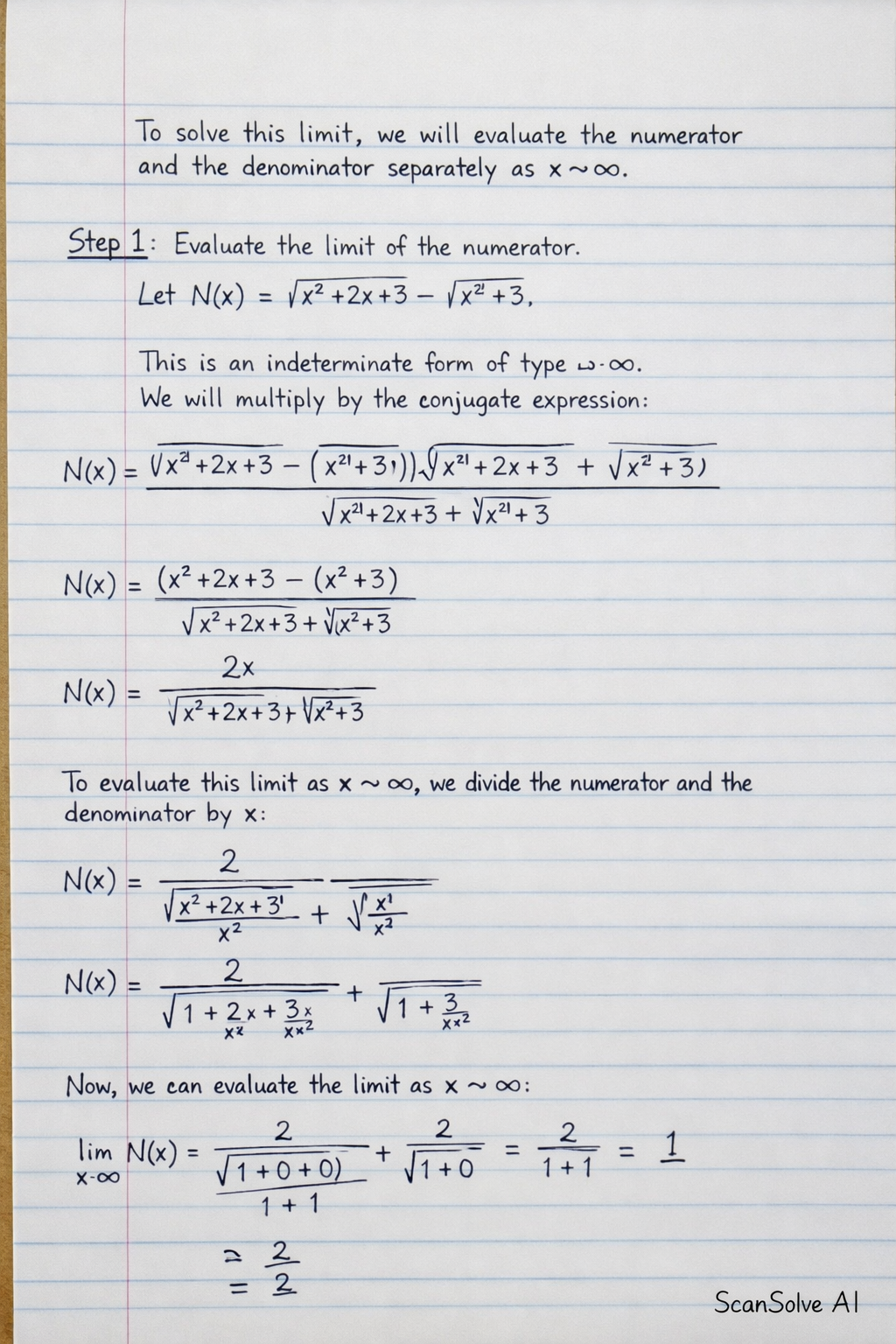
To solve this limit, we will evaluate the numerator and the denominator separately as x→∞.
Step 1: Evaluate the limit of the numerator.
Let N(x)=x2+2x+3−x2+3.
This is an indeterminate form of type ∞−∞. We will multiply by the conjugate expression:
N(x)=x2+2x+3+x2+3(x2+2x+3−x2+3)(x2+2x+3+x2+3)N(x)=x2+2x+3+x2+3(x2+2x+3)−(x2+3)N(x)=x2+2x+3+x2+32x
To evaluate this limit as x→∞, we divide the numerator and the denominator by x (noting that x2=x for x>0):
N(x)=x2x2+2x+3+x2x2+32N(x)=1+x2+x23+1+x232
Now, we can evaluate the limit as x→∞:
limx→∞N(x)=1+0+0+1+02=1+12=1
Step 2: Evaluate the limit of the denominator.
Let D(x)=1−cos(sin−1(tan(x1))).
Let u=x1. As x→∞, u→0+.
The denominator becomes:
D(u)=1−cos(sin−1(tan(u)))
As u→0+:
• tan(u)→tan(0)=0.
• sin−1(tan(u))→sin−1(0)=0.
• cos(sin−1(tan(u)))→cos(0)=1.
So, limu→0+D(u)=1−1=0.
Step 3: Determine the sign of the denominator as it approaches 0.
We use equivalent functions for u→0+:
• tan(u)∼u
• sin−1(v)∼v (for v→0)
So, sin−1(tan(u))∼tan(u)∼u.
Let w=sin−1(tan(u)). Then w∼u as u→0+.
• 1−cos(w)∼2w2 (for w→0)
Substituting w∼u, we get:
D(u)∼2u2.
Since u=x1, we have D(x)∼2(1/x)2=2x21.
As x→∞, 2x21 is always positive. Therefore, the denominator approaches 0 from the positive side (0+).
Step 4: Combine the limits of the numerator and the denominator.
The original limit is limx→∞D(x)N(x).
We found limx→∞N(x)=1.
We found limx→∞D(x)=0+.
Therefore, the limit is of the form 0+1, which tends to positive infinity.
limx→∞1−cos(sin−1(tan(x1)))x2+2x+3−x2+3=0+1=∞
The final answer is ∞.
Got more? Send 'em!
Was this helpful?
Need help with your own homework?
Get instant step-by-step solutions to any question. Free to start.
This mathematics problem involves applying core mathematical principles and formulas. Below you will find a complete step-by-step solution with detailed explanations for each step, helping you understand not just the answer but the method behind it.
ScanSolve AI Answer
To solve this limit, we will evaluate the numerator and the denominator separately as x . Step 1: Evaluate the limit of the numerator. Let N(x) = sqrt(x^2+2x+3) - sqrt(x^2+3). This is an indeterminate form of type - . We will multiply by the conjugate expression: N(x) = (sqrt(x^2+2x+3) - sqrt(x^2+3))(sqrt(x^2+2x+3) + sqrt(x^2+3))sqrt(x^2+2x+3) + sqrt(x^2+3) N(x) = ((x^2+2x+3) - (x^2+3))/(sqrt(x^2+2x+3) + x^2+3) N(x) = (2x)/(sqrt(x^2+2x+3) + x^2+3) To evaluate this limit as x , we divide the numerator and the denominator by x (noting that sqrt(x^2) = x for x > 0): N(x) = (2)/(sqrt(x^2+2x+3)x^2) + sqrt((x^2+3)/(x^2)) N(x) = (2)/(sqrt(1+2)x)+(3)/(x^2) + sqrt(1+(3)/(x^2)) Now, we can evaluate the limit as x : _x N(x) = (2)/(sqrt(1+0+0) + 1+0) = (2)/(1+1) = 1 Step 2: Evaluate the limit of the denominator. Let D(x) = 1 - (^-1(((1)/(x)))). Let u = (1)/(x). As x , u 0^+. The denominator becomes: D(u) = 1 - (^-1((u))) As u 0^+: • (u) (0) = 0. • ^-1((u)) ^-1(0) = 0. • (^-1((u))) (0) = 1. So, _u 0^+ D(u) = 1 - 1 = 0. Step 3: Determine the sign of the denominator as it approaches 0. We use equivalent functions for u 0^+: • (u) u • ^-1(v) v (for v 0) So, ^-1((u)) (u) u. Let w = ^-1((u)). Then w u as u 0^+. • 1 - (w) (w^2)/(2) (for w 0) Substituting w u, we get: D(u) (u^2)/(2). Since u = (1)/(x), we have D(x) ((1/x)^2)/(2) = (1)/(2x^2). As x , (1)/(2x^2) is always positive. Therefore, the denominator approaches 0 from the positive side (0^+). Step 4: Combine the limits of the numerator and the denominator. The original limit is _x (N(x))/(D(x)). We found _x N(x) = 1. We found _x D(x) = 0^+. Therefore, the limit is of the form (1)/(0^+), which tends to positive infinity. _x sqrt(x^2+2x+3) - sqrt(x^2+3)1 - (^-1(((1)/(x)))) = (1)/(0^+) = The final answer is . Got more? Send 'em!