
We read your photo as:
Use the given sine ratio formula.
ScanSolve AI Answer
Step-by-step solution
7 stepsHere are the solutions to the problems:
9. In a right-angled triangle, the opposite side to an angle is 7 cm and the hypotenuse is 14 cm. Using the sine ratio (), find the angle to the nearest degree.
Use the given sine ratio formula.
Substitute the given values into the formula.
Simplify the fraction.
To find the angle , take the inverse sine (arcsin) of .
The angle to the nearest degree is
10. A surveyor needs to find the height of a building. She stands 50 metres away from the base of the building and measures the angle of elevation to the top as .
This problem forms a right-angled triangle where the height of the building is the opposite side to the angle of elevation, and the distance from the base is the adjacent side.
We use the tangent ratio: .
Let be the height of the building.Multiply both sides by 50 m to solve for .
Calculate the value of and then multiply.
The height of the building is approximately
Still stuck on this one?
Ask a follow-up, and the answer starts from this question.
More Mathematics Questions
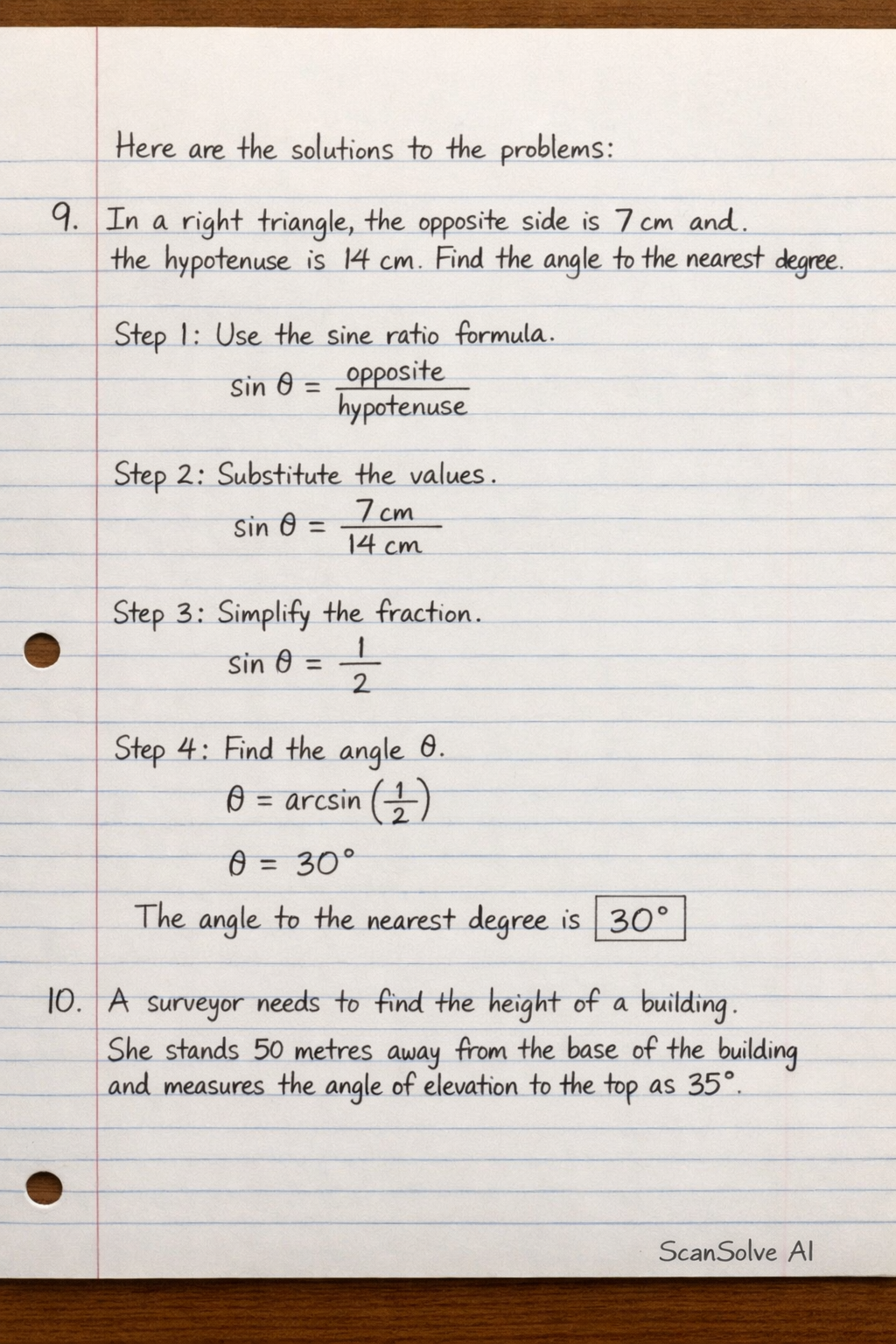
Handwritten Step-by-Step Solution
Get this as a handwritten image on WhatsApp — like a tutor wrote it for you.
Try on WhatsApp