We read your photo as:

Apply the binomial theorem.

Mathematics

ScanSolve AI Answer

Answers

2 parts
a

x5+10x4y+40x3y2+80x2y3+80xy4+32y5x^5 + 10x^4y + 40x^3y^2 + 80x^2y^3 + 80xy^4 + 32y^5

a(ii)
1.104

Step-by-step solution

5 steps

Here's the solution to your question:

Part a· 2 steps

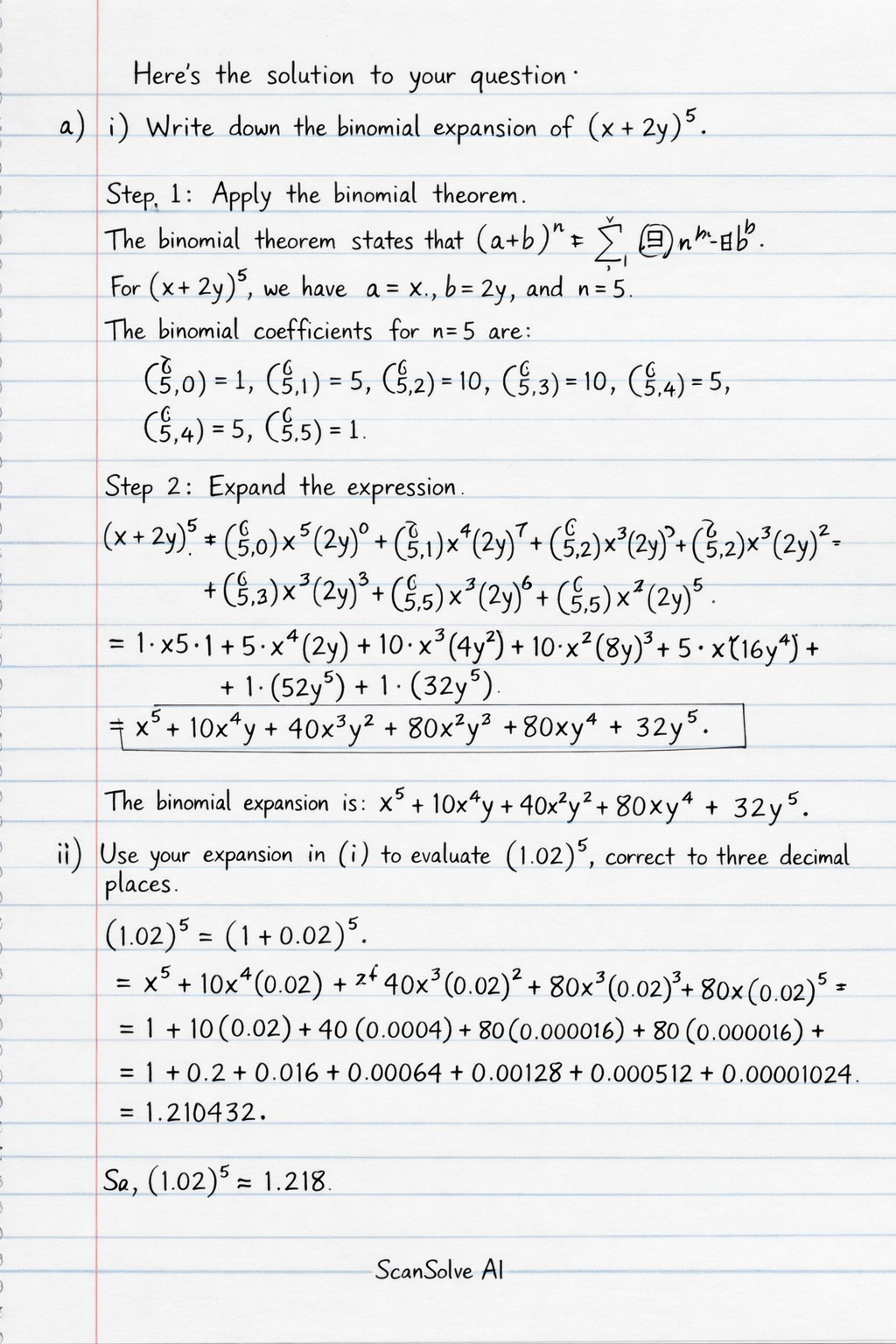
i) Write down the binomial expansion of (x+2y)5(x+2y)^5.

  1. Apply the binomial theorem.

    The binomial theorem states that (a+b)n=∑k=0n(nk)an−kbk(a+b)^n = \sum_{k=0}^{n} \binom{n}{k} a^{n-k} b^k.
    For (x+2y)5(x+2y)^5, we have a=xa=x, b=2yb=2y, and n=5n=5.
    The binomial coefficients for n=5n=5 are (50)=1\binom{5}{0}=1, (51)=5\binom{5}{1}=5, (52)=10\binom{5}{2}=10, (53)=10\binom{5}{3}=10, (54)=5\binom{5}{4}=5, (55)=1\binom{5}{5}=1.

  2. Expand the expression.

    (x+2y)5=(50)x5(2y)0+(51)x4(2y)1+(52)x3(2y)2+(53)x2(2y)3+(54)x1(2y)4+(55)x0(2y)5(x+2y)^5 = \binom{5}{0}x^5(2y)^0 + \binom{5}{1}x^4(2y)^1 + \binom{5}{2}x^3(2y)^2 + \binom{5}{3}x^2(2y)^3 + \binom{5}{4}x^1(2y)^4 + \binom{5}{5}x^0(2y)^5 (x+2y)5=1⋅x5⋅1+5⋅x4⋅(2y)+10⋅x3⋅(4y2)+10⋅x2⋅(8y3)+5⋅x⋅(16y4)+1⋅1⋅(32y5)(x+2y)^5 = 1 \cdot x^5 \cdot 1 + 5 \cdot x^4 \cdot (2y) + 10 \cdot x^3 \cdot (4y^2) + 10 \cdot x^2 \cdot (8y^3) + 5 \cdot x \cdot (16y^4) + 1 \cdot 1 \cdot (32y^5) (x+2y)5=x5+10x4y+40x3y2+80x2y3+80xy4+32y5(x+2y)^5 = x^5 + 10x^4y + 40x^3y^2 + 80x^2y^3 + 80xy^4 + 32y^5

    The binomial expansion is x5+10x4y+40x3y2+80x2y3+80xy4+32y5\boxed{x^5 + 10x^4y + 40x^3y^2 + 80x^2y^3 + 80xy^4 + 32y^5}.

Part a(ii)1.104

Use your expansion in (i) to evaluate (1.02)5(1.02)^5, correct to three decimal places.

  1. Relate (1.02)5(1.02)^5 to (x+2y)5(x+2y)^5.

    We can write 1.02 as 1+0.021 + 0.02.
    Comparing (x+2y)5(x+2y)^5 with (1+0.02)5(1+0.02)^5, we can set x=1x=1 and 2y=0.022y=0.02.
    From 2y=0.022y=0.02, we get y=0.01y=0.01.

  2. Substitute x=1x=1 and y=0.01y=0.01 into the expansion.

    (1.02)5=(1)5+10(1)4(0.01)+40(1)3(0.01)2+80(1)2(0.01)3+80(1)(0.01)4+32(0.01)5(1.02)^5 = (1)^5 + 10(1)^4(0.01) + 40(1)^3(0.01)^2 + 80(1)^2(0.01)^3 + 80(1)(0.01)^4 + 32(0.01)^5

    Calculate each term:

    (1)5=1(1)^5 = 1 10(1)4(0.01)=10×1×0.01=0.110(1)^4(0.01) = 10 \times 1 \times 0.01 = 0.1 40(1)3(0.01)2=40×1×0.0001=0.00440(1)^3(0.01)^2 = 40 \times 1 \times 0.0001 = 0.004 80(1)2(0.01)3=80×1×0.000001=0.0000880(1)^2(0.01)^3 = 80 \times 1 \times 0.000001 = 0.00008 80(1)(0.01)4=80×0.00000001=0.000000880(1)(0.01)^4 = 80 \times 0.00000001 = 0.0000008 32(0.01)5=32×0.0000000001=0.000000003232(0.01)^5 = 32 \times 0.0000000001 = 0.0000000032
  3. Sum the terms and round to three decimal places.

    (1.02)5=1+0.1+0.004+0.00008+0.0000008+0.0000000032(1.02)^5 = 1 + 0.1 + 0.004 + 0.00008 + 0.0000008 + 0.0000000032 (1.02)5=1.1040808032(1.02)^5 = 1.1040808032

    Rounding to three decimal places, we look at the fourth decimal place. Since it is 0 (which is less than 5), we keep the third decimal place as it is.

    (1.02)5≈1.104(1.02)^5 \approx 1.104

    The value of (1.02)5(1.02)^5 correct to three decimal places is 1.104\boxed{1.104}.

Was this helpful?

Try one yourself

A new problem that tests the same skill.

Still stuck on this one?

Ask a follow-up, and the answer starts from this question.

Got a different question?Ask your own question
Handwritten step-by-step solution preview

Handwritten Step-by-Step Solution

Get this as a handwritten image on WhatsApp — like a tutor wrote it for you.

Try on WhatsApp