
We read your photo as:
The exterior angle of a triangle is equal to the sum of its two non-adjacent interior angles. Let the unknown interior angle be x.
ScanSolve AI Answer
Step-by-step solution
18 stepsHere are the solutions to the problems:
1. An exterior angle of a triangle is . If one of the non-adjacent interior angles is , find the other non-adjacent interior angle.
The exterior angle of a triangle is equal to the sum of its two non-adjacent interior angles.
Let the unknown interior angle be .
Subtract from both sides to find .
The other non-adjacent interior angle is
2. A regular polygon has an interior angle of .
a) Explain why this polygon must have 10 sides.
Find the measure of one exterior angle.
The interior angle and exterior angle at any vertex of a polygon are supplementary.
For any regular polygon, the sum of its exterior angles is .
If is the number of sides, then each exterior angle is .
Solve for .
Therefore, the polygon must have 10 sides.
b) Justify your reasoning using the formula for the sum of interior angles: Sum = , where is the number of sides.
For a regular polygon, each interior angle is equal to the sum of interior angles divided by the number of sides, .
Set the given interior angle equal to the formula and solve for .
Multiply both sides by .
Rearrange the equation to solve for .
The polygon has
3. Two angles are supplementary. One angle measures . What is the measure of the other angle?
Supplementary angles add up to .
Let the unknown angle be .
Subtract from both sides to find .
The measure of the other angle is
4. A right-angled triangle has sides of 5 cm and 12 cm. Using the Pythagorean theorem, calculate the length of the hypotenuse.
The Pythagorean theorem states that for a right-angled triangle, , where and are the lengths of the two shorter sides (legs), and is the length of the hypotenuse.
Let cm and cm.
Calculate the squares of the sides.
Add the values and find the square root to get .
The length of the hypotenuse is
5. A ladder is leaning against a wall. The ladder is 10 metres long, and the base of the ladder is 6 metres away from the wall.
a) Calculate the height the ladder reaches on the wall.
This scenario forms a right-angled triangle.
The ladder is the hypotenuse (), the distance from the wall is one leg (), and the height the ladder reaches on the wall is the other leg ().
Using the Pythagorean theorem: .
Given: m, m. We need to find .Calculate the squares.
Subtract 36 from both sides.
Take the square root to find .
The height the ladder reaches on the wall is
Still stuck on this one?
Ask a follow-up, and the answer starts from this question.
More Mathematics Questions
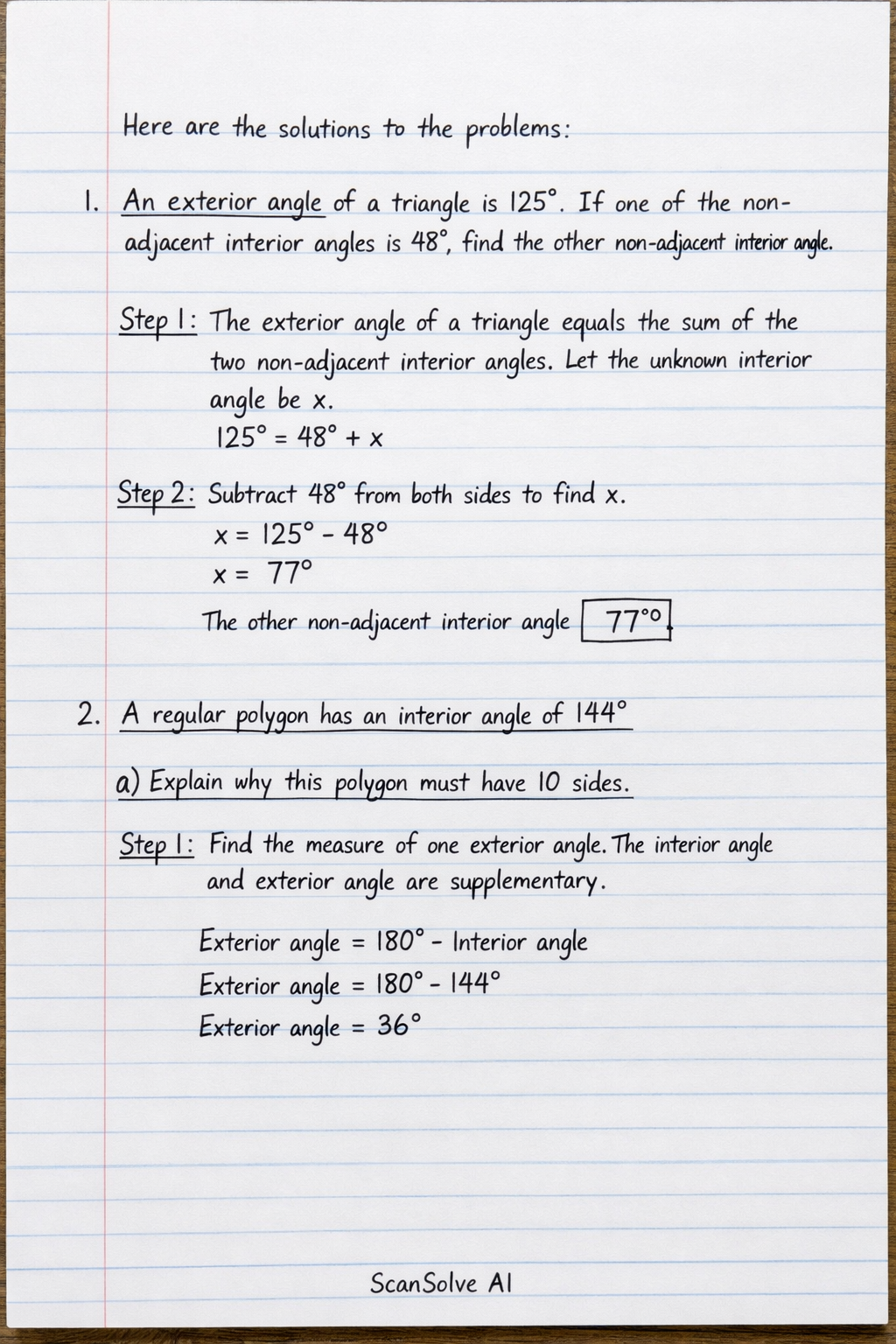
Handwritten Step-by-Step Solution
Get this as a handwritten image on WhatsApp — like a tutor wrote it for you.
Try on WhatsApp