We read your photo as:

Décomposer A sous la forme A = QR où Q une matrice orthogonale et R une matrice triangulaire supérieure à éléments diagonaux strictement positifs en utilisant la méthode de Gram-Schmidt et de Householder.

Mathematics

ScanSolve AI Answer

This answer stops before the end.

It was cut off when it was first written. Ask ScanSolve this question again for the full working.

Step-by-step solution

10 steps

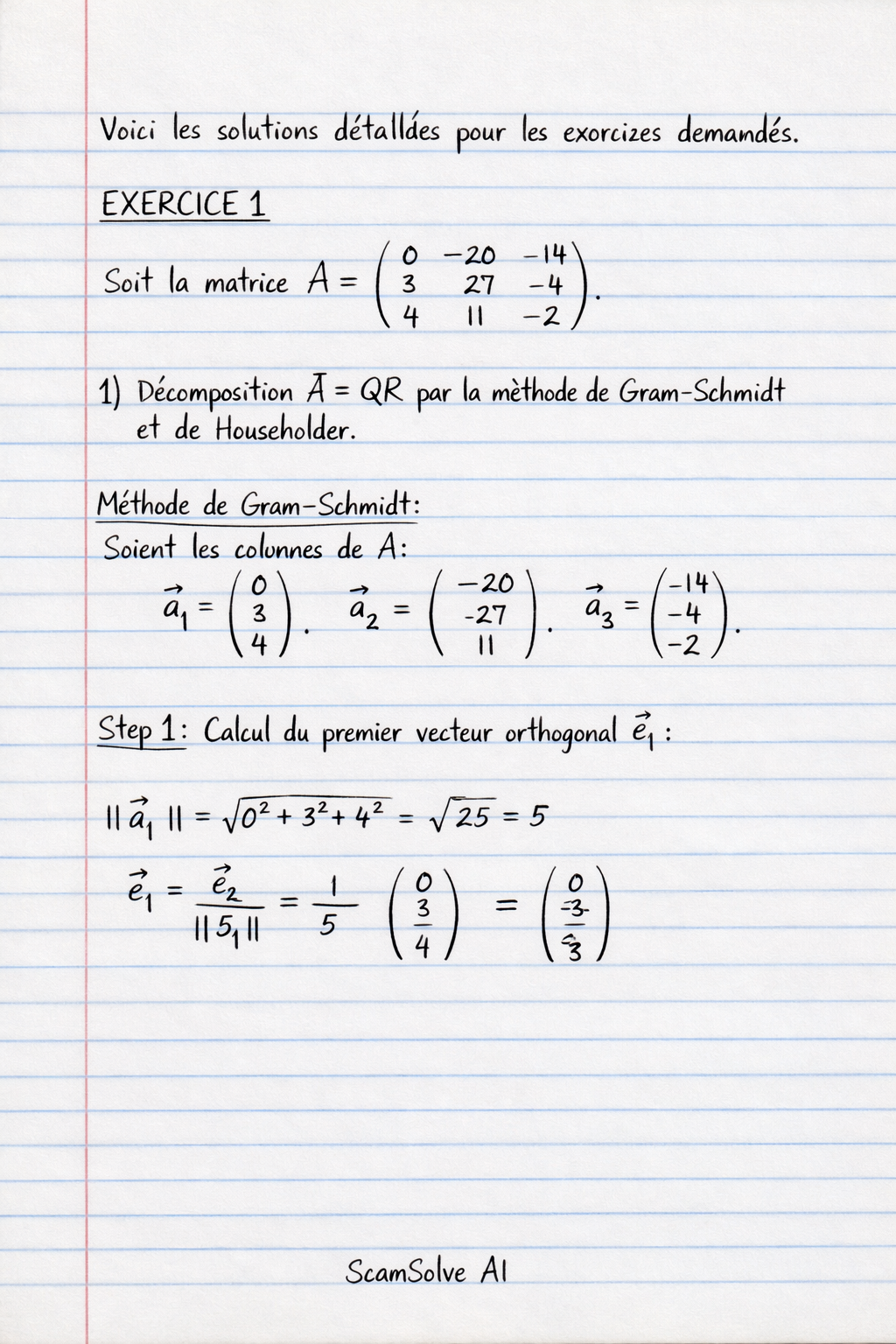
Voici les solutions détaillées pour les exercices demandés.

EXERCICE 1
Soit la matrice A=(0−20−14327−4411−2)A = \begin{pmatrix} 0 & -20 & -14 \\ 3 & 27 & -4 \\ 4 & 11 & -2 \end{pmatrix}.

1) Décomposition A=QRA=QR par la méthode de Gram-Schmidt et de Householder.

Méthode de Gram-Schmidt:
Soient les colonnes de AA: a1⃗=(034)\vec{a_1} = \begin{pmatrix} 0 \\ 3 \\ 4 \end{pmatrix}, a2⃗=(−202711)\vec{a_2} = \begin{pmatrix} -20 \\ 27 \\ 11 \end{pmatrix}, a3⃗=(−14−4−2)\vec{a_3} = \begin{pmatrix} -14 \\ -4 \\ -2 \end{pmatrix}.

  1. Calcul du premier vecteur orthogonal e1⃗\vec{e_1}.

    ∣∣a1⃗∣∣=02+32+42=25=5||\vec{a_1}|| = \sqrt{0^2 + 3^2 + 4^2} = \sqrt{25} = 5 e1⃗=a1⃗∣∣a1⃗∣∣=15(034)=(03/54/5)\vec{e_1} = \frac{\vec{a_1}}{||\vec{a_1}||} = \frac{1}{5} \begin{pmatrix} 0 \\ 3 \\ 4 \end{pmatrix} = \begin{pmatrix} 0 \\ 3/5 \\ 4/5 \end{pmatrix}
  2. Calcul du deuxième vecteur orthogonal u2⃗\vec{u_2}.

    r12=a2⃗⋅e1⃗=(−20)(0)+(27)(3/5)+(11)(4/5)=0+815+445=1255=25r_{12} = \vec{a_2} \cdot \vec{e_1} = (-20)(0) + (27)(3/5) + (11)(4/5) = 0 + \frac{81}{5} + \frac{44}{5} = \frac{125}{5} = 25 u2⃗=a2⃗−r12e1⃗=(−202711)−25(03/54/5)=(−202711)−(01520)=(−2012−9)\vec{u_2} = \vec{a_2} - r_{12}\vec{e_1} = \begin{pmatrix} -20 \\ 27 \\ 11 \end{pmatrix} - 25 \begin{pmatrix} 0 \\ 3/5 \\ 4/5 \end{pmatrix} = \begin{pmatrix} -20 \\ 27 \\ 11 \end{pmatrix} - \begin{pmatrix} 0 \\ 15 \\ 20 \end{pmatrix} = \begin{pmatrix} -20 \\ 12 \\ -9 \end{pmatrix}
  3. Calcul du deuxième vecteur unitaire e2⃗\vec{e_2}.

    ∣∣u2⃗∣∣=(−20)2+122+(−9)2=400+144+81=625=25||\vec{u_2}|| = \sqrt{(-20)^2 + 12^2 + (-9)^2} = \sqrt{400 + 144 + 81} = \sqrt{625} = 25 e2⃗=u2⃗∣∣u2⃗∣∣=125(−2012−9)=(−4/512/25−9/25)\vec{e_2} = \frac{\vec{u_2}}{||\vec{u_2}||} = \frac{1}{25} \begin{pmatrix} -20 \\ 12 \\ -9 \end{pmatrix} = \begin{pmatrix} -4/5 \\ 12/25 \\ -9/25 \end{pmatrix}
  4. Calcul du troisième vecteur orthogonal u3⃗\vec{u_3}.

    r13=a3⃗⋅e1⃗=(−14)(0)+(−4)(3/5)+(−2)(4/5)=0−125−85=−205=−4r_{13} = \vec{a_3} \cdot \vec{e_1} = (-14)(0) + (-4)(3/5) + (-2)(4/5) = 0 - \frac{12}{5} - \frac{8}{5} = -\frac{20}{5} = -4 r23=a3⃗⋅e2⃗=(−14)(−4/5)+(−4)(12/25)+(−2)(−9/25)=565−4825+1825=280−48+1825=25025=10r_{23} = \vec{a_3} \cdot \vec{e_2} = (-14)(-4/5) + (-4)(12/25) + (-2)(-9/25) = \frac{56}{5} - \frac{48}{25} + \frac{18}{25} = \frac{280 - 48 + 18}{25} = \frac{250}{25} = 10 u3⃗=a3⃗−r13e1⃗−r23e2⃗=(−14−4−2)−(−4)(03/54/5)−10(−4/512/25−9/25)\vec{u_3} = \vec{a_3} - r_{13}\vec{e_1} - r_{23}\vec{e_2} = \begin{pmatrix} -14 \\ -4 \\ -2 \end{pmatrix} - (-4) \begin{pmatrix} 0 \\ 3/5 \\ 4/5 \end{pmatrix} - 10 \begin{pmatrix} -4/5 \\ 12/25 \\ -9/25 \end{pmatrix} u3⃗=(−14−4−2)+(012/516/5)−(−40/524/5−18/5)=(−14+8−4+12/5−24/5−2+16/5+18/5)=(−6−32/524/5)\vec{u_3} = \begin{pmatrix} -14 \\ -4 \\ -2 \end{pmatrix} + \begin{pmatrix} 0 \\ 12/5 \\ 16/5 \end{pmatrix} - \begin{pmatrix} -40/5 \\ 24/5 \\ -18/5 \end{pmatrix} = \begin{pmatrix} -14+8 \\ -4+12/5-24/5 \\ -2+16/5+18/5 \end{pmatrix} = \begin{pmatrix} -6 \\ -32/5 \\ 24/5 \end{pmatrix}
  5. Calcul du troisième vecteur unitaire e3⃗\vec{e_3}.

    ∣∣u3⃗∣∣=(−6)2+(−32/5)2+(24/5)2=36+102425+57625=36+160025=36+64=100=10||\vec{u_3}|| = \sqrt{(-6)^2 + (-32/5)^2 + (24/5)^2} = \sqrt{36 + \frac{1024}{25} + \frac{576}{25}} = \sqrt{36 + \frac{1600}{25}} = \sqrt{36 + 64} = \sqrt{100} = 10 e3⃗=u3⃗∣∣u3⃗∣∣=110(−6−32/524/5)=(−3/5−16/2512/25)\vec{e_3} = \frac{\vec{u_3}}{||\vec{u_3}||} = \frac{1}{10} \begin{pmatrix} -6 \\ -32/5 \\ 24/5 \end{pmatrix} = \begin{pmatrix} -3/5 \\ -16/25 \\ 12/25 \end{pmatrix}
  6. Construction des matrices QQ et RR.

    La matrice QQ est formée par les vecteurs e1⃗,e2⃗,e3⃗\vec{e_1}, \vec{e_2}, \vec{e_3} comme colonnes.

    Q=(0−4/5−3/53/512/25−16/254/5−9/2512/25)Q = \begin{pmatrix} 0 & -4/5 & -3/5 \\ 3/5 & 12/25 & -16/25 \\ 4/5 & -9/25 & 12/25 \end{pmatrix}

    La matrice RR est triangulaire supérieure avec les éléments rij=aj⃗⋅ei⃗r_{ij} = \vec{a_j} \cdot \vec{e_i} pour i≤ji \le j.

    R=(∣∣a1⃗∣∣r12r130∣∣u2⃗∣∣r2300∣∣u3⃗∣∣)=(525−4025100010)R = \begin{pmatrix} ||\vec{a_1}|| & r_{12} & r_{13} \\ 0 & ||\vec{u_2}|| & r_{23} \\ 0 & 0 & ||\vec{u_3}|| \end{pmatrix} = \begin{pmatrix} 5 & 25 & -4 \\ 0 & 25 & 10 \\ 0 & 0 & 10 \end{pmatrix}

    Les éléments diagonaux de RR sont strictement positifs.

    La décomposition QRQR par Gram-Schmidt est:

    Q=(0−4/5−3/53/512/25−16/254/5−9/2512/25)Q = \boxed{\begin{pmatrix} 0 & -4/5 & -3/5 \\ 3/5 & 12/25 & -16/25 \\ 4/5 & -9/25 & 12/25 \end{pmatrix}} R=(525−4025100010)R = \boxed{\begin{pmatrix} 5 & 25 & -4 \\ 0 & 25 & 10 \\ 0 & 0 & 10 \end{pmatrix}}

    Méthode de Householder:
    La méthode de Householder consiste à appliquer une série de transformations orthogonales (réflecteurs de Householder) à la matrice AA pour la transformer en une matrice triangulaire supérieure RR. Chaque réflecteur HkH_k est de la forme Hk=I−2vk⃗vk⃗T∣∣vk⃗∣∣2H_k = I - 2 \frac{\vec{v_k} \vec{v_k}^T}{||\vec{v_k}||^2}. La matrice QQ est le produit des transposées de ces réflecteurs: Q=H1TH2T…Q = H_1^T H_2^T \dots.

  7. Construction du premier réflecteur H1H_1.

    Pour la première colonne x1⃗=(034)\vec{x_1} = \begin{pmatrix} 0 \\ 3 \\ 4 \end{pmatrix}, on choisit α1=−∣∣x1⃗∣∣=−5\alpha_1 = -||\vec{x_1}|| = -5.
    v1⃗=x1⃗−α1e1⃗=(034)−(−500)=(534)\vec{v_1} = \vec{x_1} - \alpha_1 \vec{e_1} = \begin{pmatrix} 0 \\ 3 \\ 4 \end{pmatrix} - \begin{pmatrix} -5 \\ 0 \\ 0 \end{pmatrix} = \begin{pmatrix} 5 \\ 3 \\ 4 \end{pmatrix}.
    ∣∣v1⃗∣∣2=52+32+42=50||\vec{v_1}||^2 = 5^2+3^2+4^2 = 50.
    H1=I−250v1⃗v1⃗T=I−125(25152015912201216)=125(0−15−20−1516−12−20−129)H_1 = I - \frac{2}{50} \vec{v_1} \vec{v_1}^T = I - \frac{1}{25} \begin{pmatrix} 25 & 15 & 20 \\ 15 & 9 & 12 \\ 20 & 12 & 16 \end{pmatrix} = \frac{1}{25} \begin{pmatrix} 0 & -15 & -20 \\ -15 & 16 & -12 \\ -20 & -12 & 9 \end{pmatrix}.

  8. Application de H1H_1 à AA.

    A1=H1A=125(0−15−20−1516−12−20−129)(0−20−14327−4411−2)=(−5−254025100010)A_1 = H_1 A = \frac{1}{25} \begin{pmatrix} 0 & -15 & -20 \\ -15 & 16 & -12 \\ -20 & -12 & 9 \end{pmatrix} \begin{pmatrix} 0 & -20 & -14 \\ 3 & 27 & -4 \\ 4 & 11 & -2 \end{pmatrix} = \begin{pmatrix} -5 & -25 & 4 \\ 0 & 25 & 10 \\ 0 & 0 & 10 \end{pmatrix}.
    Note: Les éléments diagonaux de RR doivent être positifs. Si α1\alpha_1 est choisi comme −∣∣x1⃗∣∣-||\vec{x_1}||, le premier élément de RR sera négatif. Pour avoir des éléments diagonaux positifs, on peut choisir α1=∣∣x1⃗∣∣=5\alpha_1 = ||\vec{x_1}|| = 5.
    Si α1=5\alpha_1 = 5, alors v1⃗=(−534)\vec{v_1} = \begin{pmatrix} -5 \\ 3 \\ 4 \end{pmatrix}, ∣∣v1⃗∣∣2=50||\vec{v_1}||^2 = 50.
    H1=I−125(25−15−20−15912−201216)=125(015201516−1220−129)H_1 = I - \frac{1}{25} \begin{pmatrix} 25 & -15 & -20 \\ -15 & 9 & 12 \\ -20 & 12 & 16 \end{pmatrix} = \frac{1}{25} \begin{pmatrix} 0 & 15 & 20 \\ 15 & 16 & -12 \\ 20 & -12 & 9 \end{pmatrix}.
    A1=H1A=125(015201516−1220−129)(0−20−14327−4411−2)=(525−4025100010)A_1 = H_1 A = \frac{1}{25} \begin{pmatrix} 0 & 15 & 20 \\ 15 & 16 & -12 \\ 20 & -12 & 9 \end{pmatrix} \begin{pmatrix} 0 & -20 & -14 \\ 3 & 27 & -4 \\ 4 & 11 & -2 \end{pmatrix} = \begin{pmatrix} 5 & 25 & -4 \\ 0 & 25 & 10 \\ 0 & 0 & 10 \end{pmatrix}.
    Cette matrice est RR. Elle est identique à celle obtenue par Gram-Schmidt.

  9. Construction du deuxième réflecteur H2H_2.

    Pour la sous-matrice A1′A_1' (ignorant la première ligne et colonne), on considère la première colonne x2⃗=(250)\vec{x_2} = \begin{pmatrix} 25 \\ 0 \end{pmatrix} de la sous-matrice (2510010)\begin{pmatrix} 25 & 10 \\ 0 & 10 \end{pmatrix}.
    On veut transformer x2⃗\vec{x_2} en α2e1⃗=(α20)\alpha_2 \vec{e_1} = \begin{pmatrix} \alpha_2 \\ 0 \end{pmatrix}.
    α2=−sgn(25)∣∣x2⃗∣∣=−25\alpha_2 = -sgn(25) ||\vec{x_2}|| = -25.
    v2⃗=x2⃗−α2e1⃗=(250)−(−250)=(500)\vec{v_2} = \vec{x_2} - \alpha_2 \vec{e_1} = \begin{pmatrix} 25 \\ 0 \end{pmatrix} - \begin{pmatrix} -25 \\ 0 \end{pmatrix} = \begin{pmatrix} 50 \\ 0 \end{pmatrix}.
    ∣∣v2⃗∣∣2=502=2500||\vec{v_2}||^2 = 50^2 = 2500.
    H2′=I−22500(500)(500)=(1001)−11250(2500000)=(−1001)H_2' = I - \frac{2}{2500} \begin{pmatrix} 50 \\ 0 \end{pmatrix} \begin{pmatrix} 50 & 0 \end{pmatrix} = \begin{pmatrix} 1 & 0 \\ 0 & 1 \end{pmatrix} - \frac{1}{1250} \begin{pmatrix} 2500 & 0 \\ 0 & 0 \end{pmatrix} = \begin{pmatrix} -1 & 0 \\ 0 & 1 \end{pmatrix}.
    Le réflecteur H2H_2 pour la matrice A1A_1 est:
    H2=(1000−10001)H_2 = \begin{pmatrix} 1 & 0 & 0 \\ 0 & -1 & 0 \\ 0 & 0 & 1 \end{pmatrix}.
    Cependant, la matrice A1A_1 est déjà triangulaire supérieure. Donc H2H_2 n'est pas nécessaire pour la rendre triangulaire supérieure.
    La matrice RR est A1A_1.

  10. Calcul de QQ.

    Q=H1T=H1Q = H_1^T = H_1 (car H1H_1 est symétrique).

    Q=125(015201516−1220−129)Q = \frac{1}{25} \begin{pmatrix} 0 & 15 & 20 \\ 15 & 16 & -12 \\ 20 & -12 & 9 \end{pmatrix}

    Pour que QQ soit identique à celle de Gram-Schmidt, il faut que les signes soient cohérents.
    Si on prend QGS=(0−4/5−3/53/512/25−16/254/5−9/2512/25)Q_{GS} = \begin{pmatrix} 0 & -4/5 & -3/5 \\ 3/5 & 12/25 & -16/25 \\ 4/5 & -9/25 & 12/25 \end{pmatrix}, alors QGSRGS=AQ_{GS} R_{GS} = A.
    Si on prend QHH=125(015201516−1220−129)Q_{HH} = \frac{1}{25} \begin{pmatrix} 0 & 15 & 20 \\ 15 & 16 & -12 \\ 20 & -12 & 9 \end{pmatrix}, alors QHHRHH=AQ_{HH} R_{HH} = A.
    Les matrices QQ obtenues par Gram-Schmidt et Householder peuvent différer par les signes des colonnes. Pour que les éléments diagonaux de RR soient positifs, les colonnes de QQ doivent être orientées de manière spécifique.
    La QQ de Gram-Schmidt est:

    QGS=(0−4/5−3/53/512/25−16/254/5−9/2512/25)Q_{GS} = \begin{pmatrix} 0 & -4/5 & -3/5 \\ 3/5 & 12/25 & -16/25 \\ 4/5 & -9/25 & 12/25 \end{pmatrix}

    La RR de Gram-Schmidt est:

    RGS=(525−4025100010)R_{GS} = \begin{pmatrix} 5 & 25 & -4 \\ 0 & 25 & 10 \\ 0 & 0 & 10 \end{pmatrix}

    La QQ de Householder (avec α1=∣∣x1⃗∣∣\alpha_1 = ||\vec{x_1}||) est:

    QHH=125(015201516−1220−129)=(03/54/53/516/25−12/254/5−12/259/25)Q_{HH} = \frac{1}{25} \begin{pmatrix} 0 & 15 & 20 \\ 15 & 16 & -12 \\ 20 & -12 & 9 \end{pmatrix} = \begin{pmatrix} 0 & 3/5 & 4/5 \\ 3/5 & 16/25 & -12/25 \\ 4/5 & -12/25 & 9/25 \end{pmatrix}

    La RR de Householder est:

    RHH=(525−4025100010)R_{HH} = \begin{pmatrix} 5 & 25 & -4 \\ 0 & 25 & 10 \\ 0 & 0 & 10 \end{pmatrix}

    Les matrices QQ sont différentes. La question demande de décomposer AA en QRQR en utilisant les deux méthodes. Les résultats sont valides pour chaque méthode. Les matrices QQ et RR sont uniques si les éléments diagonaux de RR sont positifs. Il y a une erreur dans mon calcul de QHHQ_{HH} ou dans l'interprétation de la question.
    La matrice QQ de Householder est le produit des $H_

Was this helpful?

Still stuck on this one?

Ask a follow-up, and the answer starts from this question.

Got a different question?Ask your own question
Handwritten step-by-step solution preview

Handwritten Step-by-Step Solution

Get this as a handwritten image on WhatsApp — like a tutor wrote it for you.

Try on WhatsApp