We read your photo as:

By the method of completing the square, obtain the roots of the following: x2 + 6x + 8 = 0 x2 − 4x − 5 = 0 x2 − 12x + 35 = 0 3x2 − 12x + 7 = 0 2x2 + 8x + 5 = 0

Mathematics

ScanSolve AI Answer

Answers

4 parts
f
-2, -4
g
5, -1
h
7, 5
h(i)

6±153\frac{6 \pm \sqrt{15}}{3}

−4±62\frac{-4 \pm \sqrt{6}}{2}

Step-by-step solution

27 steps

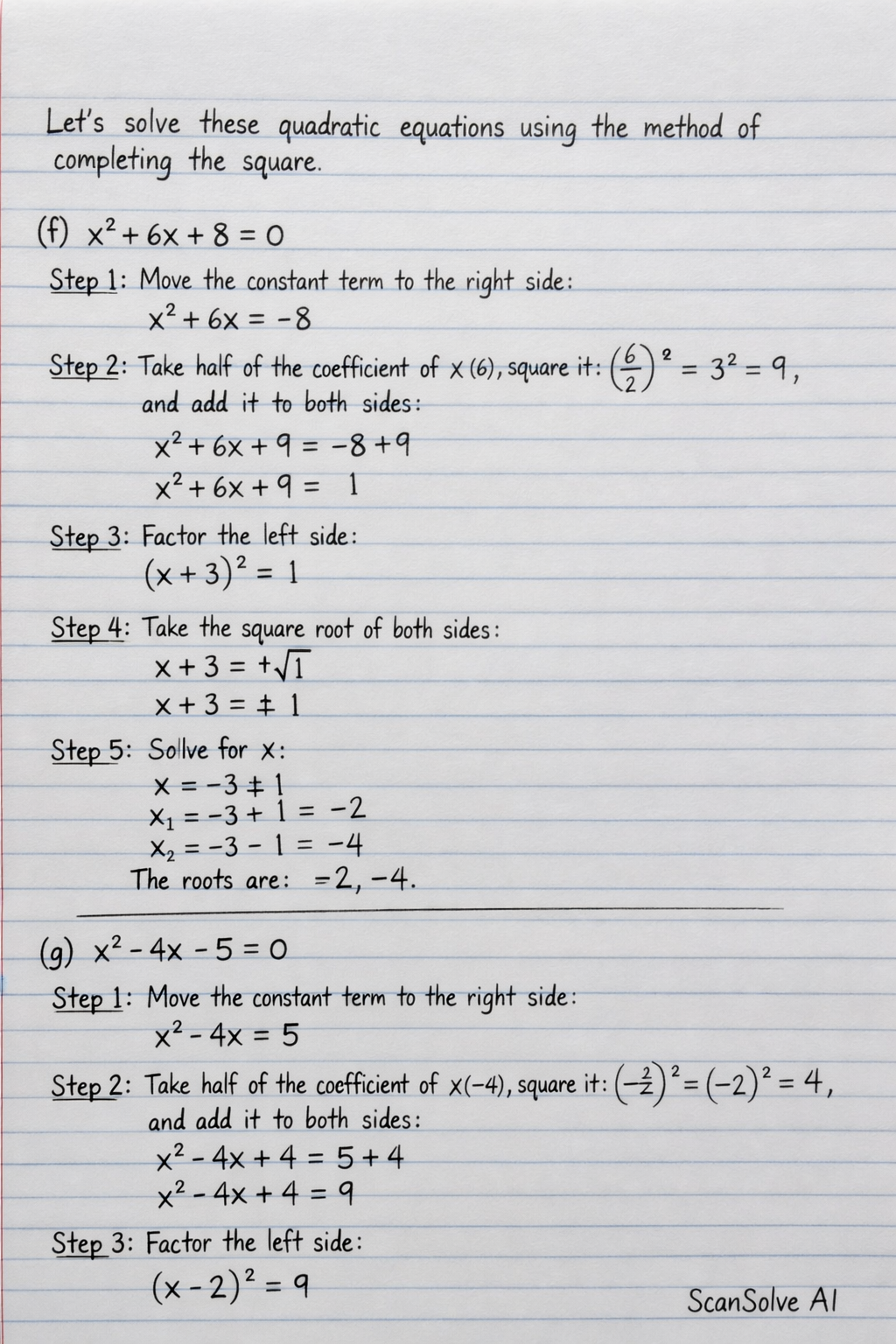
Let's solve these quadratic equations using the method of completing the square.

Part f· 5 steps

x2+6x+8=0x^2 + 6x + 8 = 0

  1. Move the constant term to the right side of the equation.

    x2+6x=−8x^2 + 6x = -8
  2. Take half of the coefficient of xx (which is 6), square it ((6/2)2=32=9(6/2)^2 = 3^2 = 9), and add it to both sides.

    x2+6x+9=−8+9x^2 + 6x + 9 = -8 + 9
  3. Factor the left side as a perfect square trinomial and simplify the right side.

    (x+3)2=1(x + 3)^2 = 1
  4. Take the square root of both sides.

    x+3=±1x + 3 = \pm\sqrt{1} x+3=±1x + 3 = \pm 1
  5. Solve for xx.

    x=−3±1x = -3 \pm 1 x1=−3+1=−2x_1 = -3 + 1 = -2 x2=−3−1=−4x_2 = -3 - 1 = -4

    The roots are −2,−4\boxed{-2, -4}.


Part g5, -1

x2−4x−5=0x^2 - 4x - 5 = 0

  1. Move the constant term to the right side of the equation.

    x2−4x=5x^2 - 4x = 5
  2. Take half of the coefficient of xx (which is −4-4), square it ((−4/2)2=(−2)2=4(-4/2)^2 = (-2)^2 = 4), and add it to both sides.

    x2−4x+4=5+4x^2 - 4x + 4 = 5 + 4
  3. Factor the left side as a perfect square trinomial and simplify the right side.

    (x−2)2=9(x - 2)^2 = 9
  4. Take the square root of both sides.

    x−2=±9x - 2 = \pm\sqrt{9} x−2=±3x - 2 = \pm 3
  5. Solve for xx.

    x=2±3x = 2 \pm 3 x1=2+3=5x_1 = 2 + 3 = 5 x2=2−3=−1x_2 = 2 - 3 = -1

    The roots are 5,−1\boxed{5, -1}.


Part h7, 5

x2−12x+35=0x^2 - 12x + 35 = 0

  1. Move the constant term to the right side of the equation.

    x2−12x=−35x^2 - 12x = -35
  2. Take half of the coefficient of xx (which is −12-12), square it ((−12/2)2=(−6)2=36(-12/2)^2 = (-6)^2 = 36), and add it to both sides.

    x2−12x+36=−35+36x^2 - 12x + 36 = -35 + 36
  3. Factor the left side as a perfect square trinomial and simplify the right side.

    (x−6)2=1(x - 6)^2 = 1
  4. Take the square root of both sides.

    x−6=±1x - 6 = \pm\sqrt{1} x−6=±1x - 6 = \pm 1
  5. Solve for xx.

    x=6±1x = 6 \pm 1 x1=6+1=7x_1 = 6 + 1 = 7 x2=6−1=5x_2 = 6 - 1 = 5

    The roots are 7,5\boxed{7, 5}.


Part h(i)

6±153\frac{6 \pm \sqrt{15}}{3}

3x2−12x+7=03x^2 - 12x + 7 = 0

  1. Divide the entire equation by the coefficient of x2x^2 (which is 3).

    x2−4x+73=0x^2 - 4x + \frac{7}{3} = 0
  2. Move the constant term to the right side of the equation.

    x2−4x=−73x^2 - 4x = -\frac{7}{3}
  3. Take half of the coefficient of xx (which is −4-4), square it ((−4/2)2=(−2)2=4(-4/2)^2 = (-2)^2 = 4), and add it to both sides.

    x2−4x+4=−73+4x^2 - 4x + 4 = -\frac{7}{3} + 4 x2−4x+4=−73+123x^2 - 4x + 4 = -\frac{7}{3} + \frac{12}{3} x2−4x+4=53x^2 - 4x + 4 = \frac{5}{3}
  4. Factor the left side as a perfect square trinomial.

    (x−2)2=53(x - 2)^2 = \frac{5}{3}
  5. Take the square root of both sides.

    x−2=±53x - 2 = \pm\sqrt{\frac{5}{3}} x−2=±53x - 2 = \pm\frac{\sqrt{5}}{\sqrt{3}} x−2=±533x - 2 = \pm\frac{\sqrt{5}\sqrt{3}}{3} x−2=±153x - 2 = \pm\frac{\sqrt{15}}{3}
  6. Solve for xx.

    x=2±153x = 2 \pm\frac{\sqrt{15}}{3} x=6±153x = \frac{6 \pm \sqrt{15}}{3}

    The roots are 6±153\boxed{\frac{6 \pm \sqrt{15}}{3}}.


    (j) 2x2+8x+5=02x^2 + 8x + 5 = 0

  7. Divide the entire equation by the coefficient of x2x^2 (which is 2).

    x2+4x+52=0x^2 + 4x + \frac{5}{2} = 0
  8. Move the constant term to the right side of the equation.

    x2+4x=−52x^2 + 4x = -\frac{5}{2}
  9. Take half of the coefficient of xx (which is 4), square it ((4/2)2=22=4(4/2)^2 = 2^2 = 4), and add it to both sides.

    x2+4x+4=−52+4x^2 + 4x + 4 = -\frac{5}{2} + 4 x2+4x+4=−52+82x^2 + 4x + 4 = -\frac{5}{2} + \frac{8}{2} x2+4x+4=32x^2 + 4x + 4 = \frac{3}{2}
  10. Factor the left side as a perfect square trinomial.

    (x+2)2=32(x + 2)^2 = \frac{3}{2}
  11. Take the square root of both sides.

    x+2=±32x + 2 = \pm\sqrt{\frac{3}{2}} x+2=±32x + 2 = \pm\frac{\sqrt{3}}{\sqrt{2}} x+2=±322x + 2 = \pm\frac{\sqrt{3}\sqrt{2}}{2} x+2=±62x + 2 = \pm\frac{\sqrt{6}}{2}
  12. Solve for xx.

    x=−2±62x = -2 \pm\frac{\sqrt{6}}{2} x=−4±62x = \frac{-4 \pm \sqrt{6}}{2}

    The roots are −4±62\boxed{\frac{-4 \pm \sqrt{6}}{2}}.

Was this helpful?

Try one yourself

A new problem that tests the same skill.

Still stuck on this one?

Ask a follow-up, and the answer starts from this question.

Got a different question?Ask your own question
Handwritten step-by-step solution preview

Handwritten Step-by-Step Solution

Get this as a handwritten image on WhatsApp — like a tutor wrote it for you.

Try on WhatsApp