
We read your photo as:
Use completing square method to solve the equation 3x2 − 7x + 2 = 0.
ScanSolve AI Answer
This answer stops before the end.
It was cut off when it was first written. Ask ScanSolve this question again for the full working.
Here are the solutions for questions 1, 2, and 3.
Question 1:
Use completing square method to solve the equation .
Step 1: Divide the entire equation by the coefficient of , which is 3.
Step 2: Move the constant term to the right side of the equation.
Step 3: Complete the square on the left side. Take half of the coefficient of and square it. Add this value to both sides of the equation.
The coefficient of is .
Half of it is .
Squaring it gives .
Step 4: Factor the left side as a perfect square and simplify the right side.
Step 5: Take the square root of both sides. Remember to include both positive and negative roots.
Step 6: Solve for for both positive and negative cases.
Case 1:
Case 2:
The solutions are .
Question 2:
Momanyi spent one eighth of his February Salary on farming, half on school fees and two thirds of the remainder on food. Calculate his February salary and the amount he spent on school fees if he spent sh. 3200 on food.
Step 1: Let Momanyi's total February salary be .
Amount spent on farming = .
Amount spent on school fees = .
Step 2: Calculate the total fraction of salary spent on farming and school fees.
Step 3: Calculate the remainder of the salary after farming and school fees.
Step 4: Calculate the amount spent on food. This is two thirds of the remainder, and it is given as KSh 3200.
Step 5: Solve for the total salary .
Momanyi's February salary is KSh 12,800.
Step 6: Calculate the amount spent on school fees.
Momanyi's February salary is and the amount he spent on school fees is .
Question 3:
Makau, Wanjiru and Kemboi start a race at 9:03 a.m in the same direction to run round a circular course. Makau makes the circuit in 252 seconds, Wanjiru in 308 seconds and Kemboi in 198 seconds. If they start from the same point, at what time will they next be all at the starting point together?
Step 1: To find when they will next meet at the starting point, calculate the Least Common Multiple (LCM) of their individual circuit times: 252 seconds, 308 seconds, and 198 seconds.
Find the prime factorization of each number:
Step 2: Calculate the LCM by taking the highest power of each prime factor present in any of the numbers.
Step 3: Convert the total time in seconds to minutes and seconds.
This means 46 full minutes and 0.2 of a minute.
So, they will meet again after 46 minutes and 12 seconds.
Step 4: Add this duration to the starting time (9:03 a.m.).
Starting time: 9 hours, 3 minutes, 0 seconds
Time to meet: 0 hours, 46 minutes, 12 seconds
Still stuck on this one?
Ask a follow-up, and the answer starts from this question.
More Mathematics Questions
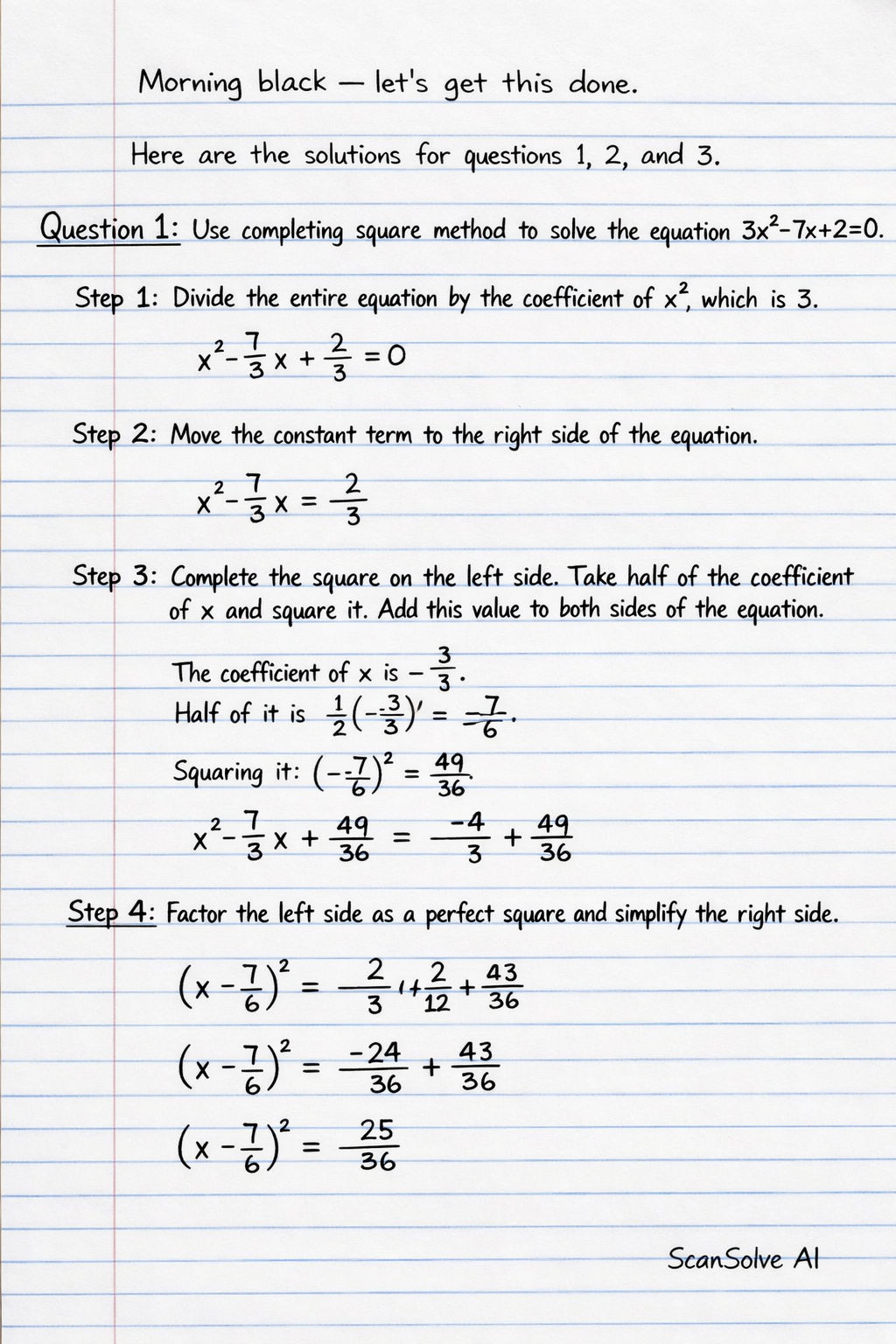
Handwritten Step-by-Step Solution
Get this as a handwritten image on WhatsApp — like a tutor wrote it for you.
Try on WhatsApp