We read your photo as:

Solve the equation x4 + 2x3 − 7x2 − 8x + 12 = 0

Mathematics

ScanSolve AI Answer

Step-by-step solution

9 steps

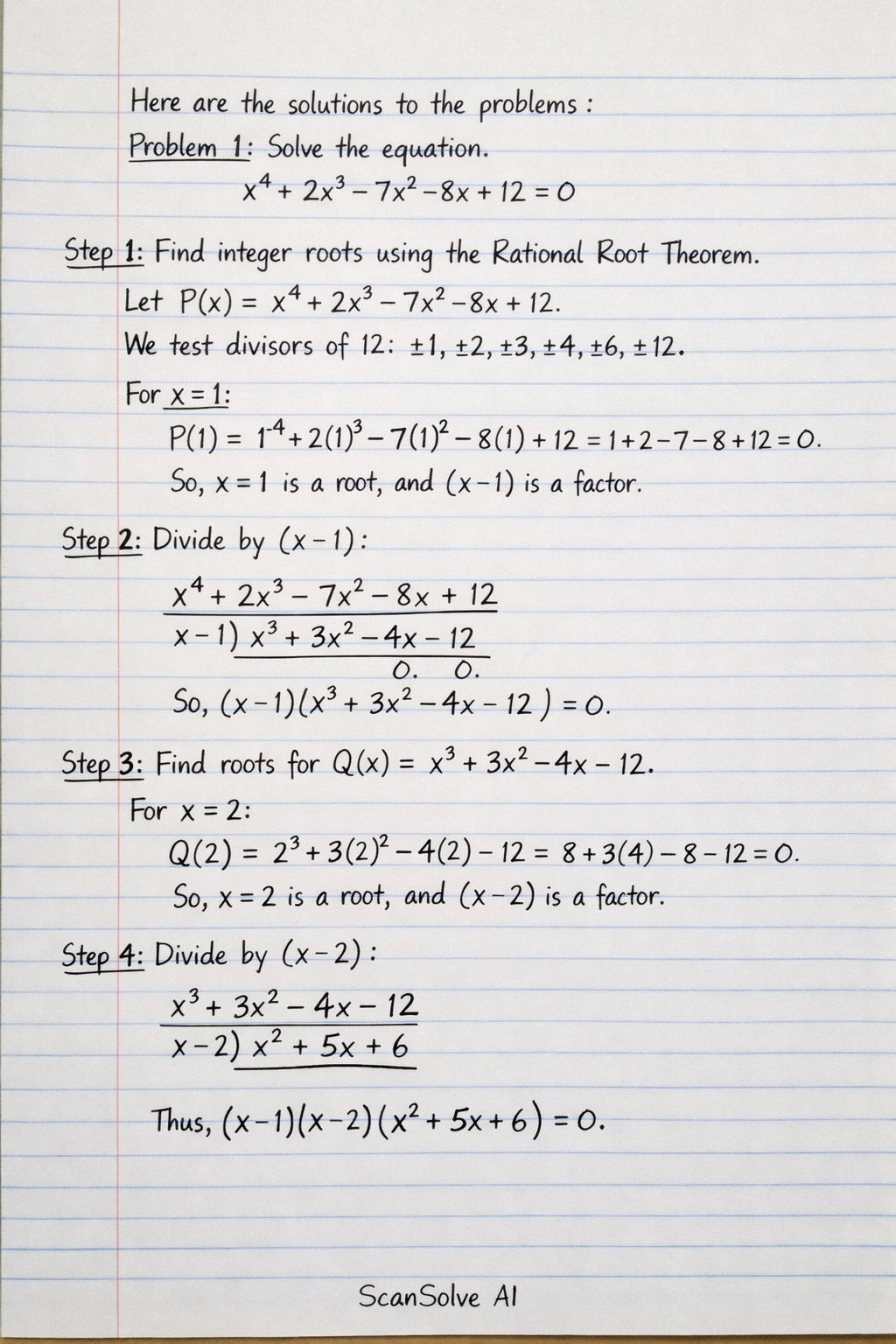
Here are the solutions to the problems:

: Solve the equation

x4+2x3−7x2−8x+12=0x^4 + 2x^3 - 7x^2 - 8x + 12 = 0
  1. Find integer roots using the Rational Root Theorem.

    Let P(x)=x4+2x3−7x2−8x+12P(x) = x^4 + 2x^3 - 7x^2 - 8x + 12.
    We test integer divisors of the constant term 12 (±1,±2,±3,±4,±6,±12\pm 1, \pm 2, \pm 3, \pm 4, \pm 6, \pm 12).
    For x=1x=1:
    P(1)=(1)4+2(1)3−7(1)2−8(1)+12=1+2−7−8+12=0P(1) = (1)^4 + 2(1)^3 - 7(1)^2 - 8(1) + 12 = 1 + 2 - 7 - 8 + 12 = 0.
    So, x=1x=1 is a root, and (x−1)(x-1) is a factor.

  2. Perform polynomial division (or synthetic division) by (x−1)(x-1).

    Dividing P(x)P(x) by (x−1)(x-1) gives x3+3x2−4x−12x^3 + 3x^2 - 4x - 12.
    So, the equation becomes (x−1)(x3+3x2−4x−12)=0(x-1)(x^3 + 3x^2 - 4x - 12) = 0.

  3. Find roots for the cubic factor Q(x)=x3+3x2−4x−12Q(x) = x^3 + 3x^2 - 4x - 12.

    Again, test integer divisors of the constant term 12.
    For x=2x=2:
    Q(2)=(2)3+3(2)2−4(2)−12=8+3(4)−8−12=8+12−8−12=0Q(2) = (2)^3 + 3(2)^2 - 4(2) - 12 = 8 + 3(4) - 8 - 12 = 8 + 12 - 8 - 12 = 0.
    So, x=2x=2 is a root, and (x−2)(x-2) is a factor of Q(x)Q(x).

  4. Perform polynomial division (or synthetic division) by (x−2)(x-2) on Q(x)Q(x).

    Dividing Q(x)Q(x) by (x−2)(x-2) gives x2+5x+6x^2 + 5x + 6.
    So, the equation becomes (x−1)(x−2)(x2+5x+6)=0(x-1)(x-2)(x^2 + 5x + 6) = 0.

  5. Factor the quadratic term x2+5x+6x^2 + 5x + 6.

    This quadratic factors as (x+2)(x+3)(x+2)(x+3).
    So, the equation is (x−1)(x−2)(x+2)(x+3)=0(x-1)(x-2)(x+2)(x+3) = 0.

  6. Set each factor to zero to find the roots.

    x−1=0  ⟹  x=1x-1 = 0 \implies x = 1
    x−2=0  ⟹  x=2x-2 = 0 \implies x = 2
    x+2=0  ⟹  x=−2x+2 = 0 \implies x = -2
    x+3=0  ⟹  x=−3x+3 = 0 \implies x = -3

    The solutions are:

    x=1,2,−2,−3\boxed{x = 1, 2, -2, -3}

    : Geometry Problem

    Given:

    • Triangle ABC is a right-angled triangle at B.
    • Length of side AB = 5 cm.
    • Length of side BC = 12 cm.
    • Point D is on AC such that BD is perpendicular to AC.

    Required: Find the length of BD.

  7. Find the length of the hypotenuse AC using the Pythagorean theorem in △ABC\triangle ABC.

    Since △ABC\triangle ABC is a right-angled triangle at B, we have:

    AC2=AB2+BC2AC^2 = AB^2 + BC^2 AC2=(5)2+(12)2AC^2 = (5)^2 + (12)^2 AC2=25+144AC^2 = 25 + 144 AC2=169AC^2 = 169 AC=169AC = \sqrt{169} AC=13 cmAC = 13 \text{ cm}
  8. Use the area of △ABC\triangle ABC.

    The area of a triangle can be calculated using the formula 12×base×height\frac{1}{2} \times \text{base} \times \text{height}.
    We can calculate the area of △ABC\triangle ABC in two ways:

    1. Using AB as base and BC as height (since ∠B=90∘\angle B = 90^\circ): Area(△ABC)=12×AB×BC\text{Area}(\triangle ABC) = \frac{1}{2} \times AB \times BC Area(△ABC)=12×5 cm×12 cm\text{Area}(\triangle ABC) = \frac{1}{2} \times 5 \text{ cm} \times 12 \text{ cm} Area(△ABC)=12×60 cm2\text{Area}(\triangle ABC) = \frac{1}{2} \times 60 \text{ cm}^2 Area(△ABC)=30 cm2\text{Area}(\triangle ABC) = 30 \text{ cm}^2
    2. Using AC as base and BD as height (since BD is perpendicular to AC): Area(△ABC)=12×AC×BD\text{Area}(\triangle ABC) = \frac{1}{2} \times AC \times BD
  9. Equate the two expressions for the area to find BD.

    12×AC×BD=30 cm2\frac{1}{2} \times AC \times BD = 30 \text{ cm}^2

    Substitute the value of AC:

    12×13 cm×BD=30 cm2\frac{1}{2} \times 13 \text{ cm} \times BD = 30 \text{ cm}^2 13×BD=60 cm13 \times BD = 60 \text{ cm} BD=6013 cmBD = \frac{60}{13} \text{ cm}

    The length of BD is:

    BD=6013 cm\boxed{BD = \frac{60}{13} \text{ cm}}
Was this helpful?

Still stuck on this one?

Ask a follow-up, and the answer starts from this question.

Got a different question?Ask your own question
Handwritten step-by-step solution preview

Handwritten Step-by-Step Solution

Get this as a handwritten image on WhatsApp — like a tutor wrote it for you.

Try on WhatsApp