We read your photo as:

Evaluate the definite integral of (e^x + 2e^-x)2 from 0 to ln 2.

Mathematics

ScanSolve AI Answer

Answer

3+4ln⁡23 + 4\ln 2

Step-by-step solution

6 steps

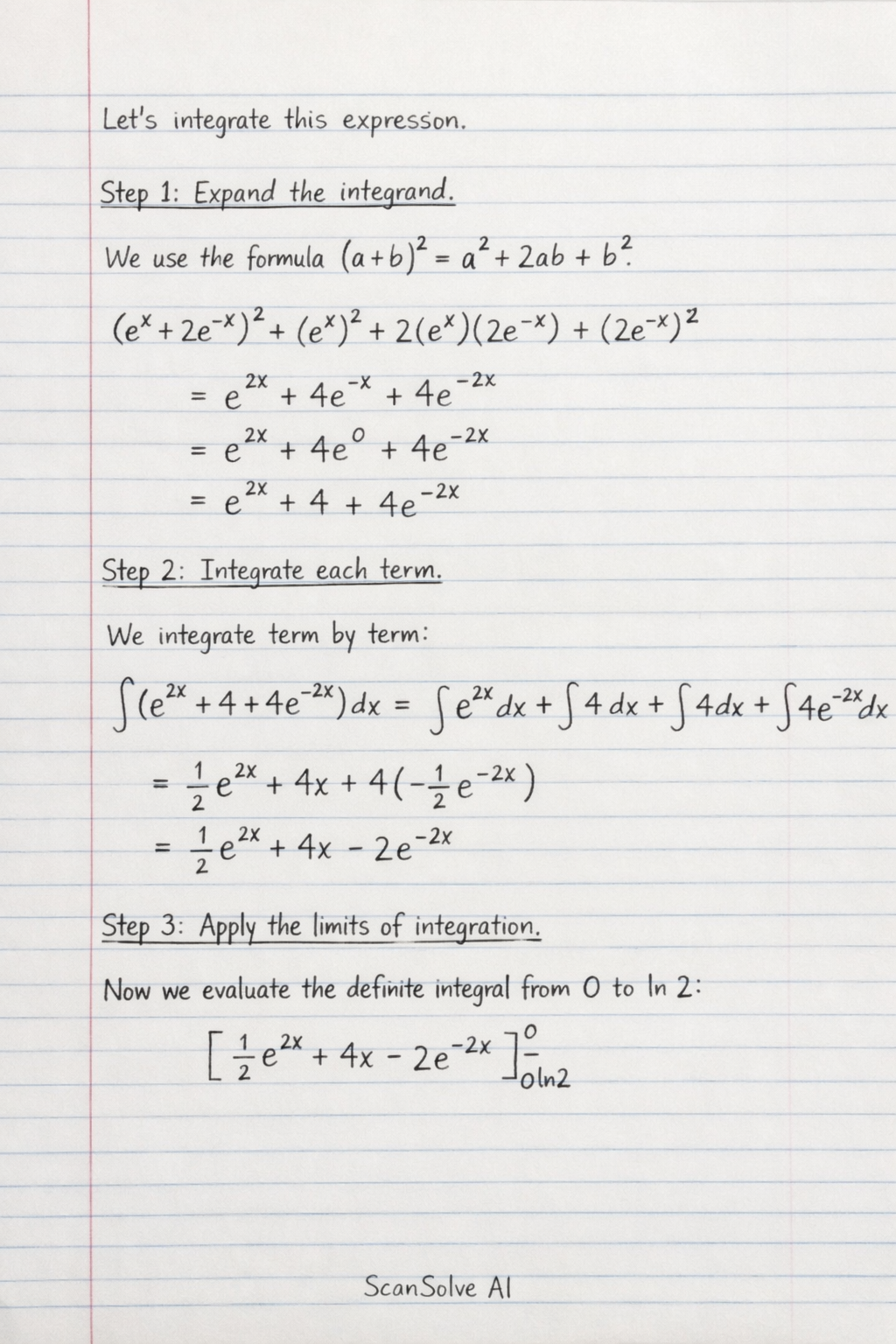
Let's integrate this expression.

  1. Expand the integrand.

    We use the formula (a+b)2=a2+2ab+b2(a+b)^2 = a^2 + 2ab + b^2.

    (ex+2e−x)2=(ex)2+2(ex)(2e−x)+(2e−x)2(e^x + 2e^{-x})^2 = (e^x)^2 + 2(e^x)(2e^{-x}) + (2e^{-x})^2 =e2x+4ex−x+4e−2x= e^{2x} + 4e^{x-x} + 4e^{-2x} =e2x+4e0+4e−2x= e^{2x} + 4e^0 + 4e^{-2x} =e2x+4+4e−2x= e^{2x} + 4 + 4e^{-2x}
  2. Integrate each term.

    We integrate term by term:

    ∫(e2x+4+4e−2x) dx=∫e2x dx+∫4 dx+∫4e−2x dx\int (e^{2x} + 4 + 4e^{-2x})\,dx = \int e^{2x}\,dx + \int 4\,dx + \int 4e^{-2x}\,dx =12e2x+4x+4(−12)e−2x= \frac{1}{2}e^{2x} + 4x + 4\left(-\frac{1}{2}\right)e^{-2x} =12e2x+4x−2e−2x= \frac{1}{2}e^{2x} + 4x - 2e^{-2x}
  3. Apply the limits of integration.

    Now we evaluate the definite integral from 0 to ln⁡2\ln 2:

    [12e2x+4x−2e−2x]0ln⁡2\left[ \frac{1}{2}e^{2x} + 4x - 2e^{-2x} \right]_{0}^{\ln 2}
  4. Evaluate at the upper limit (x=ln⁡2x = \ln 2).

    12e2ln⁡2+4ln⁡2−2e−2ln⁡2\frac{1}{2}e^{2\ln 2} + 4\ln 2 - 2e^{-2\ln 2}

    Using the logarithm property aln⁡b=ln⁡(ba)a\ln b = \ln(b^a) and eln⁡k=ke^{\ln k} = k:

    =12eln⁡(22)+4ln⁡2−2eln⁡(2−2)= \frac{1}{2}e^{\ln(2^2)} + 4\ln 2 - 2e^{\ln(2^{-2})} =12eln⁡4+4ln⁡2−2eln⁡(1/4)= \frac{1}{2}e^{\ln 4} + 4\ln 2 - 2e^{\ln(1/4)} =12(4)+4ln⁡2−2(14)= \frac{1}{2}(4) + 4\ln 2 - 2\left(\frac{1}{4}\right) =2+4ln⁡2−12= 2 + 4\ln 2 - \frac{1}{2} =42−12+4ln⁡2=32+4ln⁡2= \frac{4}{2} - \frac{1}{2} + 4\ln 2 = \frac{3}{2} + 4\ln 2
  5. Evaluate at the lower limit (x=0x = 0).

    12e2(0)+4(0)−2e−2(0)\frac{1}{2}e^{2(0)} + 4(0) - 2e^{-2(0)} =12e0+0−2e0= \frac{1}{2}e^0 + 0 - 2e^0 =12(1)−2(1)= \frac{1}{2}(1) - 2(1) =12−2=−32= \frac{1}{2} - 2 = -\frac{3}{2}
  6. Subtract the lower limit value from the upper limit value.

    (32+4ln⁡2)−(−32)\left( \frac{3}{2} + 4\ln 2 \right) - \left( -\frac{3}{2} \right) =32+4ln⁡2+32= \frac{3}{2} + 4\ln 2 + \frac{3}{2} =62+4ln⁡2= \frac{6}{2} + 4\ln 2 =3+4ln⁡2= 3 + 4\ln 2

    The final answer is 3+4ln⁡23 + 4\ln 2.

Was this helpful?

Try one yourself

A new problem that tests the same skill.

Still stuck on this one?

Ask a follow-up, and the answer starts from this question.

Got a different question?Ask your own question
Handwritten step-by-step solution preview

Handwritten Step-by-Step Solution

Get this as a handwritten image on WhatsApp — like a tutor wrote it for you.

Try on WhatsApp