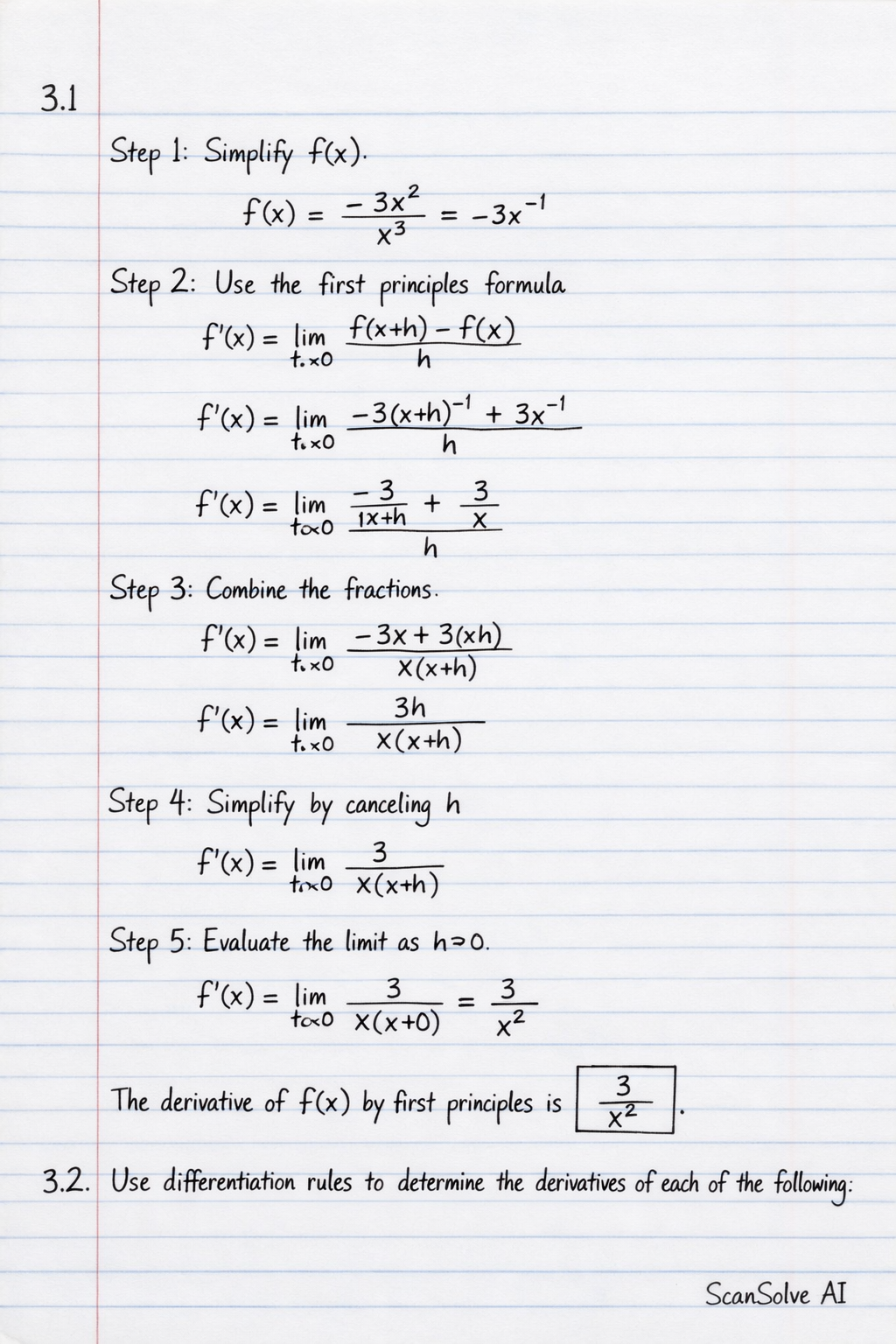
Find the derivative of f(x) = -3x2/x3 using first principles, and also use differentiation rules for y = 4e2x + 1/2 ln x - 3/√x + sin 30°.
|Mathematics
Find the derivative of f(x) = -3x2/x3 using first principles, and also use differentiation rules for y = 4e2x + 1/2 ln x - 3/√x + sin 30°.
ScanSolve AI Answer
Answer
x23
3.1
To determine the derivative of f(x)=x3−3x2 using first principles, we first simplify f(x).
Step 1: Simplify f(x).
f(x)=x3−3x2=−3x−1
Step 2: Apply the first principles formula f′(x)=limh→0hf(x+h)−f(x).
f′(x)=limh→0h−3(x+h)−1−(−3x−1)f′(x)=limh→0hx+h−3+x3
Step 3: Combine the fractions in the numerator.
f′(x)=limh→0hx(x+h)−3x+3(x+h)f′(x)=limh→0hx(x+h)−3x+3x+3hf′(x)=limh→0hx(x+h)3h
Step 4: Simplify by canceling h.
f′(x)=limh→0x(x+h)3
Step 5: Evaluate the limit as h→0.
f′(x)=x(x+0)3=x23
The derivative of f(x) by first principles is x23.
3.2
Use differentiation rules to determine the derivatives of each of the following:
3.2.1
Given y=4e2x+21lnx−x3+sin30∘.
Step 1: Rewrite terms with exponents for differentiation.
y=4e2x+21lnx−3x−1/2+sin30∘
Step 2: Differentiate each term. Remember sin30∘ is a constant.
dxdy=dxd(4e2x)+dxd(21lnx)−dxd(3x−1/2)+dxd(sin30∘)dxdy=4(2e2x)+21(x1)−3(−21x−3/2)+0dxdy=8e2x+2x1+23x−3/2
Step 3: Express with positive exponents and in surd form.
dxdy=8e2x+2x1+2x33
The derivative is 8e2x+2x1+2x33.
3.2.2
Given y=x26x4−3x2.
Step 1: Simplify the expression.
y=x26x4−x23x2=6x2−3
Step 2: Differentiate the simplified expression.
dxdy=dxd(6x2−3)dxdy=12x−0dxdy=12x
The derivative is 12x.
3.2.3
Given y=3x3sin(2x).
Step 1: Use the product rule: dxd(uv)=u′v+uv′.
Let u=3x3 and v=sin(2x).
Then u′=9x2 and v′=2cos(2x).
Step 2: Apply the product rule.
dxdy=(9x2)(sin(2x))+(3x3)(2cos(2x))dxdy=9x2sin(2x)+6x3cos(2x)
The derivative is 9x2sin(2x)+6x3cos(2x).
3.2.4
Given y=(2−x)43.
Step 1: Rewrite the expression with a negative exponent.
y=3(2−x)−4
Step 2: Use the chain rule: dxdy=dudy⋅dxdu.
Let u=2−x, so dxdu=−1.
Then y=3u−4, so dudy=3(−4)u−5=−12u−5.
Step 3: Apply the chain rule.
dxdy=(−12u−5)(−1)dxdy=12u−5
Step 4: Substitute back u=2−x and express with a positive exponent.
dxdy=12(2−x)−5=(2−x)512
The derivative is (2−x)512.
3.2.5
Given y=ln[cos(3x)].
Step 1: Use the chain rule.
Let u=cos(3x), so dxdu=−3sin(3x).
Then y=lnu, so dudy=u1.
Step 2: Apply the chain rule.
dxdy=u1⋅dxdudxdy=cos(3x)1⋅(−3sin(3x))dxdy=cos(3x)−3sin(3x)
Step 3: Simplify using trigonometric identities.
dxdy=−3tan(3x)
The derivative is −3tan(3x).
3.2.6
Given y=−3e5x+5x−22−3x5+2π.
Step 1: Rewrite terms with exponents for differentiation.
y=−3e5x+52x2−x5/3+2π
Step 2: Differentiate each term. Remember 2π is a constant.
dxdy=dxd(−3e5x)+dxd(52x2)−dxd(x5/3)+dxd(2π)dxdy=−3(5e5x)+52(2x)−35x5/3−1+0dxdy=−15e5x+54x−35x2/3
Step 3: Express with positive exponents and in surd
Was this helpful?
Need help with your own homework?
Get instant step-by-step solutions to any question. Free to start.
This mathematics problem involves applying core mathematical principles and formulas. Below you will find a complete step-by-step solution with detailed explanations for each step, helping you understand not just the answer but the method behind it.
ScanSolve AI Answer
3.1 To determine the derivative of f(x) = (-3x^2)/(x^3) using first principles, we first simplify f(x). Step 1: Simplify f(x). f(x) = (-3x^2)/(x^3) = -3x^-1 Step 2: Apply the first principles formula f'(x) = _h 0 (f(x+h) - f(x))/(h). f'(x) = _h 0 -3(x+h)^-1 - (-3x^-1)h f'(x) = _h 0 (-3)/(x+h) + (3)/(x)h Step 3: Combine the fractions in the numerator. f'(x) = _h 0 (-3x + 3(x+h))/(x(x+h))h f'(x) = _h 0 (-3x + 3x + 3h)/(x(x+h))h f'(x) = _h 0 (3h)/(x(x+h))h Step 4: Simplify by canceling h. f'(x) = _h 0 (3)/(x(x+h)) Step 5: Evaluate the limit as h 0. f'(x) = (3)/(x(x+0)) = (3)/(x^2) The derivative of f(x) by first principles is (3)/(x^2). 3.2 Use differentiation rules to determine the derivatives of each of the following: 3.2.1 Given y = 4e^2x + (1)/(2) x - (3)/(sqrt(x)) + 30^. Step 1: Rewrite terms with exponents for differentiation. y = 4e^2x + (1)/(2) x - 3x^-1/2 + 30^ Step 2: Differentiate each term. Remember 30^ is a constant. (dy)/(dx) = (d)/(dx)(4e^2x) + (d)/(dx)((1)/(2) x) - (d)/(dx)(3x^-1/2) + (d)/(dx)( 30^) (dy)/(dx) = 4(2e^2x) + (1)/(2)((1)/(x)) - 3(-(1)/(2)x^-3/2) + 0 (dy)/(dx) = 8e^2x + (1)/(2x) + (3)/(2)x^-3/2 Step 3: Express with positive exponents and in surd form. (dy)/(dx) = 8e^2x + (1)/(2x) + (3)/(2sqrt(x^3)) The derivative is 8e^2x + (1)/(2x) + (3)/(2sqrt(x^3)). 3.2.2 Given y = (6x^4 - 3x^2)/(x^2). Step 1: Simplify the expression. y = (6x^4)/(x^2) - (3x^2)/(x^2) = 6x^2 - 3 Step 2: Differentiate the simplified expression. (dy)/(dx) = (d)/(dx)(6x^2 - 3) (dy)/(dx) = 12x - 0 (dy)/(dx) = 12x The derivative is 12x. 3.2.3 Given y = 3x^3 (2x). Step 1: Use the product rule: (d)/(dx)(uv) = u'v + uv'. Let u = 3x^3 and v = (2x). Then u' = 9x^2 and v' = 2(2x). Step 2: Apply the product rule. (dy)/(dx) = (9x^2)((2x)) + (3x^3)(2(2x)) (dy)/(dx) = 9x^2 (2x) + 6x^3 (2x) The derivative is 9x^2 (2x) + 6x^3 (2x). 3.2.4 Given y = (3)/((2-x)^4). Step 1: Rewrite the expression with a negative exponent. y = 3(2-x)^-4 Step 2: Use the chain rule: (dy)/(dx) = (dy)/(du) · (du)/(dx). Let u = 2-x, so (du)/(dx) = -1. Then y = 3u^-4, so (dy)/(du) = 3(-4)u^-5 = -12u^-5. Step 3: Apply the chain rule. (dy)/(dx) = (-12u^-5)(-1) (dy)/(dx) = 12u^-5 Step 4: Substitute back u = 2-x and express with a positive exponent. (dy)/(dx) = 12(2-x)^-5 = (12)/((2-x)^5) The derivative is (12)/((2-x)^5). 3.2.5 Given y = [(3x)]. Step 1: Use the chain rule. Let u = (3x), so (du)/(dx) = -3(3x). Then y = u, so (dy)/(du) = (1)/(u). Step 2: Apply the chain rule. (dy)/(dx) = (1)/(u) · (du)/(dx) (dy)/(dx) = (1)/((3x)) · (-3(3x)) (dy)/(dx) = (-3(3x))/((3x)) Step 3: Simplify using trigonometric identities. (dy)/(dx) = -3(3x) The derivative is -3(3x). 3.2.6 Given y = -3e^5x + (2)/(5x^-2) - [3]x^5 + ()/(2). Step 1: Rewrite terms with exponents for differentiation. y = -3e^5x + (2)/(5)x^2 - x^5/3 + ()/(2) Step 2: Differentiate each term. Remember ()/(2) is a constant. (dy)/(dx) = (d)/(dx)(-3e^5x) + (d)/(dx)((2)/(5)x^2) - (d)/(dx)(x^5/3) + (d)/(dx)(()/(2)) (dy)/(dx) = -3(5e^5x) + (2)/(5)(2x) - (5)/(3)x^5/3 - 1 + 0 (dy)/(dx) = -15e^5x + (4)/(5)x - (5)/(3)x^2/3 Step 3: Express with positive exponents and in surd