
We read your photo as:
The rate of change of displacement with time is called (a) velocity (b) Acceleration (c) speed (d) momentum
ScanSolve AI Answer
Answer
velocity
Step-by-step solution
66 stepsHere are the solutions to questions 1 to 29:
Part 1
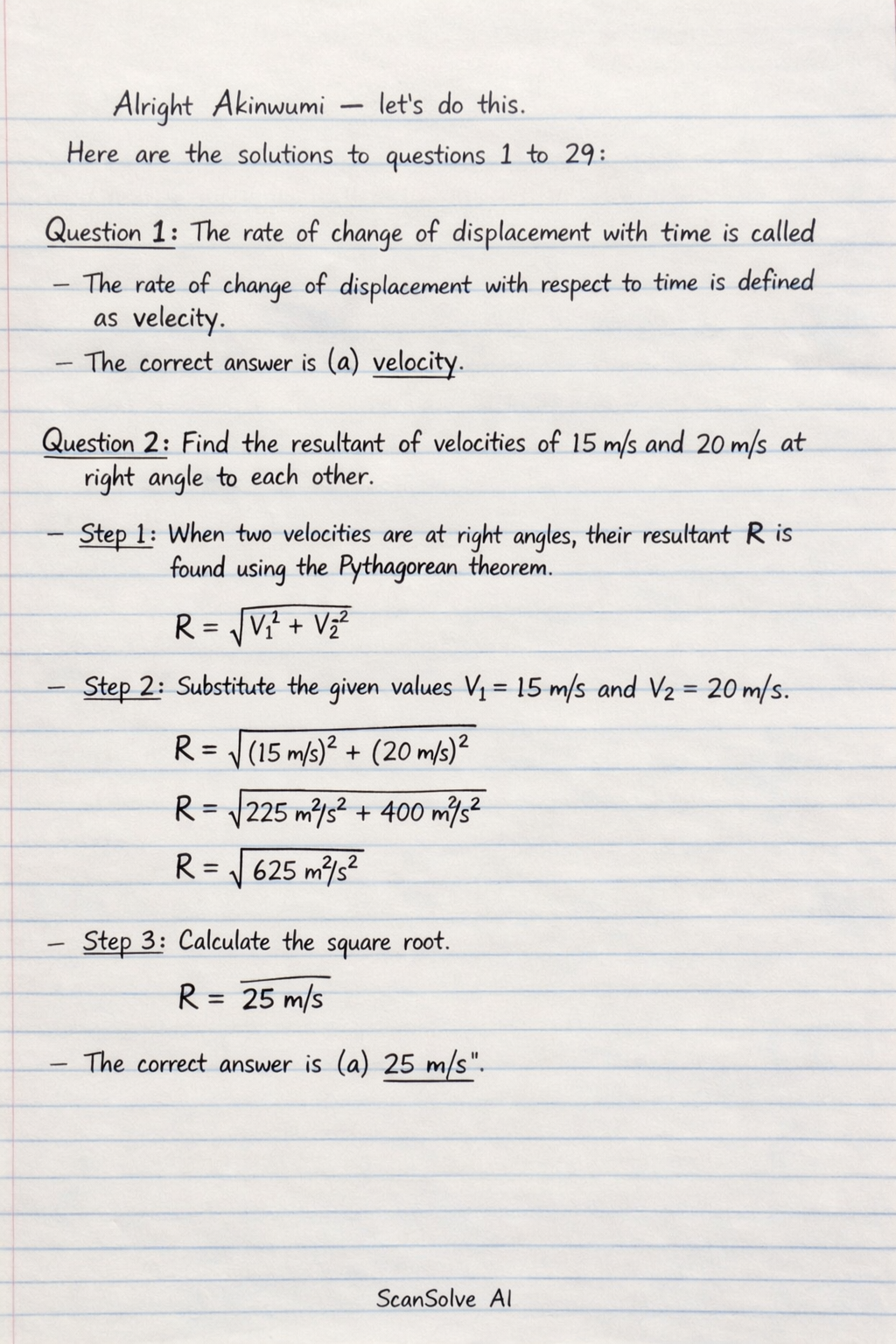
The rate of change of displacement with time is called
- The rate of change of displacement with respect to time is defined as velocity.
- The correct answer is (a) velocity.
Part 2· 3 steps
Find the resultant of velocities of and at right angle to each other.
When two velocities are at right angles, their resultant is found using the Pythagorean theorem.
$$ R = \sqrt{V_1^2 + V_2^2} $$Substitute the given values and .
$$ R = \sqrt{(15 \text{ ms}^{-1})^2 + (20 \text{ ms}^{-1})^2} $$ $$ R = \sqrt{225 \text{ m}^2\text{s}^{-2} + 400 \text{ m}^2\text{s}^{-2}} $$ $$ R = \sqrt{625 \text{ m}^2\text{s}^{-2}} $$Calculate the square root.
$$ R = 25 \text{ ms}^{-1} $$- The correct answer is (a) .
Part 3· 3 steps
Find the resultant of velocities of and at right angle to each other.
Use the Pythagorean theorem for resultant velocity at right angles.
$$ R = \sqrt{V_1^2 + V_2^2} $$Substitute and .
$$ R = \sqrt{(6 \text{ ms}^{-1})^2 + (8 \text{ ms}^{-1})^2} $$ $$ R = \sqrt{36 \text{ m}^2\text{s}^{-2} + 64 \text{ m}^2\text{s}^{-2}} $$ $$ R = \sqrt{100 \text{ m}^2\text{s}^{-2}} $$Calculate the square root.
$$ R = 10 \text{ ms}^{-1} $$- The correct answer is (a) .
Part 4
The rate of change of velocity with time is called
- The rate of change of velocity with respect to time is defined as acceleration.
- The correct answer is (b) acceleration.
Part 5
The difference between the least entry and the greatest entry is
- In statistics, the range is the difference between the highest and lowest values in a data set.
- The correct answer is (a) range.
Part 6
A graphic display of a frequency distribution is called
- A histogram is a graphical representation of the distribution of numerical data, often used for frequency distributions.
- The correct answer is (c) histogram.
Part 7
The sum of all the frequencies from the first to the last one is called
- The sum of all frequencies in a distribution is the total number of observations, which is also the final value of the cumulative frequency.
- The correct answer is (a) cumulative.
Part 8
All the following are measures of central tendency except
- Mean, median, and mode are measures of central tendency. Range is a measure of dispersion.
- The correct answer is (d) range.
Part 9
The value which occurs most frequently in the distribution is called
- The mode is the value that appears most often in a set of data.
- The correct answer is (b) mode.
Part 10
All the following are measures of dispersion except
- Range, variance, and standard deviation are measures of dispersion. Mean is a measure of central tendency.
- The correct answer is (d) mean.
Part 11· 3 steps
The term of a linear sequence is 33 and its term is 53. Find the common difference of the Sequence.
For a linear sequence (Arithmetic Progression), the term is given by .
Given $T_7 = 33 \implies a + 6d = 33$ (Equation 1) Given $T_{11} = 53 \implies a + 10d = 53$ (Equation 2)Subtract Equation 1 from Equation 2 to find .
$$ (a + 10d) - (a + 6d) = 53 - 33 $$ $$ 4d = 20 $$Solve for .
$$ d = \frac{20}{4} $$ $$ d = 5 $$- The correct answer is (c) 5.
Part 12· 4 steps
Find the median of 5, 2, 1, 3, 4, 6, 5, 7, 9, 8.
Arrange the numbers in ascending order.
$$ 1, 2, 3, 4, 5, 5, 6, 7, 8, 9 $$Count the number of terms ().
There are 10 terms.
Since is an even number, the median is the average of the two middle terms, which are the and terms.
The $5^{th}$ term is 5. The $6^{th}$ term is 5.Calculate the median.
$$ \text{Median} = \frac{5 + 5}{2} = \frac{10}{2} = 5 $$- The median is 5. (Note: This answer is not among the given options).
Part 13· 3 steps
Find the mean of 16, 18, 20, 28, and 18.
Sum all the numbers.
$$ \text{Sum} = 16 + 18 + 20 + 28 + 18 = 100 $$Count the number of terms.
There are 5 terms.
Calculate the mean by dividing the sum by the number of terms.
$$ \text{Mean} = \frac{\text{Sum}}{\text{Number of terms}} = \frac{100}{5} = 20 $$- The correct answer is (a) 20.
Part 14· 3 steps
Find the term of the A.P -4, -1.5, 1, 3.5 ...
Identify the first term () and the common difference ().
$$ a = -4 $$ $$ d = -1.5 - (-4) = -1.5 + 4 = 2.5 $$Use the formula for the term of an A.P., .
We need .
Calculate the value.
$$ T_{21} = -4 + 50 $$ $$ T_{21} = 46 $$- The correct answer is (b) 46.
Part 15· 3 steps
Simplify
Simplify .
$$ \sqrt{32} = \sqrt{16 \times 2} = \sqrt{16} \times \sqrt{2} = 4\sqrt{2} $$Substitute the simplified form back into the expression.
$$ 4\sqrt{2} - 2\sqrt{2} $$Combine the terms.
$$ (4-2)\sqrt{2} = 2\sqrt{2} $$- The correct answer is (a) .
Part 16· 4 steps
The and term of a G.P. are 81 and 16. Find the term.
For a Geometric Progression (GP), the term is .
$$ T_3 = ar^2 = 81 \quad (\text{Equation 1}) $$ $$ T_7 = ar^6 = 16 \quad (\text{Equation 2}) $$Divide Equation 2 by Equation 1 to find the common ratio .
$$ \frac{ar^6}{ar^2} = \frac{16}{81} $$ $$ r^4 = \frac{16}{81} $$ $$ r = \sqrt[4]{\frac{16}{81}} = \frac{2}{3} $$Substitute into Equation 1 to find the first term .
$$ a\left(\frac{2}{3}\right)^2 = 81 $$ $$ a\left(\frac{4}{9}\right) = 81 $$ $$ a = \frac{81 \times 9}{4} = \frac{729}{4} $$Calculate the term, .
$$ T_5 = \frac{729}{4} \times \left(\frac{2}{3}\right)^4 $$ $$ T_5 = \frac{729}{4} \times \frac{16}{81} $$ $$ T_5 = \frac{729}{81} \times \frac{16}{4} $$ $$ T_5 = 9 \times 4 = 36 $$- The correct answer is (d) 36.
Part 17· 3 steps
If , , Find .
Use the trigonometric identity .
$$ \left(\frac{3}{5}\right)^2 + \cos^2 \theta = 1 $$Solve for .
$$ \frac{9}{25} + \cos^2 \theta = 1 $$ $$ \cos^2 \theta = 1 - \frac{9}{25} $$ $$ \cos^2 \theta = \frac{25 - 9}{25} = \frac{16}{25} $$Take the square root.
Since , is positive.
- The correct answer is (a) .
Part 18· 2 steps
Factorize
Find two numbers that multiply to -21 and add up to -4.
The numbers are -7 and 3 (since $-7 \times 3 = -21$ and $-7 + 3 = -4$).Write the quadratic expression in factored form.
$$ (x-7)(x+3) $$- The factorization is . (Note: This answer is not among the given options).
Part 19· 3 steps
Solve the quadratic equation
Factorize the quadratic equation.
Find two numbers that multiply to and add to -3. These numbers are -5 and 2.
Group terms and factor out common factors.
$$ x(2x - 5) + 1(2x - 5) = 0 $$ $$ (x+1)(2x-5) = 0 $$Set each factor to zero and solve for .
$$ x+1 = 0 \implies x = -1 $$ $$ 2x-5 = 0 \implies 2x = 5 \implies x = \frac{5}{2} $$- The correct answer is (a) or .
Part 20· 2 steps
Express 0.000724 in standard form
Move the decimal point to the right until there is one non-zero digit before it.
$$ 0.000724 \implies 7.24 $$Count the number of places the decimal point moved.
It moved 4 places to the right. Since it moved to the right, the exponent will be negative.
- The correct answer is (c) .
Part 21· 4 steps
Solve the inequality .
Distribute the -2 on the left side.
$$ -26 - 2x \ge 9 + 5x $$Gather terms on one side and constant terms on the other.
Add to both sides.
Subtract 9 from both sides.
$$ -26 - 9 \ge 7x $$ $$ -35 \ge 7x $$Divide by 7.
The inequality sign does not change because we are dividing by a positive number.
- This can also be written as .
- The correct answer is (d) .
Part 22· 3 steps
Express in basic form
Find the largest perfect square factor of 98.
$$ 98 = 49 \times 2 $$Rewrite the square root using this factor.
$$ \sqrt{98} = \sqrt{49 \times 2} = \sqrt{49} \times \sqrt{2} $$Simplify the perfect square.
$$ 7\sqrt{2} $$- The correct answer is (b) .
Part 23· 3 steps
Express in basic form
Find the largest perfect square factor of 288.
$$ 288 = 144 \times 2 $$Rewrite the square root using this factor.
$$ \sqrt{288} = \sqrt{144 \times 2} = \sqrt{144} \times \sqrt{2} $$Simplify the perfect square.
$$ 12\sqrt{2} $$- The correct answer is (b) .
Part 24· 5 steps
Simplify
Simplify each surd in the expression.
$$ \sqrt{12} = \sqrt{4 \times 3} = 2\sqrt{3} $$ $$ \sqrt{48} = \sqrt{16 \times 3} = 4\sqrt{3} $$ $$ \sqrt{24} = \sqrt{4 \times 6} = 2\sqrt{6} $$Substitute the simplified surds back into the expression.
$$ \frac{2\sqrt{3} + 4\sqrt{3}}{2\sqrt{6}} = \frac{6\sqrt{3}}{2\sqrt{6}} $$Simplify the fraction.
$$ \frac{6\sqrt{3}}{2\sqrt{6}} = \frac{3\sqrt{3}}{\sqrt{6}} $$Rationalize the denominator by multiplying the numerator and denominator by .
$$ \frac{3\sqrt{3}}{\sqrt{6}} \times \frac{\sqrt{6}}{\sqrt{6}} = \frac{3\sqrt{18}}{6} $$Simplify and then the entire expression.
$$ \sqrt{18} = \sqrt{9 \times 2} = 3\sqrt{2} $$ $$ \frac{3 \times 3\sqrt{2}}{6} = \frac{9\sqrt{2}}{6} = \frac{3\sqrt{2}}{2} $$- The simplified expression is . (Note: This answer is not among the given options).
Part 25· 2 steps
Simplify
Multiply the coefficients and combine the variables using the exponent rule .
$$ (9 \times 4) \times (a^5 \times a^3) $$ $$ 36 \times a^{5+3} $$Calculate the final expression.
$$ 36a^8 $$- The simplified expression is . (Note: This answer is not among the given options).
Part 26· 3 steps
Simplify
Use the logarithm properties and .
$$ \log_4 12 - \log_4 36 + \log_4 192 = \log_4 \left(\frac{12}{36}\right) + \log_4 192 $$Simplify the fraction and then combine the remaining terms.
$$ = \log_4 \left(\frac{1}{3}\right) + \log_4 192 $$ $$ = \log_4 \left(\frac{1}{3} \times 192\right) $$ $$ = \log_4 \left(\frac{192}{3}\right) $$ $$ = \log_4 64 $$Determine the value of .
We need to find such that .
- The correct answer is (a) 3.
Part 27· 3 steps
Simplify
Use the exponent rule .
$$ 3^{(n+1) + (1-n)} $$Simplify the exponent.
$$ 3^{n+1+1-n} = 3^2 $$Calculate the value.
$$ 3^2 = 9 $$- The simplified expression is 9. (Note: This answer is not among the given options).
Part 28· 2 steps
Solve
Express both sides of the equation with the same base.
$$ 4^x = 4^3 $$Equate the exponents.
$$ x = 3 $$- The solution is . (Note: This answer is not among the given options).
Part 29· 5 steps
Solve
Express both sides of the equation with the same base.
Since , we can use base 9.
Apply the exponent rule .
$$ 9^{x+1} = 9^{2(x-2)} $$ $$ 9^{x+1} = 9^{2x-4} $$Equate the exponents.
$$ x+1 = 2x-4 $$Solve for .
Subtract from both sides.
Add 4 to both sides.
$$ 1+4 = x $$ $$ x = 5 $$- The solution is . (Note: This answer is not among the given options).
Try one yourself
A new problem that tests the same skill.
Still stuck on this one?
Ask a follow-up, and the answer starts from this question.
More Mathematics Questions
Handwritten Step-by-Step Solution
Get this as a handwritten image on WhatsApp — like a tutor wrote it for you.
Try on WhatsApp