Find the derivative of f(x) = ln(x) / (x2 sin(x)) and y = tan(x) / e^(3x).
|Mathematics
Find the derivative of f(x) = ln(x) / (x2 sin(x)) and y = tan(x) / e^(3x).
ScanSolve AI Answer
Answer
f′(x)=x3sin2(x)sin(x)(1−2ln(x))−xln(x)cos(x)
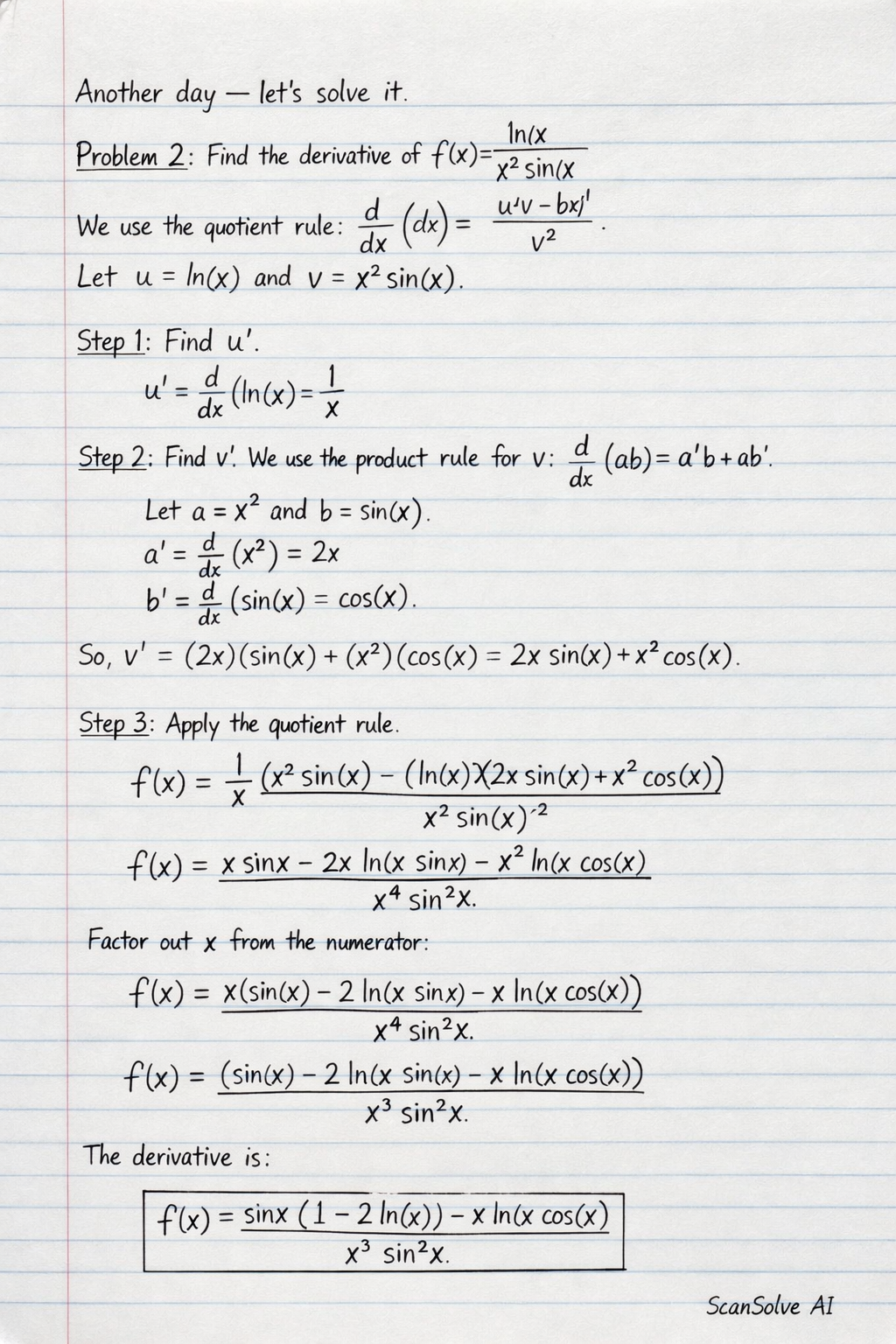
Another day — let's solve it.
: Find the derivative of f(x)=x2sin(x)ln(x).
We use the quotient rule: dxd(vu)=v2u′v−uv′.
Let u=ln(x) and v=x2sin(x).
Step 1: Find u′.
u′=dxd(ln(x))=x1
Step 2: Find v′. We use the product rule for v: dxd(ab)=a′b+ab′.
Let a=x2 and b=sin(x).
a′=dxd(x2)=2x.
b′=dxd(sin(x))=cos(x).
So, v′=(2x)(sin(x))+(x2)(cos(x))=2xsin(x)+x2cos(x).
Step 3: Apply the quotient rule.
f′(x)=(x2sin(x))2(x1)(x2sin(x))−(ln(x))(2xsin(x)+x2cos(x))f′(x)=x4sin2(x)xsin(x)−2xln(x)sin(x)−x2ln(x)cos(x)
Factor out x from the numerator.
f′(x)=x4sin2(x)x(sin(x)−2ln(x)sin(x)−xln(x)cos(x))f′(x)=x3sin2(x)sin(x)−2ln(x)sin(x)−xln(x)cos(x)
The derivative is:
f′(x)=x3sin2(x)sin(x)(1−2ln(x))−xln(x)cos(x)
: Find the derivative of y=e3xtan(x).
We use the quotient rule: dxdy=v2u′v−uv′.
Let u=tan(x) and v=e3x.
Step 1: Find u′.
u′=dxd(tan(x))=sec2(x)
Step 2: Find v′. We use the chain rule for v.
v′=dxd(e3x)=e3x⋅dxd(3x)=3e3x
Step 3: Apply the quotient rule.
dxdy=(e3x)2(sec2(x))(e3x)−(tan(x))(3e3x)dxdy=e6xe3xsec2(x)−3e3xtan(x)
Factor out e3x from the numerator.
dxdy=e6xe3x(sec2(x)−3tan(x))dxdy=e3xsec2(x)−3tan(x)
The derivative is:
dxdy=e3xsec2(x)−3tan(x)
: Find the derivative of f(x)=x22x.
Step 1: Simplify the function.
f(x)=x22x=x2=2x−1
Step 2: Find the derivative using the power rule.
f′(x)=dxd(2x−1)=2(−1)x−1−1=−2x−2f′(x)=−x22
The derivative is:
f′(x)=−x22
: Find the derivative of y=xln(x2+1).
We use the quotient rule: dxdy=v2u′v−uv′.
Let u=ln(x2+1) and v=x=x1/2.
Step 1: Find u′. We use the chain rule for u.
u′=dxd(ln(x2+1))=x2+11⋅dxd(x2+1)=x2+12x
Step 2: Find v′. We use the power rule for v.
v′=dxd(x1/2)=21x1/2−1=21x−1/2=2x1
Step 3: Apply the quotient rule.
dxdy=(x)2(x2+12x)(x)−(ln(x2+1))(2x1)dxdy=xx2+12xx−2xln(x2+1)
To simplify the numerator, find a common denominator, which is 2x(x2+1).
dxdy=x2x(x2+1)2xx⋅2x−ln(x2+1)⋅(x2+1)dxdy=2x(x2+1)x4x2−(x2+1)ln(x2+1)dxdy=2x3/2(x2+1)4x2−(x2+1)ln(x2+1)
The derivative is:
dxdy=2xx(x2+1)4x2−(x2+1)ln(x2+1)
: Find the derivative of f(x)=x2+1exlnx.
We use the quotient rule: f′(x)=v2u′v−uv′.
Let u=exlnx and v=x2+1.
Step 1: Find u′. We use the product rule for u: dxd(ab)=a′b+ab′.
Let a=ex and b=lnx.
a′=dxd(ex)=ex.
b′=dxd(lnx)=x1.
So, u′=(ex)(lnx)+(ex)(x1)=exlnx+xex=ex(lnx+x1).
Step 2: Find v′.
v′=dxd(x2+1)=2x
Step 3: Apply the quotient rule.
f′(x)=(x2+1)2(ex(lnx+x1))(x2+1)−(exlnx)(2x)f′(x)=(x2+1)2ex((x2+1)(lnx+x1)−2xlnx)
Expand the term (x2+1)(lnx+x1):
(x2+1)(lnx+x1)=x2lnx+x2⋅x1+lnx+1⋅x1=x2lnx+x+lnx+x1
Substitute this back into the numerator:
f′(x)=(x2+1)2ex(x2lnx+x+lnx+x1−2xlnx)
Combine terms with lnx:
f′(x)=(x2+1)2ex((x2−2x+1)lnx+x+x1)
Note that x2−2x+1=(x−1)2.
f′(x)=(x2+1)2ex((x−1)2lnx+x+x1)
The derivative is:
f′(x)=(x2+1)2ex((x−1)2lnx+x+x1)
Send me the next one 📸
Was this helpful?
Need help with your own homework?
Get instant step-by-step solutions to any question. Free to start.
This mathematics problem involves applying core mathematical principles and formulas. Below you will find a complete step-by-step solution with detailed explanations for each step, helping you understand not just the answer but the method behind it.
ScanSolve AI Answer
Another day — let's solve it. Problem 2: Find the derivative of f(x) = ((x))/(x^2 (x)). We use the quotient rule: (d)/(dx)((u)/(v)) = (u'v - uv')/(v^2). Let u = (x) and v = x^2 (x). Step 1: Find u'. u' = (d)/(dx)((x)) = (1)/(x) Step 2: Find v'. We use the product rule for v: (d)/(dx)(ab) = a'b + ab'. Let a = x^2 and b = (x). a' = (d)/(dx)(x^2) = 2x. b' = (d)/(dx)((x)) = (x). So, v' = (2x)((x)) + (x^2)((x)) = 2x (x) + x^2 (x). Step 3: Apply the quotient rule. f'(x) = ((1)/(x))(x^2 (x)) - ((x))(2x (x) + x^2 (x))(x^2 (x))^2 f'(x) = (x (x) - 2x (x) (x) - x^2 (x) (x))/(x^4 ^2(x)) Factor out x from the numerator. f'(x) = (x((x) - 2 (x) (x) - x (x) (x)))/(x^4 ^2(x)) f'(x) = ((x) - 2 (x) (x) - x (x) (x))/(x^3 ^2(x)) The derivative is: f'(x) = ((x)(1 - 2 (x)) - x (x) (x))/(x^3 ^2(x)) Problem 4: Find the derivative of y = ((x))/(e^3x). We use the quotient rule: (dy)/(dx) = (u'v - uv')/(v^2). Let u = (x) and v = e^3x. Step 1: Find u'. u' = (d)/(dx)((x)) = ^2(x) Step 2: Find v'. We use the chain rule for v. v' = (d)/(dx)(e^3x) = e^3x · (d)/(dx)(3x) = 3e^3x Step 3: Apply the quotient rule. (dy)/(dx) = (^2(x))(e^3x) - ((x))(3e^3x)(e^3x)^2 (dy)/(dx) = e^3x ^2(x) - 3e^3x (x)e^6x Factor out e^3x from the numerator. (dy)/(dx) = e^3x(^2(x) - 3 (x))e^6x (dy)/(dx) = (^2(x) - 3 (x))/(e^3x) The derivative is: (dy)/(dx) = (^2(x) - 3 (x))/(e^3x) Problem 6: Find the derivative of f(x) = (2x)/(x^2). Step 1: Simplify the function. f(x) = (2x)/(x^2) = (2)/(x) = 2x^-1 Step 2: Find the derivative using the power rule. f'(x) = (d)/(dx)(2x^-1) = 2(-1)x^-1-1 = -2x^-2 f'(x) = -(2)/(x^2) The derivative is: f'(x) = -(2)/(x^2) Problem 8: Find the derivative of y = ((x^2 + 1))/(sqrt(x)). We use the quotient rule: (dy)/(dx) = (u'v - uv')/(v^2). Let u = (x^2 + 1) and v = sqrt(x) = x^1/2. Step 1: Find u'. We use the chain rule for u. u' = (d)/(dx)((x^2 + 1)) = (1)/(x^2 + 1) · (d)/(dx)(x^2 + 1) = (2x)/(x^2 + 1) Step 2: Find v'. We use the power rule for v. v' = (d)/(dx)(x^1/2) = (1)/(2)x^1/2 - 1 = (1)/(2)x^-1/2 = (1)/(2sqrt(x)) Step 3: Apply the quotient rule. (dy)/(dx) = ((2x)/(x^2 + 1))(sqrt(x)) - ((x^2 + 1))((1)/(2sqrt(x)))(sqrt(x))^2 (dy)/(dx) = 2xsqrt(x)x^2 + 1 - ((x^2 + 1))/(2sqrt(x))x To simplify the numerator, find a common denominator, which is 2sqrt(x)(x^2 + 1). (dy)/(dx) = 2xsqrt(x) · 2sqrt(x) - (x^2 + 1) · (x^2 + 1)2sqrt(x)(x^2 + 1)x (dy)/(dx) = (4x^2 - (x^2 + 1)(x^2 + 1))/(2sqrt(x)(x^2 + 1)x) (dy)/(dx) = (4x^2 - (x^2 + 1)(x^2 + 1))/(2x^3/2)(x^2 + 1) The derivative is: (dy)/(dx) = (4x^2 - (x^2 + 1)(x^2 + 1))/(2xsqrt(x)(x^2 + 1)) Problem 10: Find the derivative of f(x) = (e^x x)/(x^2 + 1). We use the quotient rule: f'(x) = (u'v - uv')/(v^2). Let u = e^x x and v = x^2 + 1. Step 1: Find u'. We use the product rule for u: (d)/(dx)(ab) = a'b + ab'. Let a = e^x and b = x. a' = (d)/(dx)(e^x) = e^x. b' = (d)/(dx)( x) = (1)/(x). So, u' = (e^x)( x) + (e^x)((1)/(x)) = e^x x + (e^x)/(x) = e^x( x + (1)/(x)). Step 2: Find v'. v' = (d)/(dx)(x^2 + 1) = 2x Step 3: Apply the quotient rule. f'(x) = ((e^x( x + 1)/(x)))(x^2 + 1) - (e^x x)(2x)(x^2 + 1)^2 f'(x) = (e^x((x^2 + 1)( x + 1)/(x)) - 2x x)(x^2 + 1)^2 Expand the term (x^2 + 1)( x + (1)/(x)): (x^2 + 1)( x + (1)/(x)) = x^2 x + x^2 · (1)/(x) + x + 1 · (1)/(x) = x^2 x + x + x + (1)/(x) Substitute this back into the numerator: f'(x) = (e^x(x^2 x + x + x + 1)/(x) - 2x x)(x^2 + 1)^2 Combine terms with x: f'(x) = (e^x((x^2 - 2x + 1) x + x + 1)/(x))(x^2 + 1)^2 Note that x^2 - 2x + 1 = (x-1)^2. f'(x) = (e^x((x-1)^2 x + x + 1)/(x))(x^2 + 1)^2 The derivative is: f'(x) = (e^x((x-1)^2 x + x + 1)/(x))(x^2 + 1)^2 Send me the next one 📸