Find the derivatives of the following functions from first principles or by using differentiation rules: f(x) = -2x2, f(x) = 3x2 - 6x, and y = 2*sqrt(x) - 8/x.
|Mathematics
Find the derivatives of the following functions from first principles or by using differentiation rules: f(x) = -2x2, f(x) = 3x2 - 6x, and y = 2*sqrt(x) - 8/x.
ScanSolve AI Answer
Answer
-4x
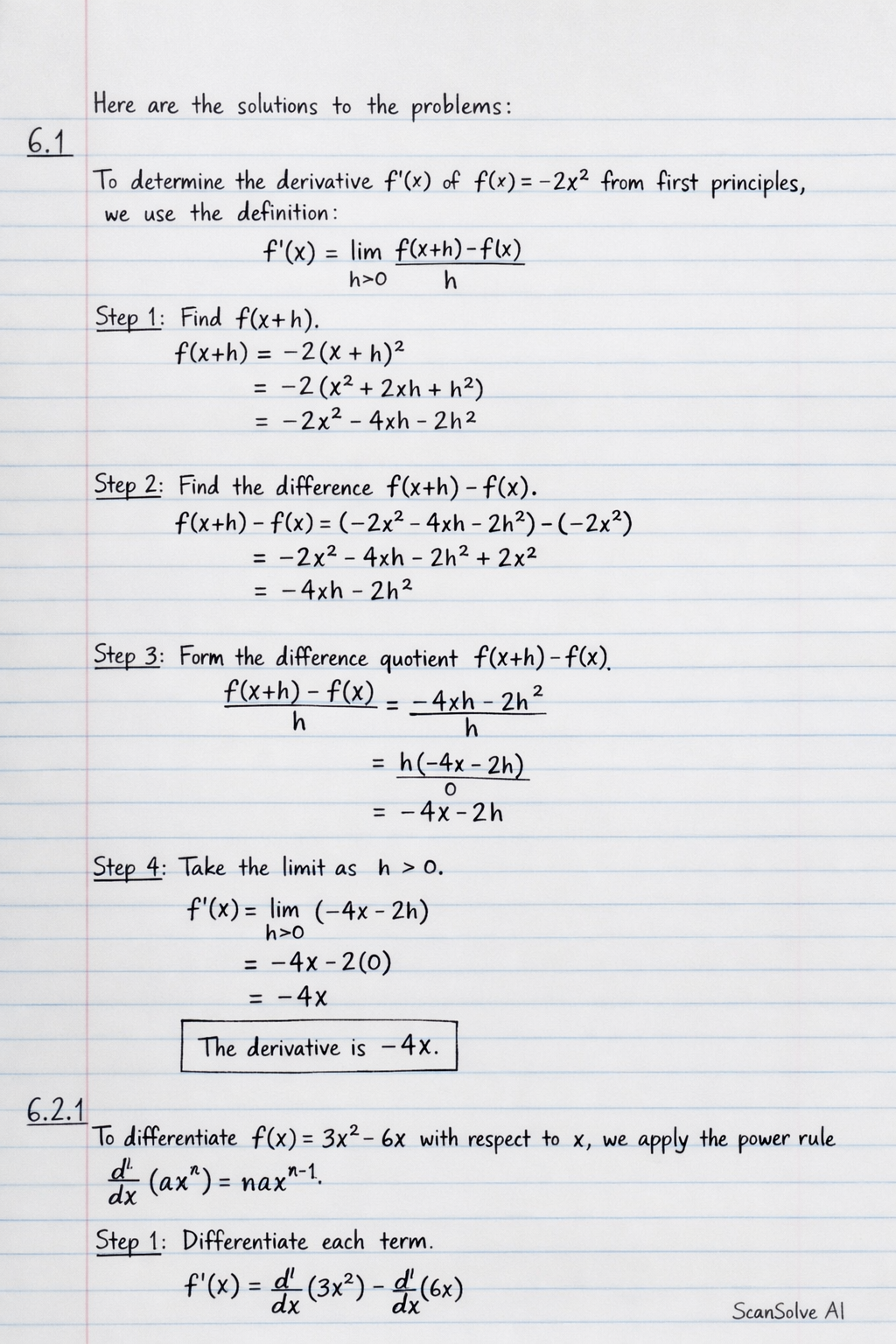
Here are the solutions to the problems:
6.1
To determine the derivative f′(x) of f(x)=−2x2 from first principles, we use the definition:
f′(x)=limh→0hf(x+h)−f(x)
Step 2: Find the difference f(x+h)−f(x).
f(x+h)−f(x)=(−2x2−4xh−2h2)−(−2x2)f(x+h)−f(x)=−2x2−4xh−2h2+2x2f(x+h)−f(x)=−4xh−2h2
Step 3: Form the difference quotient hf(x+h)−f(x).
hf(x+h)−f(x)=h−4xh−2h2=hh(−4x−2h)=−4x−2h
Step 4: Take the limit as h→0.
f′(x)=limh→0(−4x−2h)=−4x−2(0)=−4x
The derivative is ∗−4x∗.
6.2.1
To differentiate f(x)=3x2−6x with respect to x, we apply the power rule dxd(axn)=naxn−1.
Step 1: Differentiate each term.
f′(x)=dxd(3x2)−dxd(6x)
Step 2: Apply the power rule.
dxd(3x2)=3⋅2x2−1=6xdxd(6x)=6⋅1x1−1=6x0=6
Step 3: Combine the results.
f′(x)=6x−6
The derivative is ∗6x−6∗.
6.2.2
To determine dxdy if y=2x−x8, we first rewrite y using exponent notation.
Step 1: Rewrite y using exponents.
y=2x1/2−8x−1
Step 2: Differentiate each term using the power rule.
dxdy=dxd(2x1/2)−dxd(8x−1)dxd(2x1/2)=2⋅21x1/2−1=x−1/2dxd(8x−1)=8⋅(−1)x−1−1=−8x−2
Step 3: Combine the results.
dxdy=x−1/2−(−8x−2)=x−1/2+8x−2
The derivative is ∗x−1/2+8x−2∗.
6.3
To determine dxdy if xy−5=x3, we first solve for y explicitly.
Step 1: Isolate y.
xy=x3+5xy=x3/2+5y=xx3/2+5y=xx3/2+x5y=x3/2−1+5x−1y=x1/2+5x−1
Step 2: Differentiate y with respect to x using the power rule.
dxdy=dxd(x1/2)+dxd(5x−1)dxd(x1/2)=21x1/2−1=21x−1/2dxd(5x−1)=5⋅(−1)x−1−1=−5x−2
Step 3: Combine the results.
dxdy=21x−1/2−5x−2
The derivative is \boxed{*\frac{1{2}x^{-1/2} - 5x^{-2}*}}.
6.4
To determine the equation of the tangent to the graph of f(x)=10x−x2 at the point where f′(x)=−2.
Step 1: Find the derivative f′(x).
f(x)=10x−x2f′(x)=dxd(10x)−dxd(x2)=10−2x
Step 2: Find the x-coordinate of the point of tangency by setting f′(x)=−2.
10−2x=−2−2x=−2−10−2x=−12x=6
Step 3: Find the y-coordinate of the point of tangency by substituting x=6 into f(x).
f(6)=10(6)−(6)2f(6)=60−36f(6)=24
The point of tangency is (6,24). The slope of the tangent (m) is given as −2.
Step 4: Use the point-slope form of a linear equation, y−y1=m(x−x1).
y−24=−2(x−6)y−24=−2x+12y=−2x+12+24y=−2x+36
The equation of the tangent is ∗y=−2x+36∗.
Was this helpful?
Need help with your own homework?
Get instant step-by-step solutions to any question. Free to start.
6.1 To determine the derivative f'(x) of f(x) = -2x^2 from first principles, we use the definition: f'(x) = _h 0 (f(x+h) - f(x))/(h) Step 1: Find f(x+h).
Find the derivatives of the following functions from first principles or by using differentiation rules: f(x) = -2x2, f(x) = 3x2 - 6x, and y = 2*sqrt(x) - 8/x.
This mathematics problem involves applying core mathematical principles and formulas. Below you will find a complete step-by-step solution with detailed explanations for each step, helping you understand not just the answer but the method behind it.
ScanSolve AI Answer
Here are the solutions to the problems: 6.1 To determine the derivative f'(x) of f(x) = -2x^2 from first principles, we use the definition: f'(x) = _h 0 (f(x+h) - f(x))/(h) Step 1: Find f(x+h). f(x+h) = -2(x+h)^2 = -2(x^2 + 2xh + h^2) = -2x^2 - 4xh - 2h^2 Step 2: Find the difference f(x+h) - f(x). f(x+h) - f(x) = (-2x^2 - 4xh - 2h^2) - (-2x^2) f(x+h) - f(x) = -2x^2 - 4xh - 2h^2 + 2x^2 f(x+h) - f(x) = -4xh - 2h^2 Step 3: Form the difference quotient (f(x+h) - f(x))/(h). (f(x+h) - f(x))/(h) = (-4xh - 2h^2)/(h) = (h(-4x - 2h))/(h) = -4x - 2h Step 4: Take the limit as h 0. f'(x) = _h 0 (-4x - 2h) = -4x - 2(0) = -4x The derivative is -4x. 6.2.1 To differentiate f(x) = 3x^2 - 6x with respect to x, we apply the power rule (d)/(dx)(ax^n) = nax^n-1. Step 1: Differentiate each term. f'(x) = (d)/(dx)(3x^2) - (d)/(dx)(6x) Step 2: Apply the power rule. (d)/(dx)(3x^2) = 3 · 2x^2-1 = 6x (d)/(dx)(6x) = 6 · 1x^1-1 = 6x^0 = 6 Step 3: Combine the results. f'(x) = 6x - 6 The derivative is 6x - 6. 6.2.2 To determine (dy)/(dx) if y = 2sqrt(x) - (8)/(x), we first rewrite y using exponent notation. Step 1: Rewrite y using exponents. y = 2x^1/2 - 8x^-1 Step 2: Differentiate each term using the power rule. (dy)/(dx) = (d)/(dx)(2x^1/2) - (d)/(dx)(8x^-1) (d)/(dx)(2x^1/2) = 2 · (1)/(2) x^1/2 - 1 = x^-1/2 (d)/(dx)(8x^-1) = 8 · (-1) x^-1 - 1 = -8x^-2 Step 3: Combine the results. (dy)/(dx) = x^-1/2 - (-8x^-2) = x^-1/2 + 8x^-2 The derivative is x^-1/2 + 8x^-2. 6.3 To determine (dy)/(dx) if xy - 5 = sqrt(x^3), we first solve for y explicitly. Step 1: Isolate y. xy = sqrt(x^3) + 5 xy = x^3/2 + 5 y = x^3/2 + 5x y = x^3/2x + (5)/(x) y = x^3/2 - 1 + 5x^-1 y = x^1/2 + 5x^-1 Step 2: Differentiate y with respect to x using the power rule. (dy)/(dx) = (d)/(dx)(x^1/2) + (d)/(dx)(5x^-1) (d)/(dx)(x^1/2) = (1)/(2)x^1/2 - 1 = (1)/(2)x^-1/2 (d)/(dx)(5x^-1) = 5 · (-1)x^-1 - 1 = -5x^-2 Step 3: Combine the results. (dy)/(dx) = (1)/(2)x^-1/2 - 5x^-2 The derivative is (1)/(2)x^-1/2 - 5x^-2. 6.4 To determine the equation of the tangent to the graph of f(x) = 10x - x^2 at the point where f'(x) = -2. Step 1: Find the derivative f'(x). f(x) = 10x - x^2 f'(x) = (d)/(dx)(10x) - (d)/(dx)(x^2) = 10 - 2x Step 2: Find the x-coordinate of the point of tangency by setting f'(x) = -2. 10 - 2x = -2 -2x = -2 - 10 -2x = -12 x = 6 Step 3: Find the y-coordinate of the point of tangency by substituting x=6 into f(x). f(6) = 10(6) - (6)^2 f(6) = 60 - 36 f(6) = 24 The point of tangency is (6, 24). The slope of the tangent (m) is given as -2. Step 4: Use the point-slope form of a linear equation, y - y_1 = m(x - x_1). y - 24 = -2(x - 6) y - 24 = -2x + 12 y = -2x + 12 + 24 y = -2x + 36 The equation of the tangent is y = -2x + 36.