
We read your photo as:
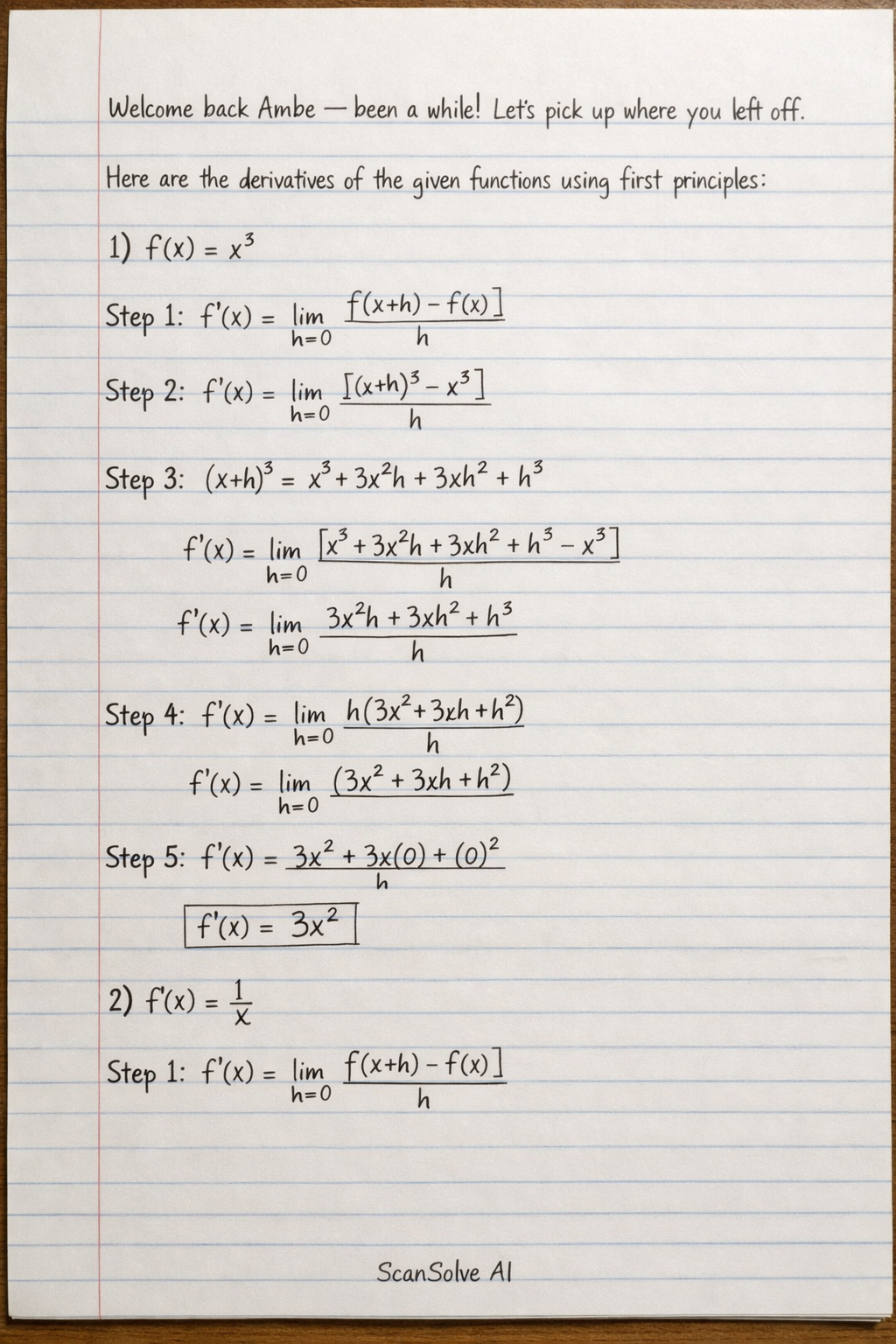
Find the derivatives of the following functions using first principles: f(x) = x3 and f(x) = (1)/(x).
Mathematics
ScanSolve AI Answer
Step-by-step solution
16 stepsHere are the derivatives of the given functions using first principles:
1)
Write the definition of the derivative from first principles.
Substitute and into the formula.
Expand and simplify the numerator.
Factor out from the numerator and cancel it with the denominator.
Apply the limit as .
2)
Write the definition of the derivative from first principles.
Substitute and into the formula.
Combine the fractions in the numerator.
Simplify the complex fraction.
Apply the limit as .
3)
Write the definition of the derivative from first principles.
Substitute and into the formula.
Multiply the numerator and denominator by the conjugate of the numerator, which is .
Expand the numerator using the difference of squares formula .
Cancel from the numerator and denominator.
Apply the limit as .
Was this helpful?
Still stuck on this one?
Ask a follow-up, and the answer starts from this question.
Got a different question?Ask your own question
More Mathematics Questions
QCalculate the derivative of f(x) = 3x − 1 from first principles.QFind the derivatives of the following functions from first principles or by using differentiation…QFind the derivatives of the following with first principle: 1) f(x) = x2-x 2) f(x) = sqrt(x+1) 3)…QFind the derivative of the following functions from first principles: i) y = x2 ii) y = 3x + 2 iii)…QI) Define derivatives of a function from first principle. ii) Find the derivatives of f(x) = 3x2…
Browse by topic:Calculus
Handwritten Step-by-Step Solution
Get this as a handwritten image on WhatsApp — like a tutor wrote it for you.
Try on WhatsApp