
We read your photo as:
A number is chosen at random from the set 1, 2, 3, ..., 103. What is the probability that the number is from the set G=x : 4 < x < 8?
ScanSolve AI Answer
Answer
Step-by-step solution
4 stepsDetermine the total number of possible outcomes.
The numbers are chosen from the set .
The total number of possible outcomes is the count of numbers in this set, which is 103.Determine the number of favorable outcomes.
The favorable outcomes are numbers such that . Since must be an integer, the numbers in this range are .
Calculate the count of favorable outcomes.
To find the number of integers between two values (exclusive), subtract the smaller value from the larger value and then subtract 1.
Number of favorable outcomes .Calculate the probability.
The probability is given by the ratio of the number of favorable outcomes to the total number of possible outcomes.
The probability is .
Try one yourself
A new problem that tests the same skill.
Still stuck on this one?
Ask a follow-up, and the answer starts from this question.
More Mathematics Questions
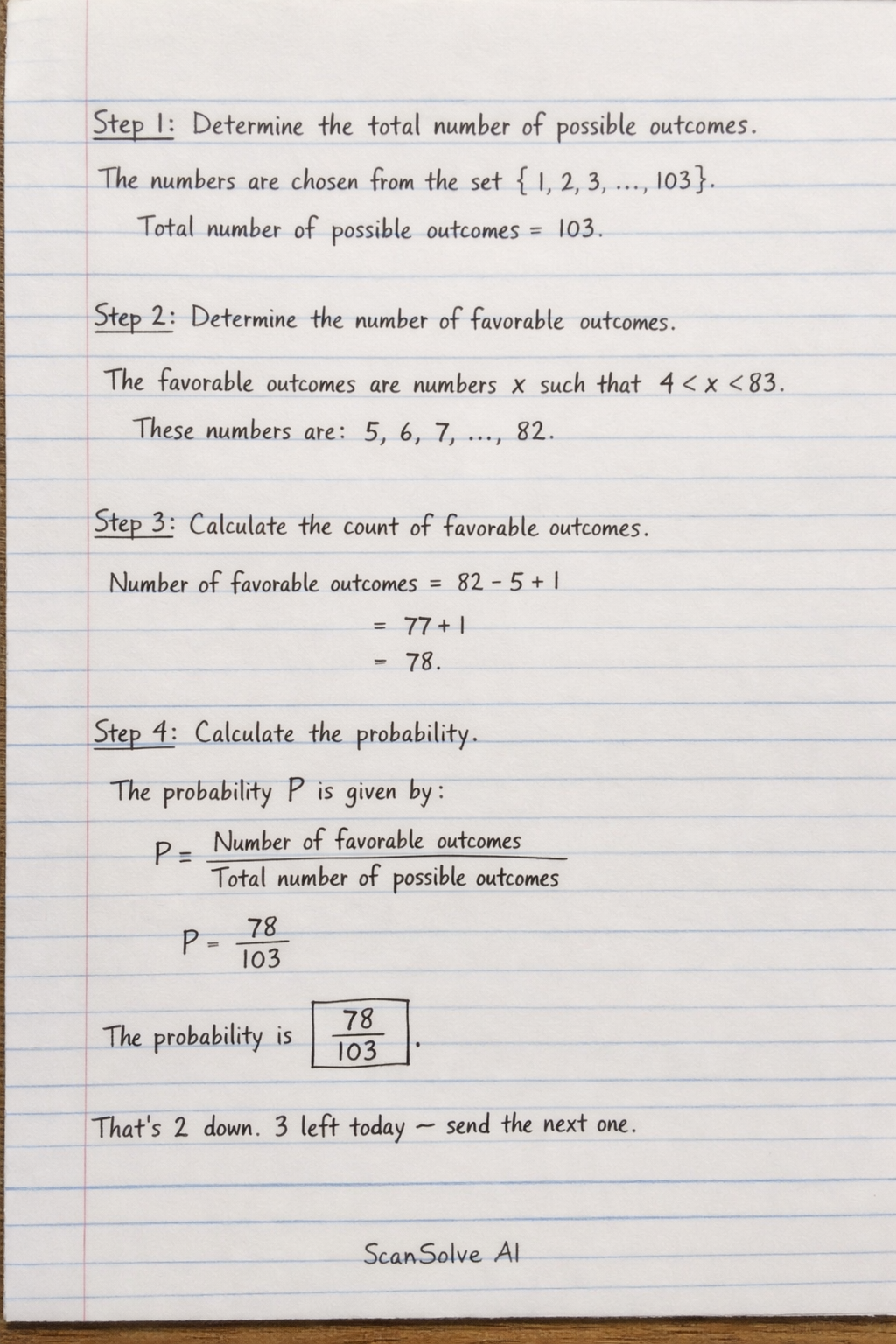
Handwritten Step-by-Step Solution
Get this as a handwritten image on WhatsApp — like a tutor wrote it for you.
Try on WhatsApp