Calculate the determinant and inverse of the given 3x3 matrix A.
|Mathematics
Calculate the determinant and inverse of the given 3x3 matrix A.
ScanSolve AI Answer
Answer
\det(A) = 3
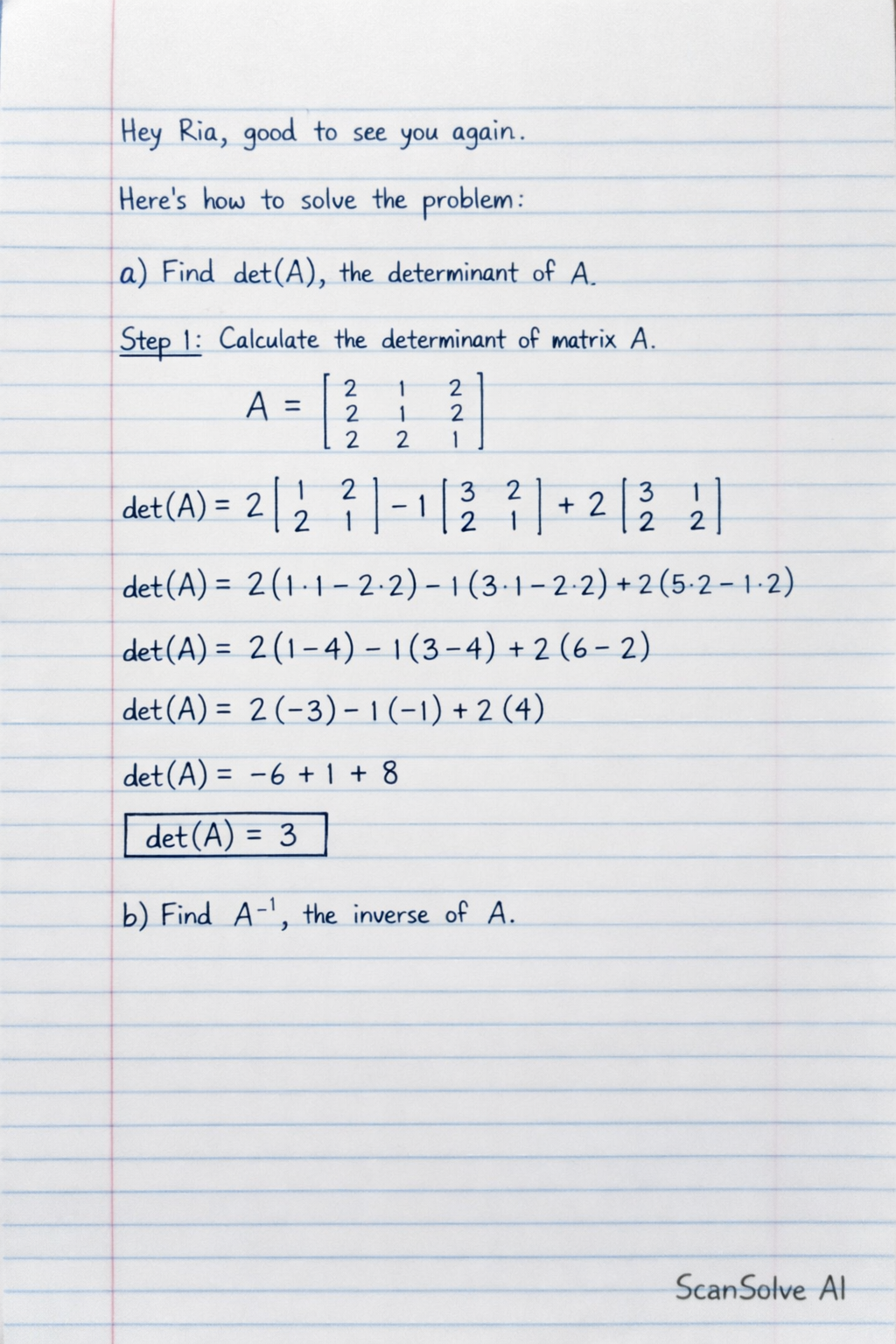
Hey Ria, good to see you again.
Here's how to solve the problem:
a) Find det(A), the determinant of A
Step 1: Calculate the determinant of matrix A.
A=232112221
The determinant is calculated as:
det(A)=21221−13221+23212det(A)=2((1)(1)−(2)(2))−1((3)(1)−(2)(2))+2((3)(2)−(1)(2))det(A)=2(1−4)−1(3−4)+2(6−2)det(A)=2(−3)−1(−1)+2(4)det(A)=−6+1+8det(A)=3
b) Find A−1, the inverse of A
Step 2: Find the cofactor matrix of A.
The cofactor Cij is (−1)i+j times the determinant of the submatrix obtained by removing row i and column j.
C11=1221=1−4=−3C12=−3221=−(3−4)=1C13=3212=6−2=4C21=−1221=−(1−4)=3C22=2221=2−4=−2C23=−2212=−(4−2)=−2C31=1122=2−2=0C32=−2322=−(4−6)=2C33=2311=2−3=−1
The cofactor matrix is:
C=−3301−224−2−1
Step 3: Find the adjugate matrix and the inverse A−1.
The adjugate matrix is the transpose of the cofactor matrix:
adj(A)=CT=−3143−2−202−1
The inverse matrix A−1 is det(A)1adj(A):
A−1=31−3143−2−202−1A−1=(−131341−32−32032−31)
Solve the system of equations
Step 4: Write the system of equations in matrix form AX=B.
The given system is:
2x+y+2z=33x+y+2z=32x+2y+z=2
This can be written as:
232112221xyz=332
Here, A=232112221, X=xyz, and B=332.
Step 5: Solve for X using X=A−1B.
xyz=31−3143−2−202−1332
Perform the matrix multiplication:
xyz=31(−3)(3)+(3)(3)+(0)(2)(1)(3)+(−2)(3)+(2)(2)(4)(3)+(−2)(3)+(−1)(2)xyz=31−9+9+03−6+412−6−2xyz=31014xyz=03134
The solution to the system of equations is:
x = 0, y = \frac{1{3}, z = \frac{4}{3}}
What's next? Send 'em! 📸
Was this helpful?
Need help with your own homework?
Get instant step-by-step solutions to any question. Free to start.
This mathematics problem involves applying core mathematical principles and formulas. Below you will find a complete step-by-step solution with detailed explanations for each step, helping you understand not just the answer but the method behind it.
ScanSolve AI Answer
Hey Ria, good to see you again. Here's how to solve the problem: a) Find (A), the determinant of A Step 1: Calculate the determinant of matrix A. A = 2 & 1 & 2 \\ 3 & 1 & 2 \\ 2 & 2 & 1 The determinant is calculated as: (A) = 2 1 & 2 \\ 2 & 1 - 1 3 & 2 \\ 2 & 1 + 2 3 & 1 \\ 2 & 2 (A) = 2((1)(1) - (2)(2)) - 1((3)(1) - (2)(2)) + 2((3)(2) - (1)(2)) (A) = 2(1 - 4) - 1(3 - 4) + 2(6 - 2) (A) = 2(-3) - 1(-1) + 2(4) (A) = -6 + 1 + 8 (A) = 3 b) Find A^-1, the inverse of A Step 2: Find the cofactor matrix of A. The cofactor C_ij is (-1)^i+j times the determinant of the submatrix obtained by removing row i and column j. C_11 = 1 & 2 \\ 2 & 1 = 1 - 4 = -3 C_12 = - 3 & 2 \\ 2 & 1 = -(3 - 4) = 1 C_13 = 3 & 1 \\ 2 & 2 = 6 - 2 = 4 C_21 = - 1 & 2 \\ 2 & 1 = -(1 - 4) = 3 C_22 = 2 & 2 \\ 2 & 1 = 2 - 4 = -2 C_23 = - 2 & 1 \\ 2 & 2 = -(4 - 2) = -2 C_31 = 1 & 2 \\ 1 & 2 = 2 - 2 = 0 C_32 = - 2 & 2 \\ 3 & 2 = -(4 - 6) = 2 C_33 = 2 & 1 \\ 3 & 1 = 2 - 3 = -1 The cofactor matrix is: C = -3 & 1 & 4 \\ 3 & -2 & -2 \\ 0 & 2 & -1 Step 3: Find the adjugate matrix and the inverse A^-1. The adjugate matrix is the transpose of the cofactor matrix: adj(A) = C^T = -3 & 3 & 0 \\ 1 & -2 & 2 \\ 4 & -2 & -1 The inverse matrix A^-1 is (1)/((A)) adj(A): A^-1 = (1)/(3) -3 & 3 & 0 \\ 1 & -2 & 2 \\ 4 & -2 & -1 A^-1 = -1 & 1 & 0 \\ (1)/(3) & -(2)/(3) & (2)/(3) \\ (4)/(3) & -(2)/(3) & -(1)/(3) Solve the system of equations Step 4: Write the system of equations in matrix form AX = B. The given system is: 2x + y + 2z = 3 3x + y + 2z = 3 2x + 2y + z = 2 This can be written as: 2 & 1 & 2 \\ 3 & 1 & 2 \\ 2 & 2 & 1 x \\ y \\ z = 3 \\ 3 \\ 2 Here, A = 2 & 1 & 2 \\ 3 & 1 & 2 \\ 2 & 2 & 1 , X = x \\ y \\ z , and B = 3 \\ 3 \\ 2 . Step 5: Solve for X using X = A^-1B. x \\ y \\ z = (1)/(3) -3 & 3 & 0 \\ 1 & -2 & 2 \\ 4 & -2 & -1 3 \\ 3 \\ 2 Perform the matrix multiplication: x \\ y \\ z = (1)/(3) (-3)(3) + (3)(3) + (0)(2) \\ (1)(3) + (-2)(3) + (2)(2) \\ (4)(3) + (-2)(3) + (-1)(2) x \\ y \\ z = (1)/(3) -9 + 9 + 0 \\ 3 - 6 + 4 \\ 12 - 6 - 2 x \\ y \\ z = (1)/(3) 0 \\ 1 \\ 4 x \\ y \\ z = 0 \\ (1)/(3) \\ (4)/(3) The solution to the system of equations is: x = 0, y = (1)/(3), z = (4)/(3) What's next? Send 'em! 📸