We read your photo as:

Calculate the determinant of M:

Mathematics

ScanSolve AI Answer

Answer

linearly independent\text{linearly independent}

Step-by-step solution

2 steps
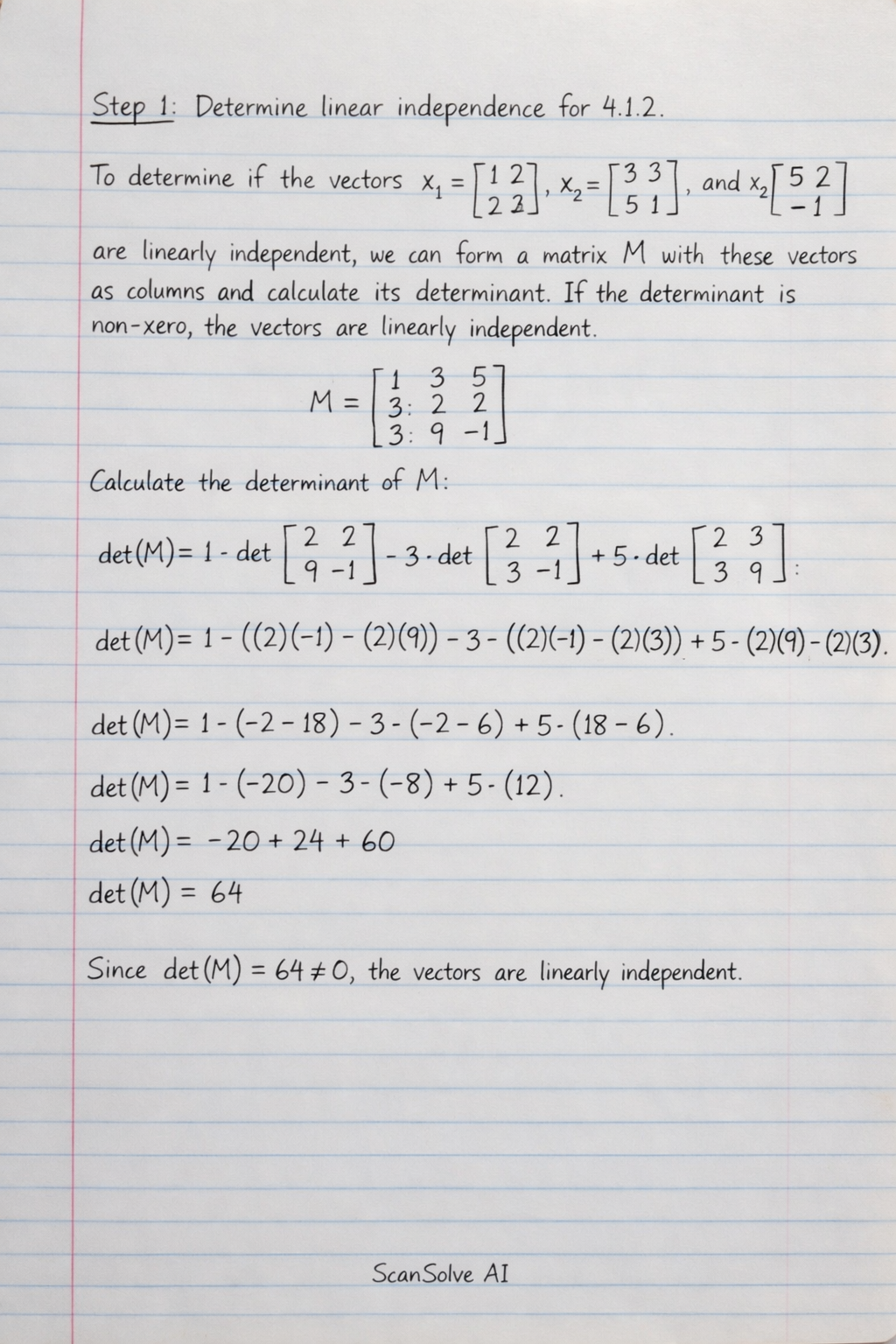
  1. Determine linear independence for 4.1.2.

    To determine if the vectors x1=[123]x_1 = \begin{bmatrix} 1 \\ 2 \\ 3 \end{bmatrix}, x2=[329]x_2 = \begin{bmatrix} 3 \\ 2 \\ 9 \end{bmatrix}, and x3=[52−1]x_3 = \begin{bmatrix} 5 \\ 2 \\ -1 \end{bmatrix} are linearly independent, we can form a matrix MM with these vectors as columns and calculate its determinant. If the determinant is non-zero, the vectors are linearly independent.

    M=[13522239−1]M = \begin{bmatrix} 1 & 3 & 5 \\ 2 & 2 & 2 \\ 3 & 9 & -1 \end{bmatrix}

    Calculate the determinant of MM:

    det⁡(M)=1⋅det⁡[229−1]−3⋅det⁡[223−1]+5⋅det⁡[2239]\det(M) = 1 \cdot \det \begin{bmatrix} 2 & 2 \\ 9 & -1 \end{bmatrix} - 3 \cdot \det \begin{bmatrix} 2 & 2 \\ 3 & -1 \end{bmatrix} + 5 \cdot \det \begin{bmatrix} 2 & 2 \\ 3 & 9 \end{bmatrix} det⁡(M)=1⋅((2)(−1)−(2)(9))−3⋅((2)(−1)−(2)(3))+5⋅((2)(9)−(2)(3))\det(M) = 1 \cdot ((2)(-1) - (2)(9)) - 3 \cdot ((2)(-1) - (2)(3)) + 5 \cdot ((2)(9) - (2)(3)) det⁡(M)=1⋅(−2−18)−3⋅(−2−6)+5⋅(18−6)\det(M) = 1 \cdot (-2 - 18) - 3 \cdot (-2 - 6) + 5 \cdot (18 - 6) det⁡(M)=1⋅(−20)−3⋅(−8)+5⋅(12)\det(M) = 1 \cdot (-20) - 3 \cdot (-8) + 5 \cdot (12) det⁡(M)=−20+24+60\det(M) = -20 + 24 + 60 det⁡(M)=64\det(M) = 64

    Since det⁡(M)=64≠0\det(M) = 64 \neq 0, the vectors are linearly independent.
    The set of vectors is linearly independent\boxed{\text{linearly independent}}.

  2. Determine linear independence for 4.1.3.

    To determine if the vectors x1=[4−12]x_1 = \begin{bmatrix} 4 \\ -1 \\ 2 \end{bmatrix}, x2=[323]x_2 = \begin{bmatrix} 3 \\ 2 \\ 3 \end{bmatrix}, and x3=[524]x_3 = \begin{bmatrix} 5 \\ 2 \\ 4 \end{bmatrix} are linearly independent, we form a matrix MM with these vectors as columns and calculate its determinant.

    M=[435−122234]M = \begin{bmatrix} 4 & 3 & 5 \\ -1 & 2 & 2 \\ 2 & 3 & 4 \end{bmatrix}

    Calculate the determinant of MM:

    det⁡(M)=4⋅det⁡[2234]−3⋅det⁡[−1224]+5⋅det⁡[−1223]\det(M) = 4 \cdot \det \begin{bmatrix} 2 & 2 \\ 3 & 4 \end{bmatrix} - 3 \cdot \det \begin{bmatrix} -1 & 2 \\ 2 & 4 \end{bmatrix} + 5 \cdot \det \begin{bmatrix} -1 & 2 \\ 2 & 3 \end{bmatrix} det⁡(M)=4⋅((2)(4)−(2)(3))−3⋅((−1)(4)−(2)(2))+5⋅((−1)(3)−(2)(2))\det(M) = 4 \cdot ((2)(4) - (2)(3)) - 3 \cdot ((-1)(4) - (2)(2)) + 5 \cdot ((-1)(3) - (2)(2)) det⁡(M)=4⋅(8−6)−3⋅(−4−4)+5⋅(−3−4)\det(M) = 4 \cdot (8 - 6) - 3 \cdot (-4 - 4) + 5 \cdot (-3 - 4) det⁡(M)=4⋅(2)−3⋅(−8)+5⋅(−7)\det(M) = 4 \cdot (2) - 3 \cdot (-8) + 5 \cdot (-7) det⁡(M)=8+24−35\det(M) = 8 + 24 - 35 det⁡(M)=32−35\det(M) = 32 - 35 det⁡(M)=−3\det(M) = -3

    Since det⁡(M)=−3≠0\det(M) = -3 \neq 0, the vectors are linearly independent.

Was this helpful?

Try one yourself

A new problem that tests the same skill.

Still stuck on this one?

Ask a follow-up, and the answer starts from this question.

Got a different question?Ask your own question
Handwritten step-by-step solution preview

Handwritten Step-by-Step Solution

Get this as a handwritten image on WhatsApp — like a tutor wrote it for you.

Try on WhatsApp