
We read your photo as:
Determine the third angle of the triangular apparatus.
ScanSolve AI Answer
Answers
2 partsStep-by-step solution
14 stepsHere are the solutions to your tasks:
Part a· 4 steps
Help John to know the length of the remaining sides and angle of the remaining vertex.
Determine the third angle of the triangular apparatus.
The sum of angles in a triangle is . Given angles are and .
The angle of the remaining vertex is .
Use the Sine Rule to find the lengths of the remaining sides.
Let the given side be ft, opposite the angle. Let the other angles be and , with opposite sides and respectively.
The Sine Rule states: .
We have .Calculate side .
The length of one remaining side is .
Calculate side .
The length of the other remaining side is .
Part b
Guide the learners on how to come up with the angle in the experiment present them in a solution set.
Rewrite the given equation using trigonometric identities.
The equation is .
Recall the identity , which implies .
Substitute with :Rearrange the equation into a quadratic form.
Move all terms to one side to form a quadratic equation in terms of :
Solve the quadratic equation for .
Let . The equation becomes .
Factor the quadratic equation:This gives two possible values for :
So, or .
Convert to and find the angles in the range .
Since , we have .
Case 1: . This is not possible because the range of is . So, there are no solutions from this case.
Case 2: .
The principal value (reference angle) for is .
Since is positive, lies in Quadrant I and Quadrant IV.
In Quadrant I: .
In Quadrant IV: .
The solution set for is .
Part c· 6 steps
Take the students through the steps on how holds.
Given that . We need to show that equals the given expression.
Apply the tangent subtraction formula.
The formula for is .
Substitute and :Substitute the value of .
We know that .
Apply the tangent double angle formula.
The formula for is .
Substitute the expression for into the equation for .
Simplify the complex fraction by multiplying the numerator and denominator by .
Rearrange the terms in the numerator and denominator.
This matches the expression given by the student, thus showing how it holds.
Try one yourself
A new problem that tests the same skill.
Still stuck on this one?
Ask a follow-up, and the answer starts from this question.
More Mathematics Questions
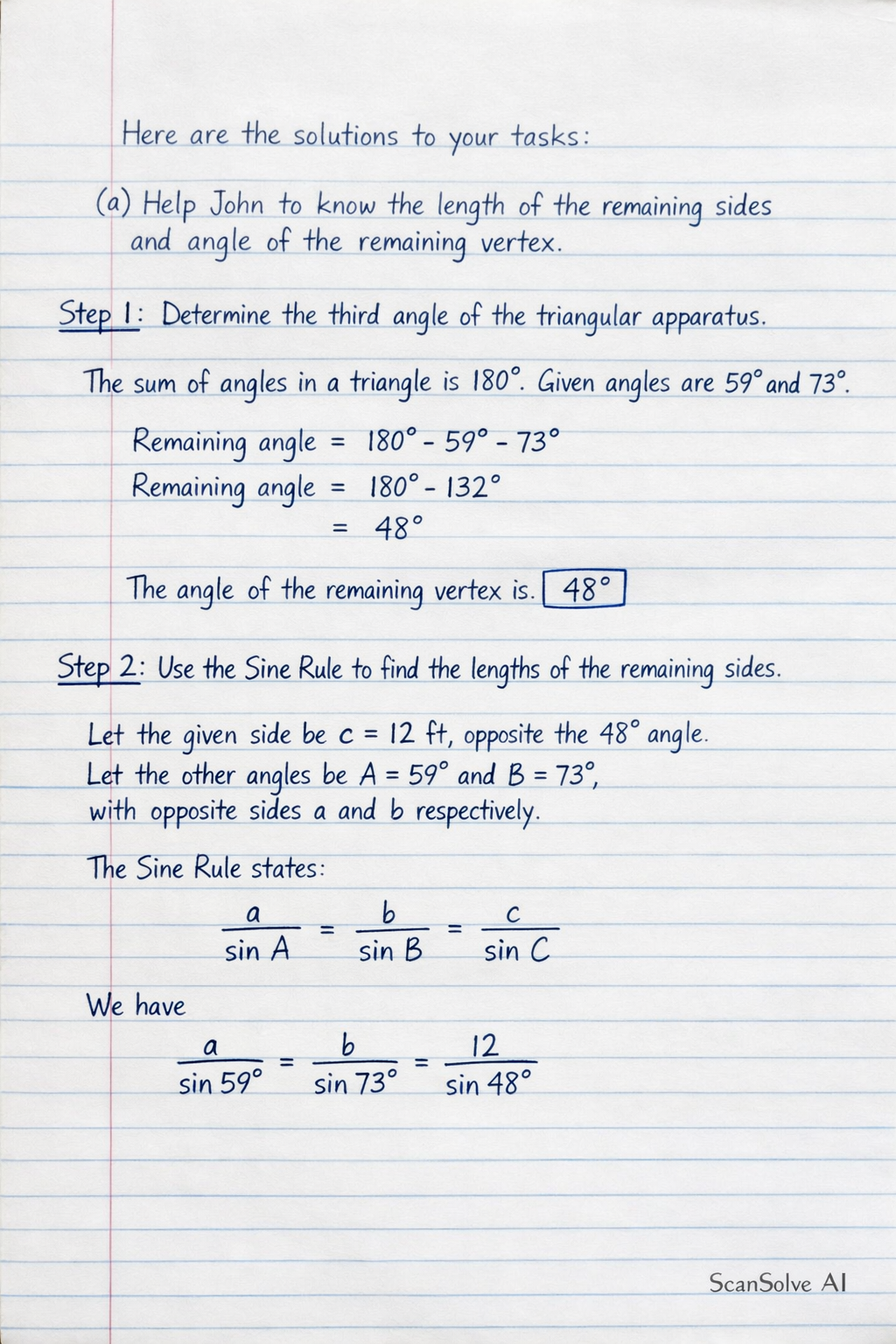
Handwritten Step-by-Step Solution
Get this as a handwritten image on WhatsApp — like a tutor wrote it for you.
Try on WhatsApp