
We read your photo as:
Determine: (i) The length of XY (ii) The angle between the planes RSY and QRST.
ScanSolve AI Answer
Answers
2 partsHaya hapa masuluhisho ya maswali uliyotoa:
13. Determine:
(i) The length of XY
-
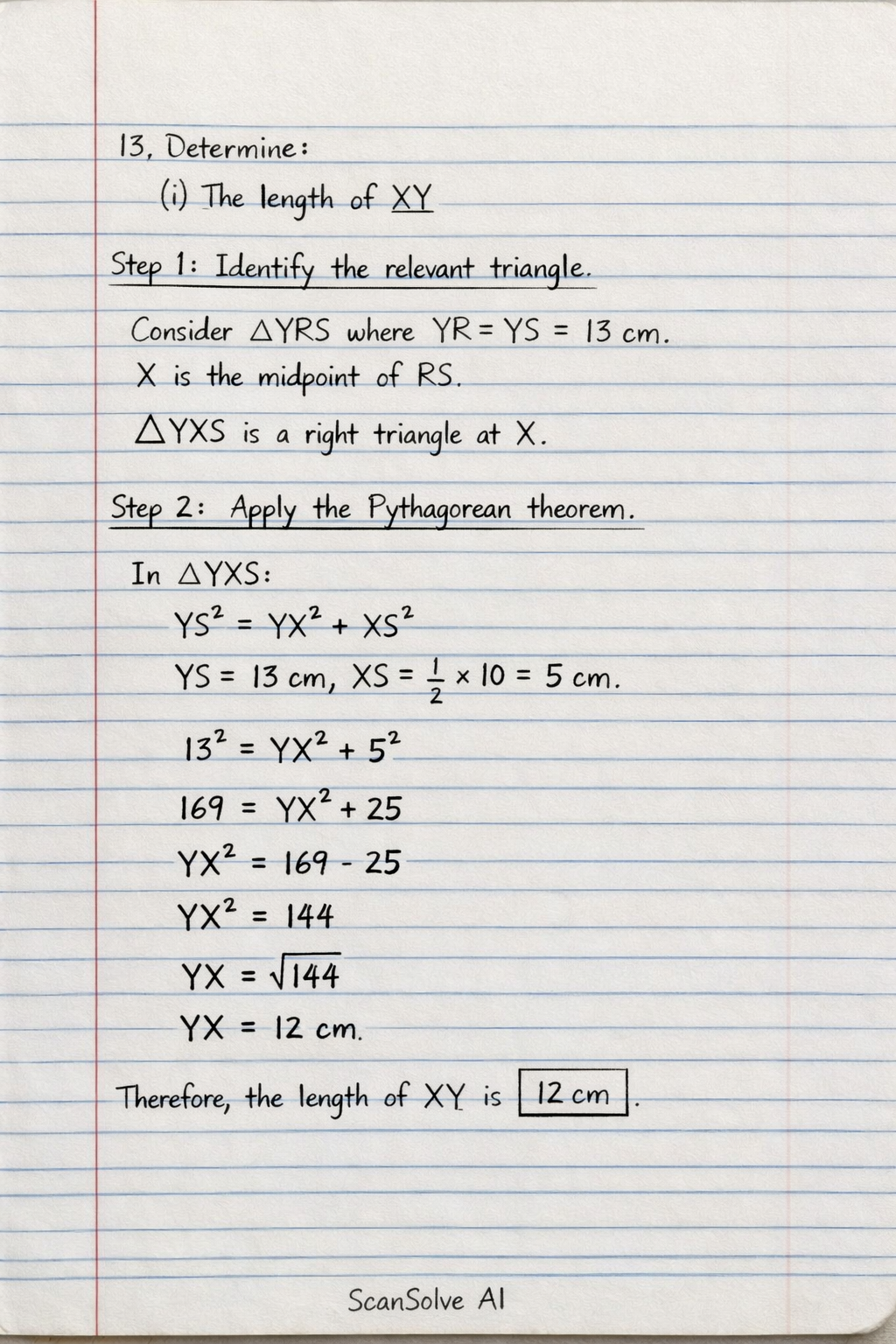
Step 1: Identify the relevant triangle. From the previous problem, we know the pyramid has a square base PQRS of side 10 cm. Y is the apex, and X is the midpoint of RS. YS is a slant edge with length 13 cm. We need to find the length of XY, which is the slant height of the triangular face YRS. Consider the triangle YRS. Since YR = YS = 13 cm (slant edges of a right pyramid), is an isosceles triangle. X is the midpoint of RS, so YX is the altitude from Y to RS. Therefore, is a right-angled triangle at X.
-
Step 2: Apply the Pythagorean theorem. In right-angled triangle YXS: We know cm and cm.
The length of XY is .
(ii) The angle between the planes RSY and QRST.
-
Step 1: Identify the line of intersection and perpendiculars. The plane RSY is a triangular face of the pyramid. The plane QRST is the base of the pyramid. The line of intersection of these two planes is RS. To find the angle between the planes, we need to find two lines, one in each plane, that are perpendicular to the line of intersection (RS) at the same point. In plane RSY, YX is perpendicular to RS (as calculated in part (i), YX is the slant height to the base edge RS). In plane QRST (the base), OX is perpendicular to RS. (O is the center of the square base, and X is the midpoint of RS. OX is parallel to PQ and perpendicular to RS). Therefore, the angle between the planes RSY and QRST is .
-
Step 2: Determine the lengths of the sides of . OY is the perpendicular height of the pyramid. From the previous problem (or by calculation): The diagonal of the base is cm. cm. In right-angled triangle OYS: cm. OX is half the side length of the square base: cm. YX is the slant height calculated in part (i): cm.
-
Step 3: Calculate the angle . Consider the right-angled triangle YXO (right-angled at O). We can use the cosine ratio:
Rounding to one decimal place: The angle between the planes RSY and QRST is .
14. ABCD is a square of side 5cm. A point P moves inside this square so that . Show by construction, the locus of P.
-
Step 1: Understand the condition. The condition means that point P forms an angle with points A and B that is greater than or equal to . The locus of points P such that is a circle with AB as its diameter. If , point P lies inside the circle with diameter AB. Therefore, the locus of P satisfying is the region on or inside the circle with diameter AB.
-
Step 2: Combine with the square boundary. The point P must also move inside the square ABCD. So, the locus of P is the region within the square that is also on or inside the circle with diameter AB. This region is a segment of the circle.
-
Step 3: Construction steps.
- Draw the square ABCD with side length 5 cm.
- Locate the midpoint of the side AB. Let's call this point M.
- Using M as the center and MA (or MB) as the radius, draw a semicircle that passes through A and B and lies inside the square.
- The locus of P is the region bounded by the side AB and the arc of the semicircle drawn. This region should be shaded or clearly indicated.
**15. Without using tables, find the value of x in the equation.
$\log x^3 +
Try one yourself
A new problem that tests the same skill.
Still stuck on this one?
Ask a follow-up, and the answer starts from this question.
More Mathematics Questions
Handwritten Step-by-Step Solution
Get this as a handwritten image on WhatsApp — like a tutor wrote it for you.
Try on WhatsApp