
We read your photo as:
Develop concepts of number recognition, place value, estimation, comparing quantities, counting in multiples, and ordering for Grade R learners.
ScanSolve AI Answer
Step-by-step solution
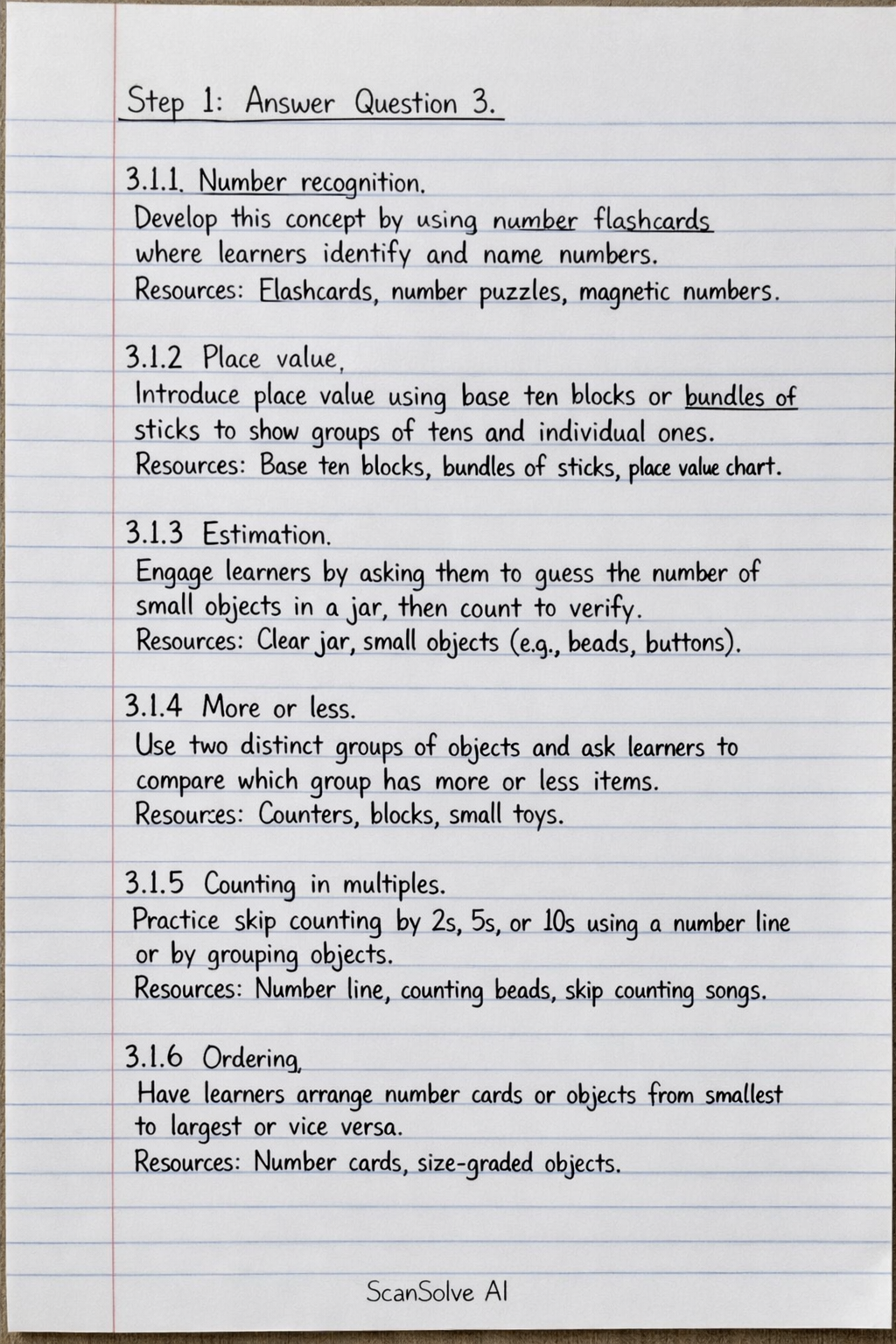
2 stepsAnswer Question 3.
3.1.1 Number recognition
Develop this concept by using number flashcards where learners identify and name numbers. Resources: Flashcards, number puzzles, magnetic numbers.3.1.2 Place value
Introduce place value using base ten blocks or bundles of sticks to show groups of tens and individual ones. Resources: Base ten blocks, bundles of sticks, place value chart.3.1.3 Estimation
Engage learners by asking them to guess the number of small objects in a jar, then count to verify. Resources: Clear jar, small objects (e.g., beads, buttons).3.1.4 More or less
Use two distinct groups of objects and ask learners to compare which group has more or less items. Resources: Counters, blocks, small toys.3.1.5 Counting in multiples
Practice skip counting by 2s, 5s, or 10s using a number line or by grouping objects. Resources: Number line, counting beads, skip counting songs.3.1.6 Ordering
Have learners arrange number cards or objects from smallest to largest or vice versa. Resources: Number cards, size-graded objects.3.2 Design an activity for Grade R learners to help them gain the concepts mentioned in question 3.1
Activity: "Maths Station Fun"
Set up different stations around the classroom.- Station 1 (Number Recognition & Ordering): Learners find hidden number cards (1-10) and then arrange them in the correct sequence.
- Station 2 (More or Less & Estimation): Learners compare two piles of blocks to identify "more" or "less" and then estimate how many small items are in a small, clear container.
- Station 3 (Counting in Multiples): Learners count small toy cars in groups of 2s or 5s.
- Station 4 (Place Value): Learners use bundles of 10 sticks and single sticks to represent numbers like 12 (one bundle of 10 and two single sticks). Resources: Number cards, blocks, small containers, small toys, sticks, elastic bands.
Answer Question 4.
4.1 Design an activity for Grade R learners that involve number patterns that they have to copy and extend. Write down your instructions to the learners as well.
Activity: "Number Train"
Instructions:- "Look at my number train: 1, 2, 3, __, __. What numbers come next to make the train longer?"
- "Now, let's make a new train: 2, 4, 6, __, __. Can you tell me what numbers are missing?"
- "You can use your number cards to build your own number trains and show me the next numbers." Resources: Number cards (1-20).
4.2 Design an activity for Grade R learners that involve patterns using physical objects or drawing.
Activity: "Shape and Color Pattern Chain"
Instructions:- "Look at this pattern I made with blocks: Red, Blue, Red, Blue, __, __. What blocks come next to continue the pattern?"
- "Now, let's try with shapes: Circle, Square, Circle, Square, __, __. Can you draw the next shapes in the pattern?"
- "You can use your own blocks or crayons to make your own patterns and show them to a friend." Resources: Colored blocks (e.g., red, blue), shape cut-outs (circle, square), paper, crayons.
4.3 Design an activity where your learners copy a pattern with sound.
Activity: "Clap and Tap Pattern"
Instructions:- "Listen carefully to my sound pattern: Clap, Tap, Clap, Tap, __, __. What sounds come next?" (Demonstrate again)
- "Now, let's try a different one: Stomp, Clap, Stomp, Clap, __, __. Can you copy my pattern and then continue it?"
- "Let's make our own sound patterns together!" Resources: None (uses body sounds).
4.4 The following graph represents monthly income of a family (R8 500) and is spent as illustrated below:
The total monthly income is R8 500.
From the graph:- Rent: 5%
- Food: 45%
- Insurance: 15%
- Saving: 20%
- Recreation: 10%
- Other: 5%
Calculate the amount spent on each category:
The amounts spent are:
- Rent: R425
- Food: R3825
- Insurance: R1275
- Saving: R1700
- Recreation: R850
- Other: R425
Still stuck on this one?
Ask a follow-up, and the answer starts from this question.
More Mathematics Questions
Handwritten Step-by-Step Solution
Get this as a handwritten image on WhatsApp — like a tutor wrote it for you.
Try on WhatsApp