
This mathematics problem involves applying core mathematical principles and formulas. Below you will find a complete step-by-step solution with detailed explanations for each step, helping you understand not just the answer but the method behind it.
ScanSolve AI Answer
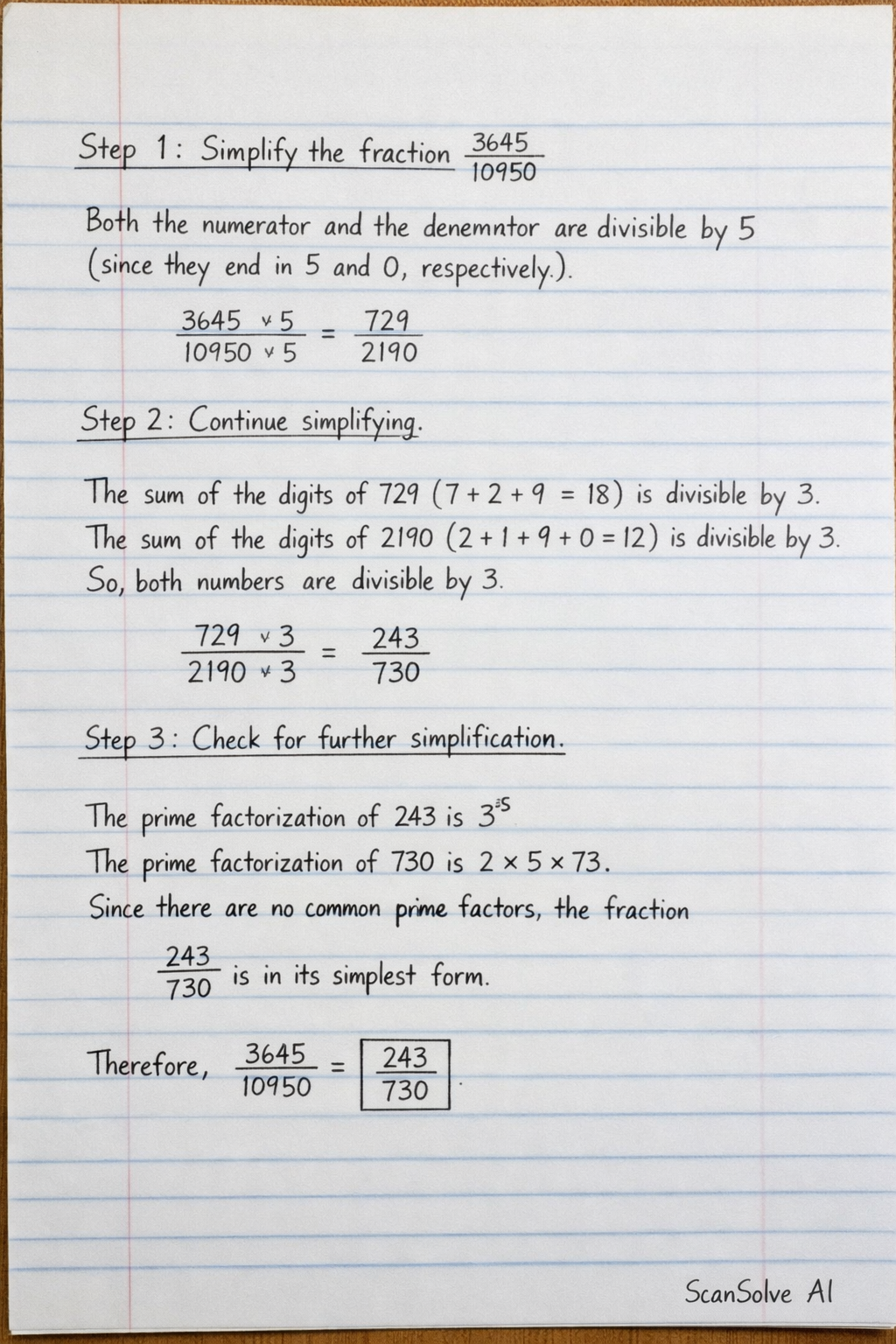
My previous response incorrectly stated that (3645)/(10950) = (1)/(3). Let me correct that and show the proper simplification. Step 1: Simplify the fraction (3645)/(10950). Both the numerator and the denominator are divisible by 5 (since they end in 5 and 0, respectively). (3645 ÷ 5)/(10950 ÷ 5) = (729)/(2190) Step 2: Continue simplifying. The sum of the digits of 729 (7+2+9=18) is divisible by 3. The sum of the digits of 2190 (2+1+9+0=12) is divisible by 3. So, both numbers are divisible by 3. (729 ÷ 3)/(2190 ÷ 3) = (243)/(730) Step 3: Check for further simplification. The prime factorization of 243 is 3^5. The prime factorization of 730 is 2 × 5 × 73. Since there are no common prime factors, the fraction (243)/(730) is in its simplest form. Therefore, (3645)/(10950) = (243)/(730). Clarification on the common ratio used in the previous solution: In the previous solution, it was stated that the common ratio r = (3,645)/(10,950) = (1)/(3). This was an error in calculation. As shown above, (3,645)/(10,950) = (243)/(730). However, if we calculate the ratio between the third and second prize amounts: r' = (1,215)/(3,645) r' = (1,215 ÷ 1,215)/(3,645 ÷ 1,215) = (1)/(3) This ratio is exactly (1)/(3). The problem statement implies a geometric progression with the phrase "as so on". Given that the ratio between the second and third terms is exactly (1)/(3), it was assumed in the previous solution that the intended common ratio for the entire progression was (1)/(3), despite the first term not perfectly fitting this ratio (10,950 × (1)/(3) = 3,650, which is not 3,645). The previous solution proceeded with a_1 = 10,950 and r = (1)/(3) to answer the questions, interpreting the problem as having an intended common ratio of 1/3. 3 done, 2 left today. You're making progress.