
We read your photo as:
Differentiate the following equations: a) y = (ln x)/x2 b) y = (x3 + 3x)5 c) y = e^(2x) sin x d) y = 2x4 − 5x2 + 6x + 1
ScanSolve AI Answer
Answers
5 partsStep-by-step solution
13 stepsLet's solve Question 1 and Question 2.
Part 1
Differentiate the following equations
Part a
Apply the quotient rule .
Let .
Let .Simplify the expression.
Part b
Apply the chain rule .
Let , so .
Let , so .Factor out common terms.
Part c
Apply the product rule .
Let .
Let .Factor out the common term .
Part d
Differentiate each term using the power rule.
Part 23, 5, 7, 9
Two sequences and for .
I. Write down the first four terms of the sequence ().
Substitute into .
For
For
For
For
The first four terms are .II. Hence, write down the first four terms of the sequence ().
Substitute the terms of into .
For
For
For
For
The first four terms are .III. Show that .
Substitute into the expression for .
Expand the squared term and simplify.
IV. Determine whether the sequence and is a GP or AP.
Check for AP and GP.
The terms of are
Common difference: . .
Since there is a constant common difference, is an Arithmetic Progression (AP).
Common ratio: . . Since the ratios are not equal, is not a GP.Check for AP and GP.
The terms of are
Common difference: . $V_3
Still stuck on this one?
Ask a follow-up, and the answer starts from this question.
More Mathematics Questions
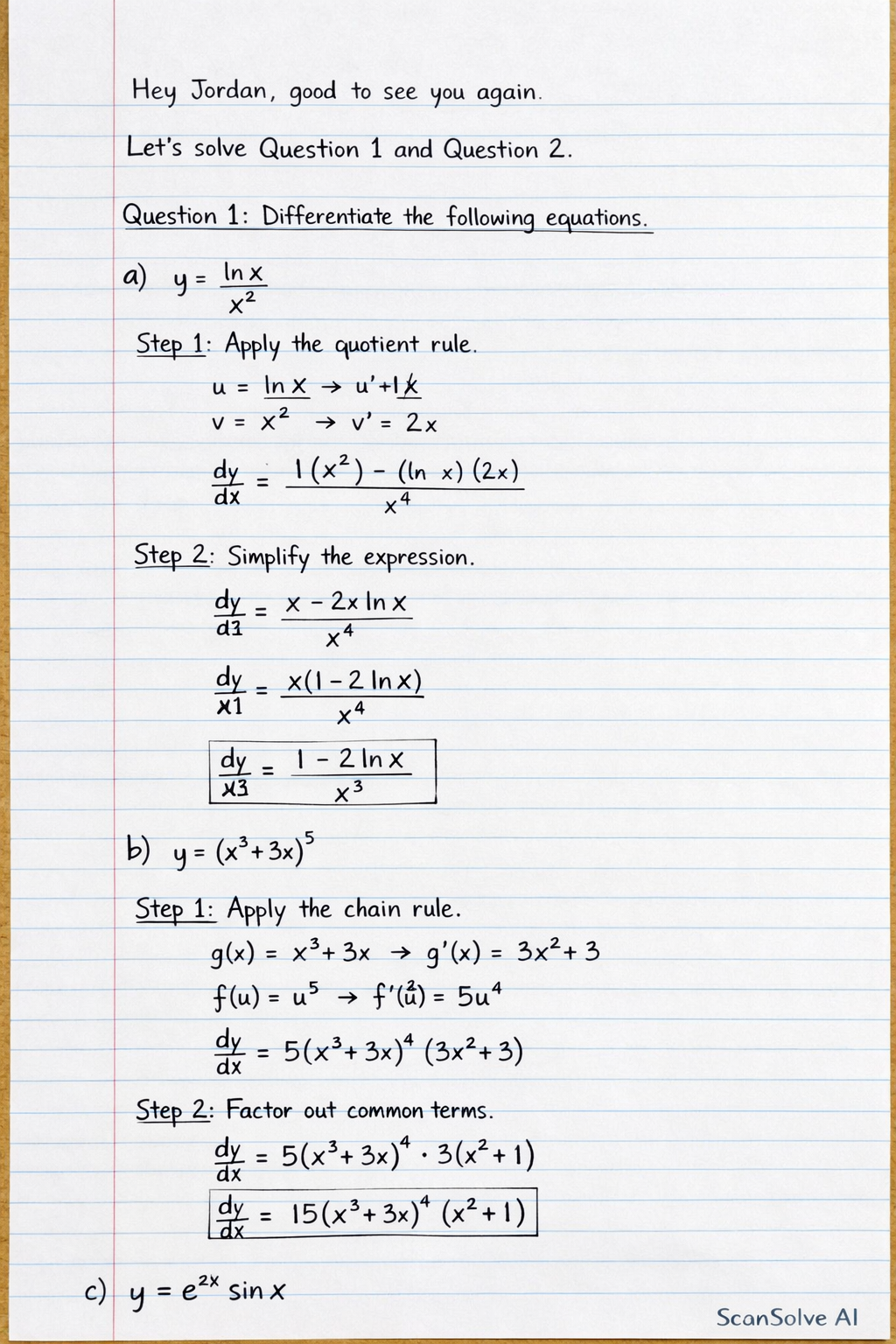
Handwritten Step-by-Step Solution
Get this as a handwritten image on WhatsApp — like a tutor wrote it for you.
Try on WhatsApp